 i
LenbachhausMaxvorstadt / Kunstareal
What May Vanish Becomes Image. Regarding Nature and Art
19th- and 20th-century landscape works from the Lenbachhaus collection and partner institutions examine how art captures nature amid climate change and environmental transformation.
More in Munich
Johann Georg von Dillis drew clouds in chalk, often on blue paper, from the window of his office flat in Munich's Hofgarten, so the towers of the Theatinerkirche sometimes slip into the sky. He gets several densely hung walls near the end, one of them only clouds.
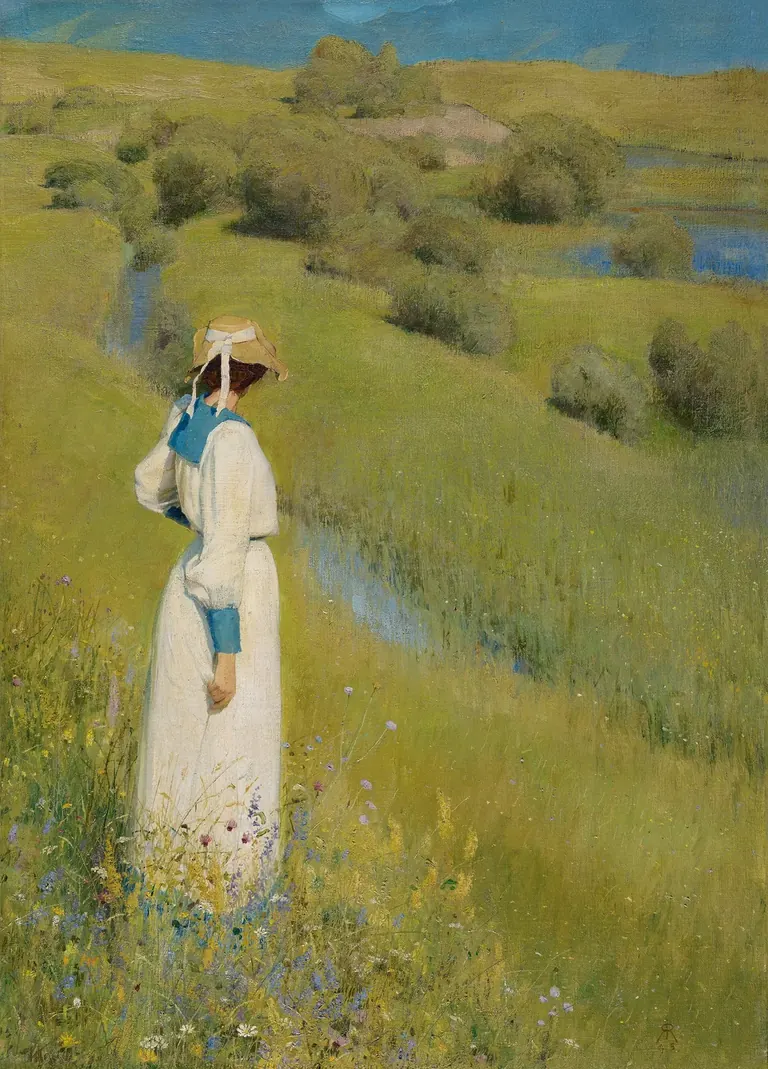
You walk through 19th- and 20th-century landscapes, many rarely or never shown, hung around one idea: whatever was painted has since changed or gone. Morgenstern's empty Starnberger See dates from the 1840s, before the 1854 railway brought the city out to it. Corinth paints himself beside a skeleton, and a wall text explains how the forest of Fontainebleau got the world's first marked hiking trails.
The Süddeutsche Zeitung's critic called it "höchst sehenswert" (very much worth seeing), and the Augsburger Allgemeine's found the cloud wall the loveliest answer to the title. Entry is the €10 museum ticket (€6 reduced, free under 18) with the audioguide included, and Thursdays run to 8pm.
Look for
Dillis's cloud wall
Look for quick chalk studies of passing clouds on blue and blue-grey paper, many drawn from his Hofgarten window with the Theatinerkirche spires poking in.
Corinth's Self-Portrait with Skeleton
The 38-year-old painter stands backlit against his north-facing studio window, face in shadow, not painting, with a skeleton hanging on a hook beside him.
Timm Ulrichs' honeycomb-wax-collage
Stretcher frames that sat inside a beehive until honeybees filled them with comb; a QR code at the window leads to the bee colonies in the museum garden.
Richter's two sculptures in Palermo's room
Bronze heads of Richter and Palermo face each other with closed eyes on stone pedestals, in an ochre room whose open windows look outside.
Fritz Winter's At the Weir
Night scenes from 1936, made in Dießen am Ammersee by dripping white paint onto grey and black, then spreading or painting over the shapes it formed.
Good for
- Evening Visits
- Nerding Out
- Rainy Days
With kids
Under-18s get in free, and the audioguide is included with the ticket.
Free in the same building
Plan a visit to LenbachhausAlso at Lenbachhaus
On now nearby

Nearby
Image credits
7
- What May Vanish Becomes Image. Regarding Nature and ArtCourtesy of Lenbachhaus
- Collecting with Style: Caroline Murat, Ludwig I and AntiquityCourtesy of State Collections of Antiquities
- LenbachhausBurkhard Mücke / Wikimedia Commons, CC BY-SA 4.0
- GlyptothekDaderot, Public domain
- State Collections of AntiquitiesDiego Delso, delso.photo, CC BY-SA 4.0
- Munich Documentation Centre for the History of National SocialismRaimond Spekking, CC BY-SA 4.0
- State Museum of Egyptian ArtFred Romero / Wikimedia Commons, CC BY 2.0