Building the Business Case for a Museum Audio Guide
Frequently Asked Questions
How do I justify the cost of a museum audio guide to my board?
Frame it around three pillars: visitor experience, institutional reputation, and revenue. Audio guides improve dwell time, review scores, and repeat visits. With usage-based pricing models, there's no large upfront spend to justify — you can propose a measured pilot with clear success metrics instead of asking for a multi-year commitment.
What is the ROI of a museum audio guide?
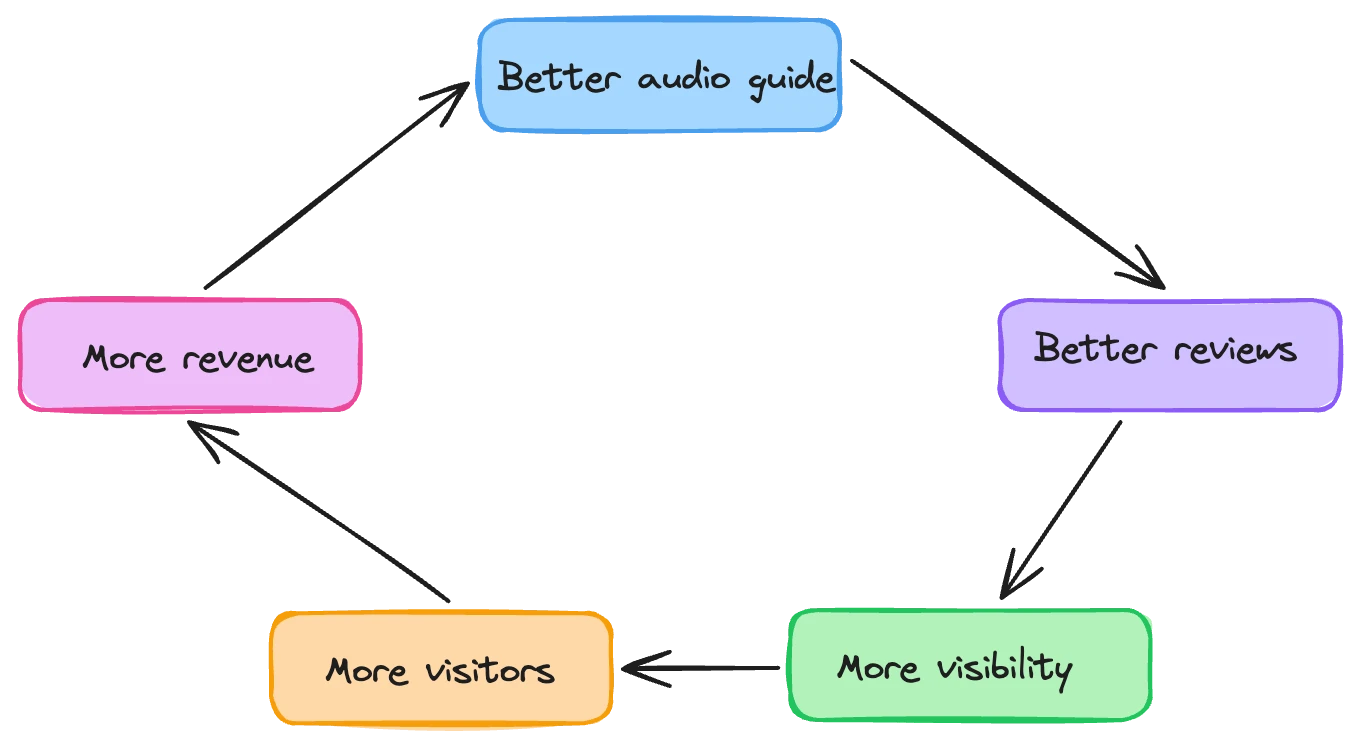
Direct audio guide revenue is only part of the picture. The bigger return comes from indirect effects: higher visitor satisfaction leads to better reviews, which drives more ticket sales, which funds further investment. Museums can track this through review sentiment, average visit duration, return visit rates, and per-visitor revenue before and after launch.
How much does it cost to launch an audio guide with no upfront investment?
Usage-based and revenue-share pricing models mean museums can launch an audio guide with near-zero upfront cost. You pay per interaction or share a percentage of guide revenue. This makes it possible to run a pilot, measure results, and scale only if the numbers work.
How long does it take to pilot a museum audio guide?
A focused pilot can run in about 30 days from kickoff to live visitors. That includes data ingestion, tour design, internal testing, and a soft launch. Most museums have enough data within 4-6 weeks of the pilot going live to decide whether to scale.
You have a strong feeling that your museum should offer a better audio guide. Maybe you've watched visitors wander without context, or you've seen what peer institutions are doing and know you're behind. The conviction is there. The problem is translating that conviction into a proposal that a board, director, or funding body will approve.
This is a pitch problem, not a belief problem. And most failed audio guide proposals fail for the same reason: they focus almost entirely on cost. The proposal becomes a spreadsheet. The board sees a line item and asks, "Is this really necessary?" The answer, presented as a cost, is never convincing enough.
A better approach builds the case around what the audio guide actually changes — for visitors, for the institution's standing, and eventually for revenue. Cost becomes one section of the proposal, not the whole thing. Here's how to structure it.
The three pillars: experience, reputation, revenue
Every audio guide decision sits on three pillars. Most proposals lean on one and ignore the other two. Don't.
Visitor experience is the most direct argument. An audio guide changes what it feels like to walk through your museum. Visitors with a guide spend more time in front of objects. They understand more of what they're seeing. They leave feeling like the visit was worth the trip. This isn't soft reasoning. It shows up in dwell time data, in exit surveys, and in the difference between a visitor who saw 15 objects and a visitor who understood 15 objects. That gap determines whether someone tells a friend to go.
Institutional reputation is harder to measure but no less real. A museum that offers interpretation in 20 languages signals something different than one with English-only wall text. A museum that lets visitors ask questions about any object (and gets good answers) positions itself as a modern, accessible institution. This matters for partnerships, grant applications, press coverage, and how your museum sits relative to peers. Reputation compounds. Being known as "the museum with the incredible audio guide" is a real competitive advantage in a city with multiple cultural options.
Revenue is where most people start, but it's the most misunderstood pillar. An audio guide can generate direct revenue (visitors pay for the guide, and the museum keeps a share). But the bigger financial impact is indirect. Better visitor experience leads to better reviews. Better reviews drive more visitors. More visitors mean more ticket revenue, more gift shop spending, more membership conversions. It's a flywheel, and the audio guide is one of the strongest inputs.
Your proposal should address all three. A board that only sees cost and revenue math will always be skeptical, because the direct revenue alone rarely justifies the investment on a simple ROI calculation. The experience and reputation arguments are what make the revenue math credible, because they explain the mechanism by which the guide pays for itself.
The revenue flywheel is real, but indirect
Let's be specific about how the revenue case works, because hand-waving about "increased visitor satisfaction" won't survive a finance committee.
The chain goes like this: a better audio guide makes visits more satisfying. More satisfied visitors leave better reviews on Google, TripAdvisor, and social media. Higher ratings increase your visibility in search results and recommendation algorithms. More visibility drives more visits from tourists researching what to do in your city. More visitors mean more ticket revenue.
Each link in this chain is supported by data. There is well-documented research showing that a half-star improvement on major review platforms corresponds to meaningful increases in visitor traffic for cultural venues. The effect is strongest for institutions competing with other attractions in tourist-heavy cities, which is most museums.
The audio guide contributes to this chain in specific, trackable ways:
Longer dwell times. Visitors with a guide spend more time in the museum, which increases per-visit spending at the cafe and gift shop.
Higher satisfaction scores. Exit surveys consistently show that guided visitors rate their experience higher.
Language coverage. International visitors who can experience your museum in their own language leave dramatically better reviews than those who struggled with language barriers.
Word of mouth. A visitor who had a great, personalized experience tells people about it. A visitor who walked through rooms of unlabeled objects does not.
None of these are guaranteed. They depend on the quality of the guide and how well it's promoted. But the direction is consistent, and the mechanism is clear enough to put in a proposal.
Who buys audio guides and why
In our experience, museums that invest in new audio guide technology fall into two camps.
The first are technology-forward institutions, teams that see what AI can do now and want to be early. They've tried ChatGPT, they follow the technology press, and they recognize that the visitor experience their competitors will offer in two years is available today. These museums don't need much convincing on the "why." They need help with the "how": procurement, evaluation, piloting.
The second camp is larger and more interesting. These are museums where the favorite product is their human tour guides. They know a great guided tour is better than any audio guide ever made. But they also know that human tours can't scale to every language, every visitor, every time slot. They want the audio guide to fill the gap. Not to replace tour guides, but to make sure the 80% of visitors who don't join a guided tour still get a meaningful experience.
This distinction matters for your proposal. If your institution is in the first camp, lead with the technology angle: what's possible now that wasn't before. If you're in the second camp, lead with the complementary angle. Make it clear that you're not proposing to replace anyone. You're proposing to extend the quality of interpretation that your best guides provide to every visitor who walks through the door, in any language, at any time.
This framing matters because the most common internal resistance to audio guides comes from staff who see it as a threat to human-led experiences. It's not. Position the audio guide as the thing that handles the 80% so your guides can focus on the 20% they do best.
The AI moment: why now, specifically
If your board asks "why now," there's a real answer that goes beyond "technology is always improving."
AI-generated audio guides represent a step-change, not an incremental improvement. For decades, the options were: hire writers and voice actors to produce static recordings, or give visitors a pamphlet. The quality ceiling was high if you spent enough, but the cost floor was also high. Small museums couldn't afford it. Mid-sized museums could afford one language. Large museums could afford several but still ended up with rigid, non-interactive content that visitors outgrew. Understanding what an AI audio guide actually delivers is key to making the "why now" argument land.
What happened in the last two years isn't a small upgrade. It's a different category of product. An AI-generated guide can narrate your entire collection, respond to visitor questions, speak in 40+ languages at native quality, and adapt its depth to each person, all from the same underlying content. The museum designs the tour structure, the voice, the narrative priorities. The AI handles generation.
This didn't exist three years ago. Not in a crude form. Not in an early version. It simply wasn't possible. The convergence of better language models, cheaper inference, and natural-sounding speech synthesis created a new product category. Proposals that went to boards five years ago were asking for a fundamentally different thing than what's available now.
That's the "why now" argument: the technology has changed what an audio guide is. You're not proposing to buy the same thing your peer institution bought in 2019. You're proposing something that didn't exist when your current strategy was written.
The risk argument: near zero with usage-based pricing
This is the part of the proposal that removes the biggest blocker. Traditionally, audio guide projects meant large upfront commitments: scripting, recording, translation, hardware, multi-year contracts. If it didn't work out, the money was spent. That history makes boards cautious, and rightfully so.
Modern pricing models change this entirely. Usage-based pricing means you pay per interaction. Revenue share means you pay a percentage of what visitors pay for the guide. Subscription models set a predictable monthly cost. In all cases, the upfront investment is near zero. No hardware to buy. No five-figure production budgets. No locked-in contracts.
That changes the ask completely. You're not asking the board to bet a capital budget on something that might not work. You're asking them to approve a pilot where the financial exposure is minimal and the results are measurable before any scaling decision.
Frame it exactly this way: "We'd like to run a 60-day pilot. The upfront cost is zero. The per-visitor cost during the pilot will be X. If the results meet our success criteria, we scale. If they don't, we stop. Total financial exposure during the pilot period: roughly Y."
That's a very different conversation from "We need 50,000 for a three-year audio guide contract."
Structuring the proposal
Here's a practical framework for the document you'll put in front of decision-makers.
Problem statement. What's the gap today? Be specific. "42% of our visitors are international, and we offer interpretation in two languages." "Our TripAdvisor rating has been flat at 4.1 for three years while comparable institutions in the city average 4.4." "Visitor surveys consistently cite lack of context as the primary criticism." Real data from your own institution is ten times more persuasive than industry generalities.
Market context. What are peer institutions doing? Name specific museums. "The National Museum of [comparable city] launched an AI-powered guide last year and saw their TripAdvisor rating increase by 0.3 stars within six months." Boards respond to competitive positioning. They don't want to be the institution that fell behind.
What's changed. The technology section. Keep it short. Don't educate the board on how language models work. Say: "AI-generated audio guides became viable in the last 18-24 months. They deliver multilingual, interactive, conversational tours from the museum's own content. The cost model is usage-based, no upfront investment." Two paragraphs, maximum.
Pilot plan. Specifics on what you're proposing. Duration (30-60 days). Scope (one wing, one exhibition, or the full collection). Success criteria defined upfront. Cost estimate for the pilot period.
Success metrics. This is where you earn credibility. Define what "working" means before you start. Suggested metrics:
Audio guide adoption rate (what percentage of visitors use it)
Average engagement duration per visitor
Visitor satisfaction delta (exit survey scores, guide users vs. non-users)
Review sentiment on public platforms
Per-visitor revenue change (gift shop, cafe, if trackable)
Language usage breakdown
ROI projection. A simple framework the board can follow. Not a precise forecast (those are fiction for new initiatives), just a range estimate.
An ROI framework you can adapt
Here's a basic model. Plug in your own numbers.
Monthly visitors: 10,000 (use your actual figure)
Expected adoption rate: 10% (conservative for a promoted, free, web-based guide)
Guide users per month: 1,000
Revenue scenario A — free guide, indirect returns: If guide users rate their experience 0.5 stars higher on average, and your overall review score increases by 0.2 stars over six months, published data suggests a 5-10% increase in tourist-driven visits. On a base of 10,000 monthly visitors, that's 500-1,000 additional visitors per month. At an average ticket price of 15, that's 7,500-15,000 in additional monthly ticket revenue, plus secondary spending.
Revenue scenario B — paid guide at 3 per use: 1,000 users at 3 generates 3,000 per month. Under a revenue share model where the museum keeps 70%, that's 2,100 monthly. Plus the indirect effects above.
Cost: Usage-based pricing varies, but for 1,000 interactions per month, typical costs range from a few hundred to low four figures depending on the platform. The margin is positive in both scenarios.
This isn't a guarantee. It's a structure for the conversation. The specific numbers depend on your institution, your visitors, and your pricing decisions. The point is to show the board a plausible path from "pilot" to "self-funding."
What the board actually worries about
Beyond the numbers, prepare for these questions:
"Will this replace our guides / docents?" No. Audio guides serve the majority of visitors who don't join a human-led tour. They extend interpretation, they don't substitute for it. If anything, a good audio guide increases overall interest in your collection, which benefits guided tours too.
"What about data privacy?" Modern guide platforms are designed for GDPR compliance. Visitors don't need to create accounts. Usage data is anonymized. PII is automatically redacted. The museum retains control over what data is collected and how long it's stored.
"What if visitors have a bad experience?" This is what the pilot is for. You test with a subset of visitors, measure the results, and adjust before scaling. AI-generated guides can be tuned in real time. If the tone is wrong, you adjust instructions and the change takes effect immediately. No re-recording, no re-distribution.
"Why this vendor?" Be ready with evaluation criteria: curatorial control (can you shape the voice and narrative?), language quality (demo it in languages you care about), pricing model (usage-based, no lock-in), analytics (what data will you get back?), hallucination safeguards (how does the system stay grounded in your content?). If you're looking at Musa specifically, the answers to all of these are strong, but any vendor should be able to address these questions directly.
Start with "try it" instead of "commit to it"
The strongest version of this proposal doesn't ask for a permanent decision. It asks for a pilot.
A pilot with clear success metrics, a defined timeline, and near-zero financial exposure is a very easy thing for a board to approve. It sidesteps the hardest part of institutional decision-making: the fear of making a costly, irreversible choice. A 30-60 day pilot with usage-based pricing is neither costly nor irreversible.
Define what success looks like before the pilot starts. Run it. Measure it. Then bring the results back and let the data make the case for scaling.
In our experience, museums that run pilots almost always scale. Not because we're good salespeople, but because the visitor response is visible within weeks. When you watch real visitors engage with an AI-powered guide — asking questions, spending more time, smiling at their phone in front of a painting — the business case writes itself. Your job is to get to that moment with the smallest possible institutional commitment.
If you're working on a proposal and want to talk through how to structure it for your specific situation, get in touch.