 i
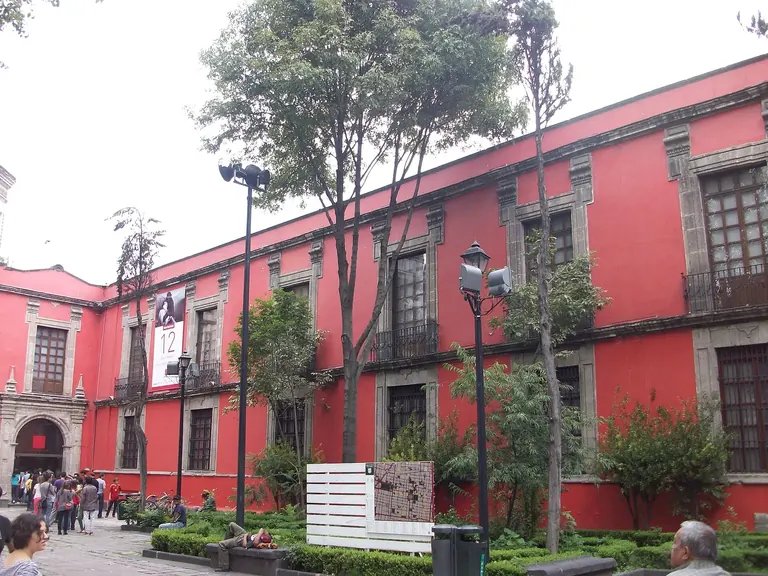
Museo Franz MayerCentro Histórico
Biodiseño Mx. Territorios vivos
This exhibition has ended.
Mexico's first biodesign exhibition: emerging designers working with living systems to show design that is conscious of the interdependence of all living beings.
Museum websiteMore in Mexico City
The walls are the first exhibit. Mixterra plastered them with clay-rich earth from Oaxaca, an old technique that regulates the room's temperature and humidity by itself, and the display stands are recycled-plastic panels. Inside that landscape, shaped after Mexico's mountains, are 74 works by more than 60 designers in what the museum bills as Mexico's first biodesign exhibition.
It runs in five sections: Flora, Fauna, Microbia, Funga and Bioinspiration. You walk from agave-fibre lamps and textiles grown from bacterial cellulose to bee shelters, insect pigments and 3D-printed reefs for coral restoration. The curator's argument, quoted in Excélsior, is that Mexican biodesign is neither new nor futuristic but comes from ancestral knowledge. Cena con Micelio makes it the one dinner table in Mexico City where fungus on the furniture is the point.
It's in Temporales II and included in the MXN 130 general ticket (under-12s free, everyone free on Tuesdays). The museum now lists it until 25 October, two weeks past the closing date first announced.
Editor's pick
Mexico's first biodesign exhibition: emerging designers working with living systems, built on the idea that every living thing depends on the others. For most of us, the nearest equivalent is a sourdough starter. Regular exhibitions are free on Tuesdays.
Look for
Patachón by Fernando Laposse
Look for a light sculpture made from agave fibres.
Cena con Micelio
Proyector, Radial and LABVA present mycelium and ferments as a living dinner table.
SEED Collective's soil seats
Seats 3D-printed from earth, meant to show how tactile and regenerative earth can be as a material.
MANUFACTURA's eggshell bioceramics
In the Bioinspiration section, 3D-printed ceramics made from used eggshells.
The walls
Mixterra's clay coatings from Oaxacan soils cover the gallery and regulate its temperature and humidity naturally.
Good for
- Cheap Culture
- Locals Who've Seen It All
- Nerding Out
Skip if
You came for the Franz Mayer's colonial silver and Talavera: this room is all contemporary experimental materials.
With kids
Under-12s go free, and the museum has lifts and ramps to most galleries.
Also at Museo Franz Mayer
On now nearby


Nearby
Image credits
8
- Museo Franz MayerGAED / Wikimedia Commons, CC BY-SA 3.0
- Alexandre Estrela. RedSkyFalls: RéplicaCourtesy of Museo Universitario Arte Contemporáneo (MUAC)
- El Códice de AzcatitlanCourtesy of Museo Nacional de Antropología
- Julian Rosefeldt. ManifestoCourtesy of Museo Universitario Arte Contemporáneo (MUAC)
- Museo del Palacio de Bellas ArtesXavier Quetzalcoatl Contreras Castillo / Wikimedia Commons, CC BY-SA 3.0
- Museo KaluzYmblanter / Wikimedia Commons, CC BY-SA 4.0
- Museo Memoria y ToleranciaMuseo Memoria y Tolerancia / Wikimedia Commons, CC BY-SA 4.0
- Museo Mural Diego RiveraJosé Luiz / Wikimedia Commons, CC BY-SA 4.0