 i
Bode-MuseumMitte
Sound Bodies – Variations on a Theme of Art
A musical intervention pairing historical and modern instruments with artworks that depict music, from late antique textiles and angel choirs to Canova's 'Dancer'.
More in Berlin
Preview: written before the show opened
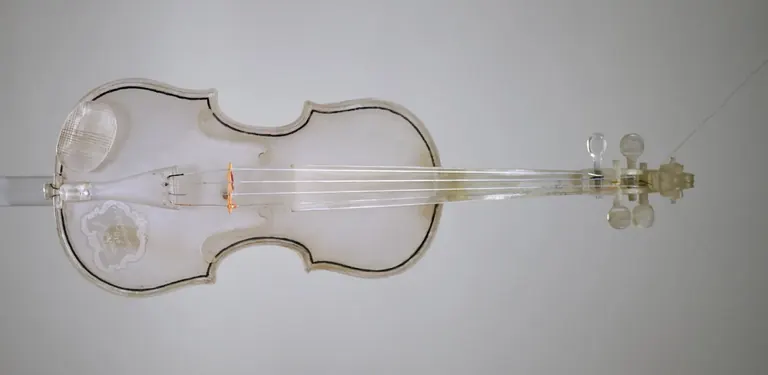
The lead image for this show is a see-through violin, made from Plexiglas by a prisoner of war in Foggia in 1946. Inside, real instruments like it are set beside the sculpted angels, putti and mythical creatures who make music all over the Bode-Museum, some of them on instruments that now survive only in art.
The intervention spreads across all three floors and runs by instrument family: organ first, then wind, plucked and string instruments, percussion, and finally Nevin Aladağ's works on home music-making. The curators treat each instrument as a sculpture in its own right, and you can hear some of them in sound samples. They also go for odd pairings: East and West German synthesizers from the early 1970s facing the angel orchestra of the Minden Altar.
Concerts run alongside, some played on Aladağ's instrument sculptures, with the Staatsoper Berlin as a partner. Under-18s get in free, and the museum stays open until 8pm on Thursdays through December.
Editor's pick
Early-1970s East and West German synthesizers face the Minden Altar's angel orchestra, and a Plexiglas violin made in a 1946 prisoner-of-war camp sits among Baroque organ putti. Under-18s go free.
Look for
The Plexiglas violin
A transparent violin that F. Krolikowski built for himself as a prisoner of war in Foggia, Italy, in 1946.
The Minden Altar's angel orchestra
Angels playing instruments on the Minden Altar, set against East and West German synthesizers from the early 1970s.
The Salem organ putti
Johann Georg Dir's putti making music on clouds, carved around 1770 for the organ front of the Cistercian abbey church at Salem on Lake Constance.
The Nuremberg bagpiper
A bagpiper figure from Nuremberg, around 1530/40, playing one of the instruments in the show that is still around today.
Canova's Dancer
Antonio Canova's Dancer of 1809/12, which the curators set to music, asking what rhythm she would keep time to today.
Good for
- Evening Visits
- Going Solo
- Nerding Out
With kids
Children and teenagers up to 18 get in free.
Also at Bode-Museum
On now nearby
Nearby
Image credits
9
- Sound Bodies – Variations on a Theme of Art© SIMPK/Barnes Ziegler
- 100 Years of the Dictionary of the Egyptian Language© Ägyptisches Wörterbuch
- Destiny in the Stars: The Beginnings of the Zodiac© Staatliche Museen zu Berlin, Ägyptisches Museum und Papyrussammlung, Foto: Sandra Steiß
- Dioscuri – The Given Day© Staatliche Museen zu Berlin, Ägyptisches Museum und Papyrussammlung / Rendering: Studio Michael Müller
- Bode-MuseumThomas Wolf / Wikimedia Commons, CC BY-SA 3.0
- PergamonmuseumHerrAdams / Wikimedia Commons, CC BY-SA 4.0
- Neues MuseumFred Romero / Wikimedia Commons, CC BY 2.0
- Alte NationalgalerieManfred Brückels / Wikimedia Commons, Public domain
- Altes MuseumJean-Pierre Dalbéra / Wikimedia Commons, CC BY 2.0