 i
Museu Marítim de BarcelonaEl Raval
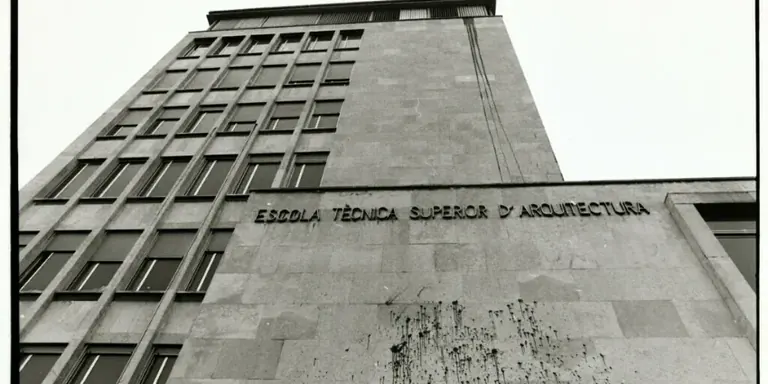
Barcelona School of Architecture in shaping everyday life in the city (1875–2025)
Works and writings by ETSAB faculty trace how architecture, planning and landscape shaped daily life in Barcelona, with a focus on the sea.
More in Barcelona
You can look for your own street on a 1:2,500 map of Barcelona, pinned with the locations of nearly 600 works by teachers at ETSAB, the city's public school of architecture. They run from small domestic cells to metropolitan structures, and the question is how they shaped daily life since industrialisation.
Around the map are a chronology, a wall of covers of texts the teachers wrote, 24 photographs by Manuel Laguillo and six videos of everyday scenes in these places. Six plaster sculptures from the school's Fine Arts beginnings give the room a human scale. Because it's the Maritime Museum, the centrepiece is six seafront works shown large, with video: from Coderch and Valls's Barceloneta flats to the Fòrum's solar pergola. If you've watched a Primavera Sound set under that pergola, this is where you meet who drew it.
It's the school's own account of itself, chosen by five ETSAB professors. Entry is free, in the Mirador space, daily 10:00 to 20:00, with texts in Catalan, Spanish and English.
Look for
The seafront centrepiece
Six waterfront works shown large with video: Coderch and Valls's Barceloneta flats, the Moll de la Fusta, the Vila Olímpica, the Gas Natural offices, the Fòrum pergola and the Greenh@use.
The 1:2,500 city map
Look for the plan of Barcelona that marks where each of the nearly 600 selected works stands.
Manuel Laguillo's 24 photographs
Everyday scenes in the buildings and spaces the show covers, alongside six videos by Alomar-Guillamon Videography.
The plaster sculptures
Six plaster figures from the school's collection, a reminder that it began alongside the Fine Arts, placed to give the room a human scale.
The mural of covers
A wall made of the covers of the texts ETSAB teachers wrote about the city over 150 years.
Good for
- Cheap Culture
- Locals Who've Seen It All
- Nerding Out
Also at Museu Marítim de Barcelona
On now nearby
Nearby
Image credits
9
- Barcelona School of Architecture in shaping everyday life in the city (1875–2025)Courtesy of Museu Marítim de Barcelona
- Barcelona Materials: Local Materials for Regenerative ArchitectureCourtesy of Museu d'Història de Barcelona (MUHBA)
- VisiblesCourtesy of Museu d'Història de Catalunya
- 50 anys dels concerts de la Transició. Barcelona, Palau d'EsportsCourtesy of Museu d'Història de Catalunya
- Museu Marítim de BarcelonaEnric / Wikimedia Commons, CC BY-SA 4.0
- Museu d'Història de Barcelona (MUHBA)J Irigoyen / Wikimedia Commons, CC BY-SA 3.0
- Museu d'Història de CatalunyaJordiferrer / Wikimedia Commons, CC BY-SA 3.0
- Museu Frederic MarèsEnfo / Wikimedia Commons, CC BY-SA 4.0
- Moco Museum BarcelonaRolima.moco / Wikimedia Commons, CC BY-SA 4.0