Museum BrandhorstKunstareal, Maxvorstadt
Long Story Short: An Art History from the Brandhorst Collection from the 1960s to the Present
A survey drawing on six decades of the Brandhorst Collection, from the 1960s to today.
More in Munich
At one extreme is Mark Leckey's Inflatable Felix, a ten-metre blow-up of Felix the Cat, the first image ever broadcast on television. At the other is André Cadere's hand-painted wooden rod, 29 centimetres long, which he used to smuggle into other people's exhibitions.
This is the first time since it opened in 2009 that Brandhorst has hung its collection in chronological order: nearly 80 works by more than 30 artists, over 20 of them never shown before. Each room on the lower level is its own small show, from Arte Povera and Minimalism through 1980s work on body and identity and 1990s painting to digital media. In Jacqueline Humphries' room the paintings glow under black light, which the museum compares to a club, and nobody at the door judges your trainers.
It's a crash course, and a selective one: the museum says it isn't attempting a complete history. The normal €7 ticket covers it (€1 on Sundays), and Thursdays run until 8pm.
Look for
Mark Leckey's Inflatable Felix
Look up at a ten-metre inflatable Felix the Cat, Leckey's version of the first image ever broadcast on television.
André Cadere's Barre de bois rond
Look for a hand-painted wooden rod just 29 centimetres long, the kind of piece Cadere carried into other artists' exhibitions uninvited.
Jacqueline Humphries' Black Light Paintings
These 2005 canvases glow in the dark, so the paintings themselves become the room's light source.
Marisa Merz's La conta
A 1967 black-and-white film that turns an everyday kitchen scene into what the museum calls a feminist manifesto.
Good for
- Cheap Culture
- Evening Visits
- Rainy Days
Skip if
You want the full story: the museum picks selected movements, mostly European and American, not a complete survey.
With kids
Under-18s get in free, and the Open Factory runs drop-in art workshops for everyone on Sundays from 1pm.
Also at Museum Brandhorst
On now nearby

Nearby
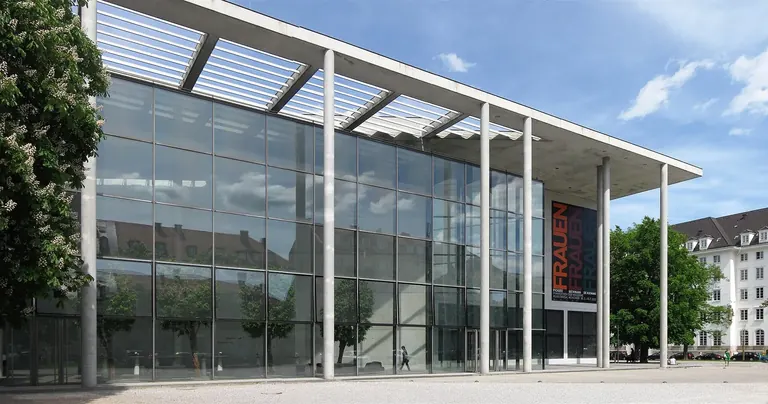
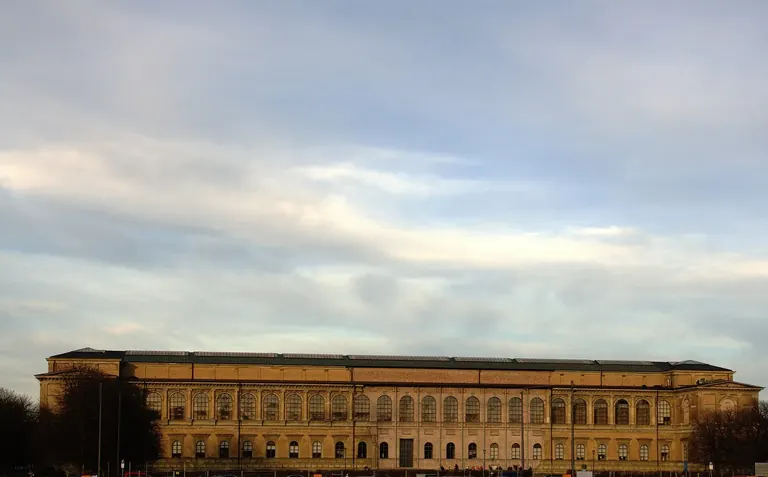
Image credits
8
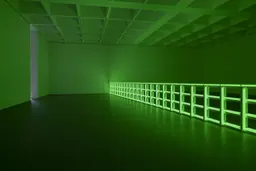
- Between and Beyond: Interspaces and Transitions in Art since 1960Foto: Bayerische Staatsgemäldesammlungen, Sibylle Forster © Estate of Dan Flavin / VG Bild-Kunst, Bonn 2026
- Klarenbeek & Dros: Design of the UnusualPhoto: Klarenbeek & Dros
- Robotic WorldsCourtesy of Pinakothek der Moderne
- Museum BrandhorstMartin Falbisoner, CC BY-SA 3.0
- Pinakothek der ModerneRufus46, CC BY-SA 3.0
- Alte PinakothekChronox-A / Wikimedia Commons, CC BY-SA 4.0
- State Museum of Egyptian ArtFred Romero / Wikimedia Commons, CC BY 2.0
- Munich Documentation Centre for the History of National SocialismRaimond Spekking, CC BY-SA 4.0