 i
Plum Tree and Nasori (Ume ni Nasori-zu): Sugito-e at the Honmaru-goten Palace
This exhibition has ended.
Hara Zaisho's 1852 painted cedar doors of two Bugaku dancers performing Nasori beside a white plum, one of 14 door sets shown one at a time in the Honmaru-goten Palace.
Museum websiteMore in Kyoto
Two dancers in dragon masks stand beside a white plum, and under each mask you can see the dancer's own mouth. Hara Zaisho painted them on cedar doors in 1852, down to clenched fists and the bark of the plum.
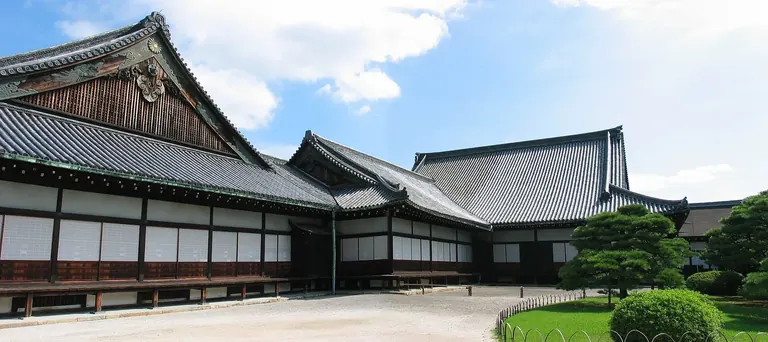
The dance is Nasori, which the National Theatre describes as a pair of playful dragons running the stage, once the Heian court's victory dance at wrestling and archery contests. It is the answering dance to Ryoo, and Hara's Plum and Ryoo hung here until March. You leave your shoes in a locker, watch an eight-minute video in a group of about 15, and walk the narrow corridors in socks to the Unkaku Second Room, where one of 14 door sets comes out of storage every six months.
It closes 18 October, and Pine Trees and Cranes takes over on the 21st. Entry is by timed web ticket, 1,000 yen on top of 800 yen castle admission. The walk from Higashi Ote-mon Gate takes 15 to 20 minutes. No photos inside.
Look for
The mouths under the masks
Look just below each Bugaku mask, where Hara let the dancer's real mouth show through, one of the details the castle points to as his push for realism.
The clenched hands
Both performers grip their hands tight mid-dance, painted with the same close attention as the faces.
The white plum's bark
Beside the dancers stands a white plum in flower, its trunk painted so the rough texture of the bark reads on the cedar.
The costumes
The castle singles out the fine, exact detail of the dancers' court costumes as the thing to look at longest.
Good for
- Locals Who've Seen It All
- Nerding Out
Skip if
You want photos: cameras and video are banned throughout the Honmaru-goten Palace.
With kids
The palace ticket is 300 yen for junior and senior high students and 200 yen for elementary pupils, plus castle admission; under elementary age are free. Shoes come off and socks are required inside.
Also at Nijo Castle (Nijo-jo)
On now nearby

Nearby

Image credits
7
- Nijo Castle (Nijo-jo)Keith Pomakis / Wikimedia Commons, CC BY-SA 2.5
- Children Who Grew Up with Manga: 40 Years of Manga in EuropeCourtesy of Kyoto International Manga Museum
- A Symphony of Chrysanthemums: Masterpieces by the Successive Generations of the Raku FamilyCourtesy of Raku Museum
- Kan'ei: Beauty Nurtured by PeaceCourtesy of The Museum of Kyoto
- Kyoto International Manga Museum珈琲ルンバ via Wikimedia Commons, CC BY-SA 3.0
- Raku MuseumAt by At / Wikimedia Commons, CC BY-SA 3.0
- The Museum of KyotoTokumeigakarinoaoshima / Wikimedia Commons, CC BY-SA 4.0