 i
Chicago History MuseumLincoln Park / Old Town
US at 250: Dorian Sylvain
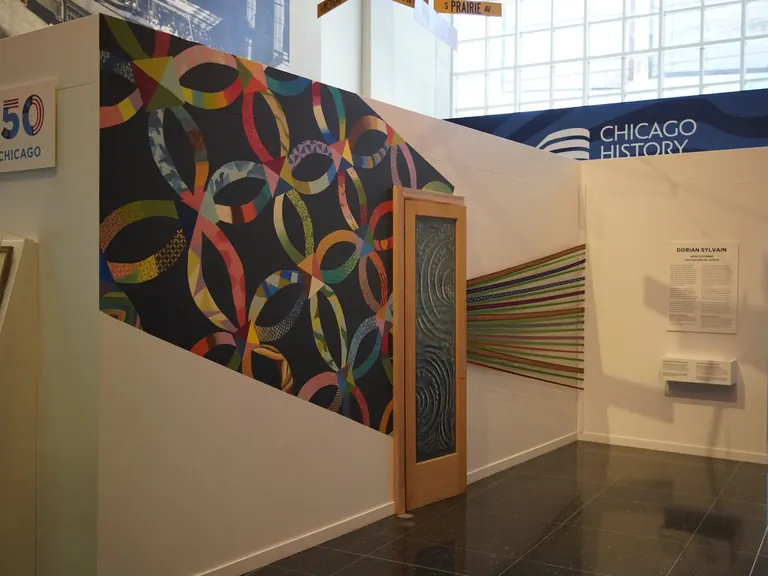
Dorian Sylvain's immersive installation "We Weave Our Future" answers the Thirteenth Amendment with patterns drawn from quilts made by enslaved people. Final part of US at 250.
More in Chicago
Two quilt patterns share the Museum's first-floor lobby. The symbols on one stand for hope and freedom; those on the other stand for the chaos and uncertainty of the nation's prison system. Both draw on quilts made by enslaved people in the 18th and 19th centuries.
We Weave Our Future is Bronzeville artist Dorian Sylvain's answer to the Thirteenth Amendment, which in 1865 ended slavery except as punishment for a crime, a clause the Museum ties to mass incarceration. Students at Art in Motion Creative Arts school co-designed it. It comes with material on the John Howard Association, the Illinois prison watchdog founded in 1901 that still reports on prison conditions. You don't only look: the Museum invites visitors to add to the installation.
It is one installation, not a full gallery, the last of four 2026 lobby works on founding documents, and no critic has reviewed it. Entry is included with museum admission ($24 for adults, free for children 12 and under). It closes January 3, 2027.
Look for
The freedom quilt pattern
Look for the pattern whose symbols stand for hope and freedom, drawn from quilts made by enslaved people in the 18th and 19th centuries.
The carceral quilt pattern
Its counterpart uses symbols for the chaos and uncertainty of the nation's prison system, the loophole the Thirteenth Amendment left open in 1865.
Good for
- An Hour Or Less
- Locals Who've Seen It All
Also at Chicago History Museum
On now nearby

Image credits
5
- US at 250: Dorian SylvainCourtesy of Chicago History Museum
- Self, Made: Fourteen Modern Artists from the Richard and Ellen Sandor Family CollectionCourtesy of Richard and Ellen Sandor.
- A Tale of Today Presents Brendan Fernandes: In the RoundCourtesy of Richard H. Driehaus Museum
- Saint-Porchaire Ceramics: Rediscovered Treasures of the French RenaissancePrivate collection. Paul-David Young/Spektra Imaging LLC.
- Chicago History MuseumMichael Barera / Wikimedia Commons, CC BY-SA 4.0