 i
Art Institute of ChicagoGrant Park / Loop
Saint-Porchaire Ceramics: Rediscovered Treasures of the French Renaissance
Nine rare Saint-Porchaire ceramics of the French Renaissance from a private collection, most on public view for the first time since the late 1800s.
More in Chicago
The covered cup here stands almost 10 inches high and weighs very little, because its clay walls are so thin. The curators think its black knotwork and fleurs-de-lis were pressed in with bookbinders' brass stamps. Inside the bowl, where only the person drinking would see it, sits François I's crowned, fire-breathing salamander.
Only about 70 Saint-Porchaire pieces are known to survive, and most of this group, lent from a private collection, hasn't been shown in public since the late 1800s. You find them in Gallery 238, the small room usually kept for Renaissance jewelry, next to coarser, brightly glazed French earthenware from the museum's own collection.
It's one room of jewel-like objects, made for leaning in close, with the armor and metalwork of the surrounding Deering galleries as context. It's free with museum admission, and it closes on 15 November, when the jewelry moves back in.
Look for
The covered cup
Look for black interlaced knotwork, chains and fleurs-de-lis inlaid in the creamy clay, with small green seashells applied around the middle of the stem.
The triangular saltcellar
Each face has an arched niche under a pediment, the corners stack large-eared masks, bearded herms and ram's heads, and the salt bowl is ringed with Diane de Poitiers' interlaced crescent moons.
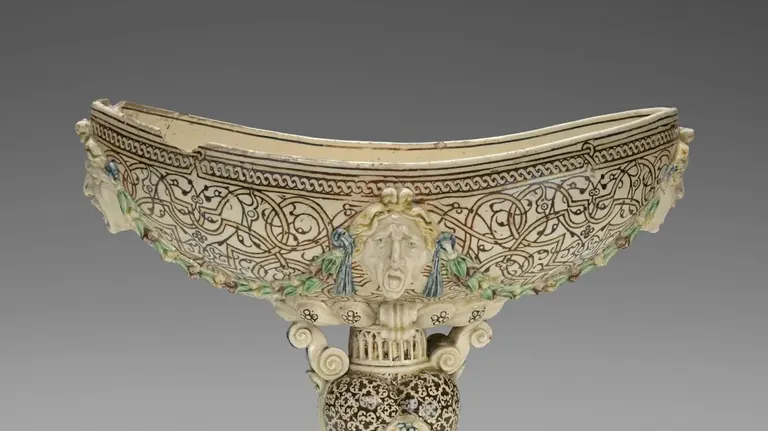
The nef-shaped cup
A drinking cup shaped like a ship, with the royal arms of France set inside it.
Gondola Cup with a Figure of Spring
A recent museum purchase in coarser earthenware, covered all over in colourful glaze, with Spring personified as a figure: the louder cousin of the creamy Saint-Porchaire pieces.
Good for
- An Hour Or Less
- Locals Who've Seen It All
- Nerding Out
Skip if
You want a big exhibition: this is one small gallery of tabletop ceramics.
Also at Art Institute of Chicago
On now nearby



Nearby




Image credits
9
- Saint-Porchaire Ceramics: Rediscovered Treasures of the French RenaissancePrivate collection. Paul-David Young/Spektra Imaging LLC.
- Flyway City: Architecture for a Flourishing EcosystemPhoto by Steve Hall, courtesy of Studio Gang.
- Chicago's Living HabitatPhoto by Madison Smith
- Currents: 60 Years of the Chicago Architecture CenterCourtesy of Chicago Architecture Center
- Art Institute of ChicagoDiego Delso, via Wikimedia Commons, CC BY-SA 3.0
- Chicago Architecture CenterAlanscottwalker / Wikimedia Commons, CC BY-SA 4.0
- Museum of Contemporary PhotographyAjay Suresh via Wikimedia Commons, CC BY 2.0
- Shedd AquariumDiego Delso, via Wikimedia Commons, CC BY-SA 3.0
- Field MuseumPaul Sableman via Wikimedia Commons, CC BY 2.0