Studio recordings, AI narration and open questions in one guide
How the Lokschuppen Rosenheim kept the audio stories it had commissioned from ten authors, built a much larger tour around them, and let visitors ask whatever they wanted.
Temporary exhibition · · 5 min read
3 in 4
questions typed or spoken by visitors, not tapped from suggestions
55%
of visits were active, asking questions along the route, not only listening
45 min
average time in the guide
10
audio stories kept from the original guide
In brief
The audio stories the museum commissioned from ten authors, Bernhard Hennen, Theresa Hannig and Markus Heitz among them, stayed in. The AI narrates the stops around them and answers questions.
The Lokschuppen's team checked the content themselves, station by station, over about a week. Musa supported them entirely remotely.
A drawn floor plan of both levels shows visitors where they are and where the next stop is.
Deployment
Temporary exhibition
Location
Rosenheim, Germany
Languages
German, English, French, Italian, Spanish, Portuguese, Catalan, Basque, Arabic, Chinese (Simplified), Chinese (Traditional)
You could type in pretty much anything. Things that occurred to me along the way, questions about something that wasn't on a panel. If you hadn't quite understood something, it just explained it again.
Visitor to the RÖMER exhibition, in the Lokschuppen's Instagram video
Pilot Musa at your museum.
A pilot runs on your own collection and content, the way it did at Ausstellungszentrum Lokschuppen Rosenheim, and takes weeks rather than a procurement cycle.
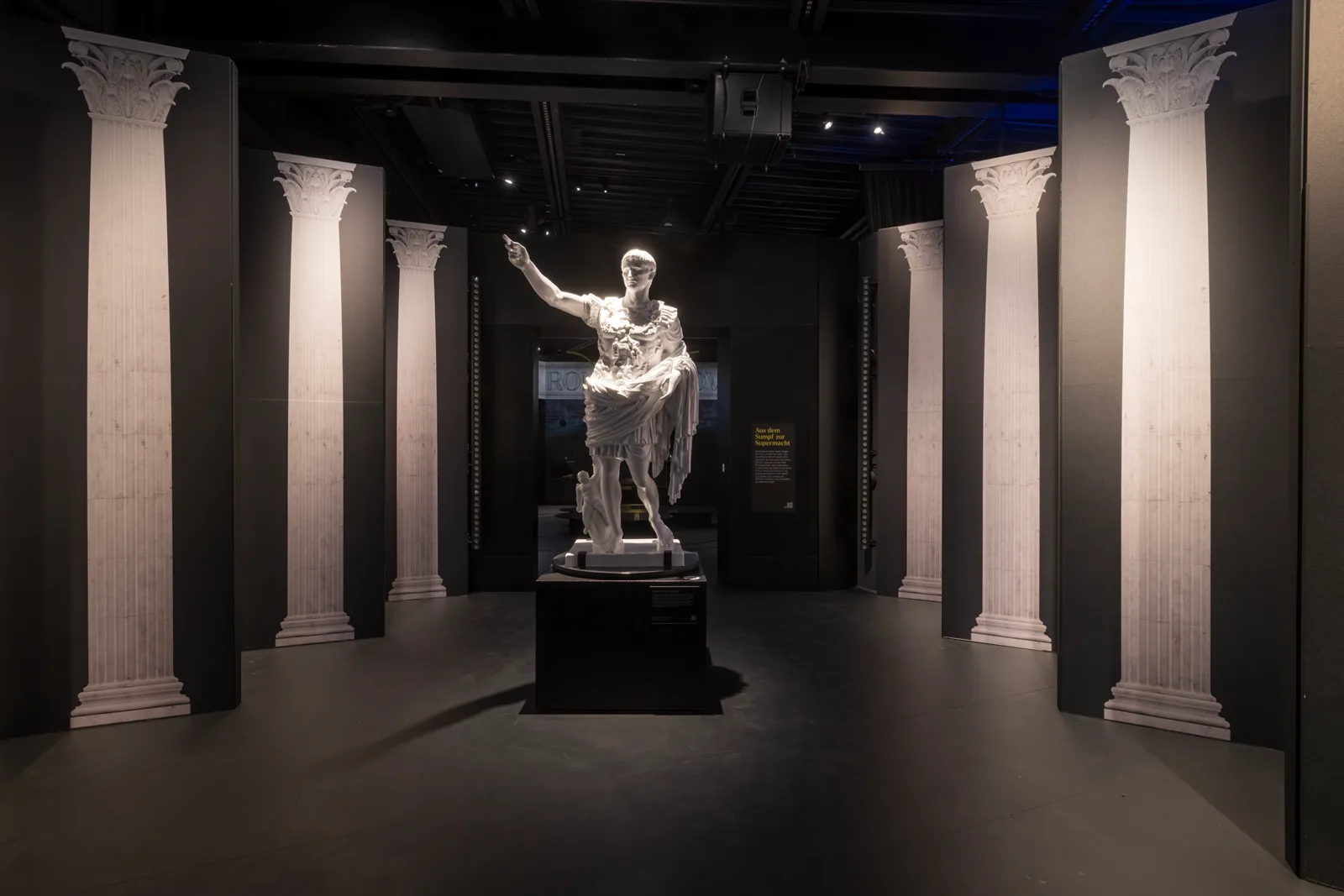
The Ausstellungszentrum Lokschuppen in Rosenheim is a former locomotive shed that puts on one large exhibition at a time and draws around 200,000 visitors a year. Its current show, RÖMER, runs from March 2026 to August 2027 across 1,500 m² and two floors: more than 1,200 objects from some 30 lenders, a Roman city built from half a million LEGO bricks, a digital chariot race, and a hands-on games street where visitors sit down and play Rundmühle.
The Lokschuppen's Instagram video from the first week: four visitors, asked halfway through their visit how the guide was going. English subtitles; tap the speaker for sound.
Challenge
The Lokschuppen already had an audio guide when RÖMER opened. For the exhibition it had commissioned ten authors, among them the fantasy novelists Bernhard Hennen and Markus Heitz and the science-fiction writer Theresa Hannig, to each write a short story from Roman life: an olive farmer in Baetica, a midwife in Ephesus, an auxiliary soldier on the Limes, a potter at Pons Aeni on the Inn, a beast-fighter in North Africa. The people are invented; the finds around them are real. The stories were recorded in a studio in German and English and played on rented devices at numbered stations, each with a black-and-white portrait on the wall.
A recorded guide covers the stations it was recorded for. It cannot take a question, switch tone for a child, or tell a visitor from Rosenheim what the Roman Empire looked like on the Inn, ten kilometres from where they are standing. Extending it meant another studio booking for every new station, in every language.
The team did not want to give up the stories to get those things.
Approach
The guide that went live on 17 August 2026 is built in three layers.
The stories stayed. The ten author-written audio stories, and the recorded founding myth, sit in the tour exactly as they were produced, in German and English. When the route reaches one of those stations, the guide hands over to the recording and picks up again afterwards.
The AI narrates the rest. Around those recordings, the Lokschuppen's team wrote a 29-stop main tour of about 75 minutes in Musa Studio, from the object list and texts of the existing guide, the exhibition catalogue and the floor plans. Each stop carries a short brief on what matters there, so the narration follows the team's brief even though the wording is generated. Sixteen generated ambient sounds sit under the narration: wolves at the founding myth, a Mediterranean harbour, a Mithraeum, the crowd at the chariot race. The narration runs in twelve languages; the stories play in the two they were recorded in.
Visitors can ask. At any point a visitor can type or speak a question, or tap one of the guide's suggestions. The answers come from the exhibition's own material, not the open web.
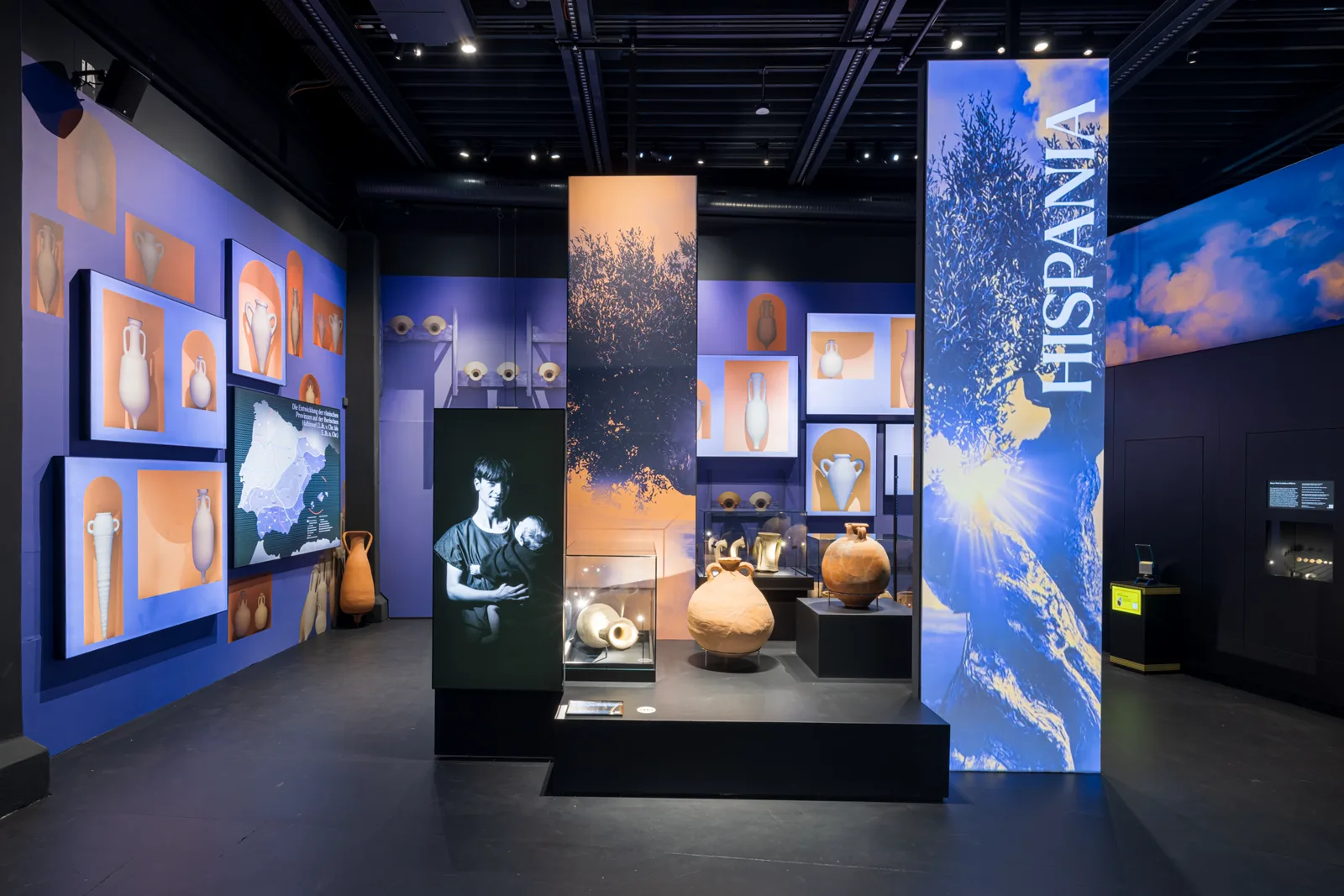
The guide at the Hispania stop, from the map to the narration and back. The portrait on the wall is Marcus Aemilius Ianuarius, an olive farmer from Baetica, whose recorded story plays at this station inside the tour. Photo: Axel Jusseit.
A visitor who only wants to listen gets a tour that sounds like an audio guide, with the museum's own recordings where the museum recorded them. A visitor who wants to know why Roman coins have holes in them, or how big LOCDVNVM would have been, can ask.
Knowing where you are
The Lokschuppen is a large hall on two levels, and the RÖMER route crosses between them. Wayfinding was the most common note in the staff test: the guide sent one tester from the games display straight to the Tabula Peutingeriana without mentioning the stairs.
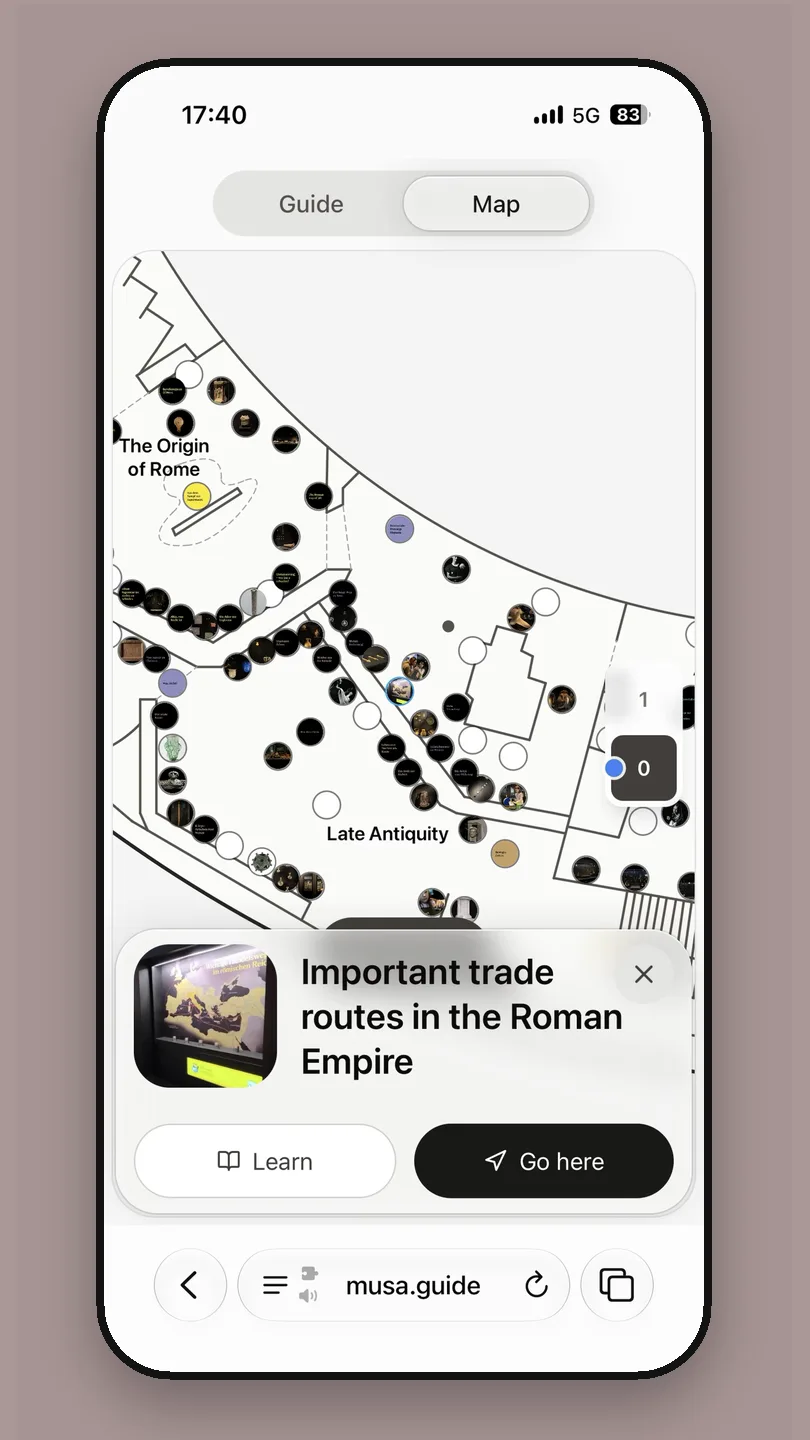
So the guide carries a drawn floor plan of both levels, with the stairs marked as connectors between them. Every stop is pinned to it. Visitors see where they are, where the next stop is, and which floor it is on, and the narration's own directions are written against the same plan.
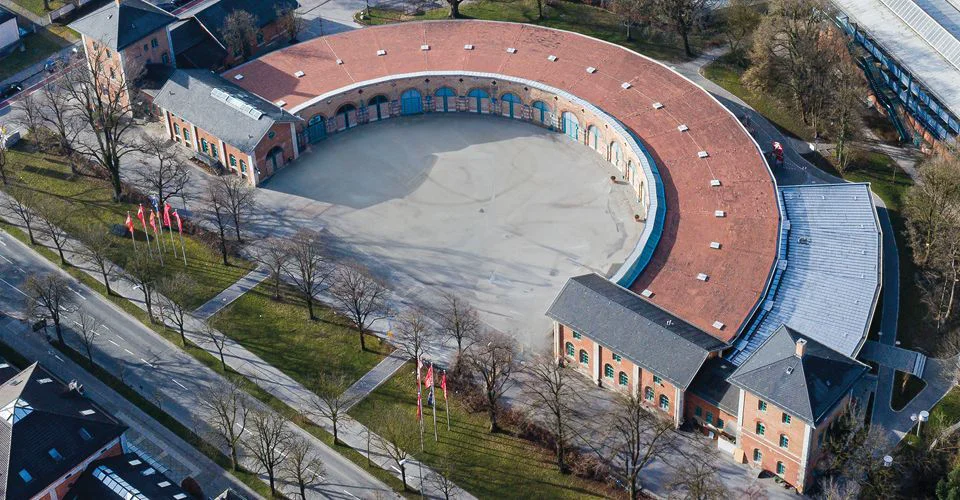
The same building twice: as the guide draws it, with a stop selected and the floor switch on the right, and from above, a semicircle around the old turntable. Photo: Andreas Jakob.
The same exhibition for different visitors
The launch focused on the main tour. The same knowledge base already carries five more, curated by the team in Studio.
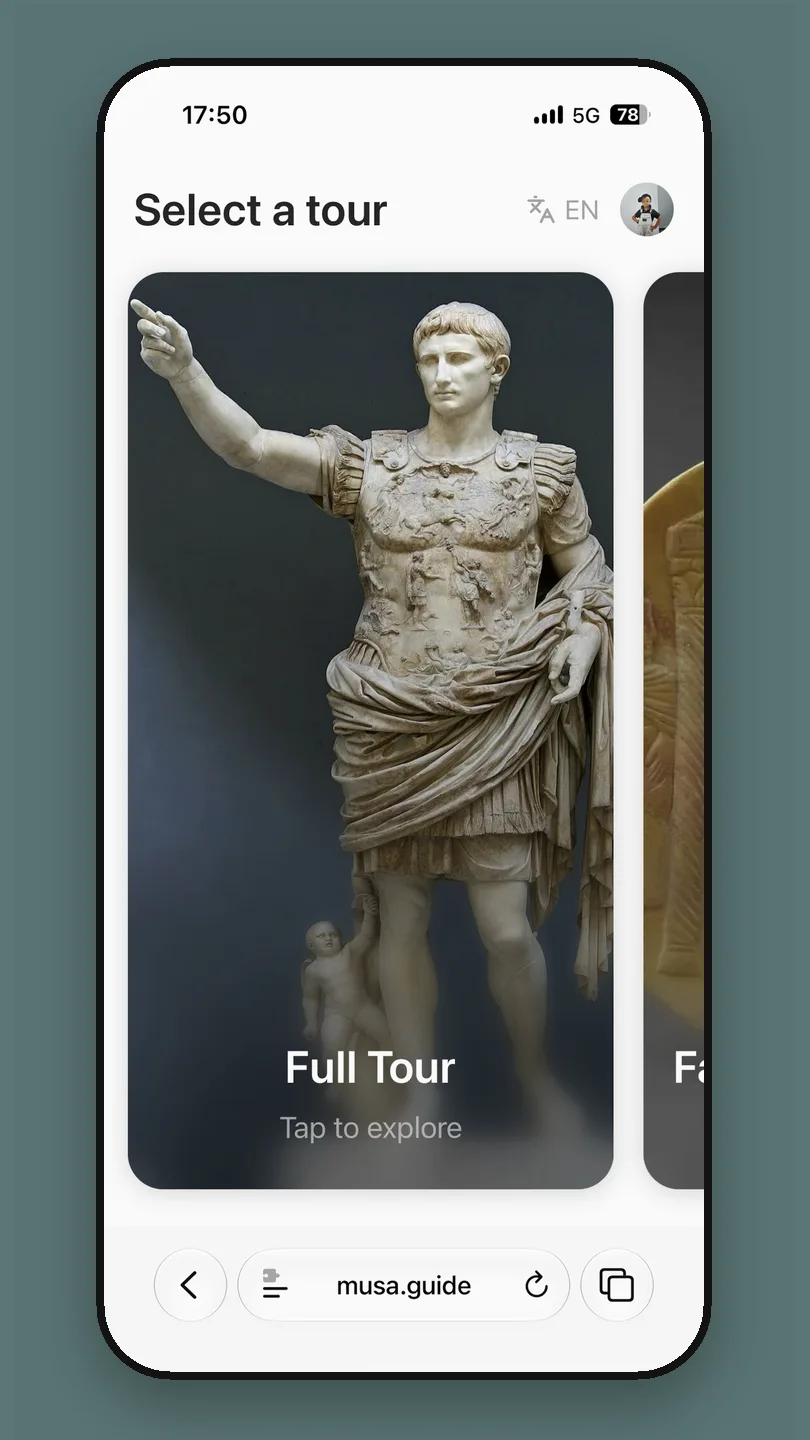
Felix, a Roman cat in a toga, leads a family tour that follows the printed Mosaik-Rätselheft the museum hands out at the ticket desk: sixteen stations, one mosaic tile each, a picture at the end.
Rom am Inn is for people from the region. Rosenheim itself was not a Roman town, and the tour says so, but the potteries at Pfaffenhofen, the Mithras sanctuary at Mühlthal a few kilometres from the Lokschuppen and the tableware from Westerndorf that was exported as far as Poland were, and the tour goes to them.
A version of the main tour in simple language, short sentences and one idea per sentence, is there for visitors who find long narration hard to follow. Two shorter thematic routes, on Roman religion and on five objects archaeology still cannot explain, are for people coming back.
The tour picker. The main tour first, the family tour with Felix next to it.
Outcomes
Before launch, the Lokschuppen checked the content themselves. Stefanie Kießling, who runs exhibition education at the Lokschuppen, spent about a week walking the guide station by station, with Musa supporting the work entirely remotely. In the week before the go-live she and three colleagues did a full test run and sent back a page of notes: the missing stairs, a confusing reference to "the map" that turned out to mean a page in the children's booklet, a section of the games street the guide had not yet understood, and the pronunciation of LOCDVNVM. All of it went in before the go-live on the Monday.
All three testers scored the guide five out of five on every item and said they would recommend it. On the forms they singled out the ambient sounds, the voice and its pronunciation, and how the guide handled "Darf ich das anfassen?" and "Ich will das Lego klauen!" One noted that the questions the guide raises in the first room are picked up again at the end of the exhibition. Another that the tour survived being interrupted: after leaving the app to take photos and rescanning the QR code, it resumed at the exact stop.
Ihnen hat der musa-Guide insgesamt sehr gefallen. Besonders positiv wurde hervorgehoben, dass er
die Besucherinnen und Besucher kurzweilig durch die Ausstellung führt.
"They liked the Musa guide a lot overall. What they singled out most was that it leads visitors through the exhibition in an engaging way."
In the first four weeks, visitors spent 45 minutes in the guide on average. Of the visits that went beyond a couple of interactions, 55% were active rather than passive, with questions along the route. Three in four of those questions were typed or spoken by the visitor rather than picked from a suggestion, and nine in ten of them the guide could answer from the exhibition's material. Among them: what Romans ate most, why the coins have holes, who designed the LEGO city, whether it is really pax romana or pax augusta. One visitor asked for everything in the room. Another asked "Welchen Bezug hat Rosenheim dazu?"
In the first week the Lokschuppen's team took a microphone into the exhibition and asked visitors, halfway through their visit, how it was going.
Du hast eigentlich alles eingeben können. Weil mir zwischendurch mal was eingefallen ist oder ich
Fragen hatte, so was, was jetzt nicht auf einer Tafel gestanden ist. Wenn man es nicht ganz
verstanden hat, hat man es einfach nochmal erklärt bekommen.
Visitor to the RÖMER exhibition, in the Lokschuppen's Instagram video
"You could type in pretty much anything. Things that occurred to me along the way, questions about something that wasn't on a panel. If you hadn't quite understood something, it just explained it again."
Another called it "ein super Guide zusätzlich, um durch die Ausstellung zu kommen", a great extra guide for getting through the exhibition. Asked whether they would recommend it: "Ja, definitiv."
Paying for it
Visitors buy the guide on their phone at the entrance, at 3 € to start with. The Lokschuppen and Musa share the revenue on every sale, so the museum pays nothing up front, and the price will be adjusted over the coming months as both sides see how visitors respond. Payment currently runs through Musa; the next step is to sell the guide inside the Lokschuppen's own ticket system, so it can be added to an entry ticket in the webshop or at the desk.
The recordings, the tours, the map and the knowledge base all live in the Lokschuppen's Musa Studio account. When RÖMER closes in August 2027, the Lokschuppen can build the guide for the next exhibition in the same account.