 i
National Folk Museum of KoreaJongno-gu
ZERO: The North Korea
North Korean folk culture through regional memories of Gaeseong, Hwanghae-do, Pyeongan-do and Hamgyeong-do, shared everyday traditions, and Geumgangsan Mountain as a common cultural memory.
More in Seoul
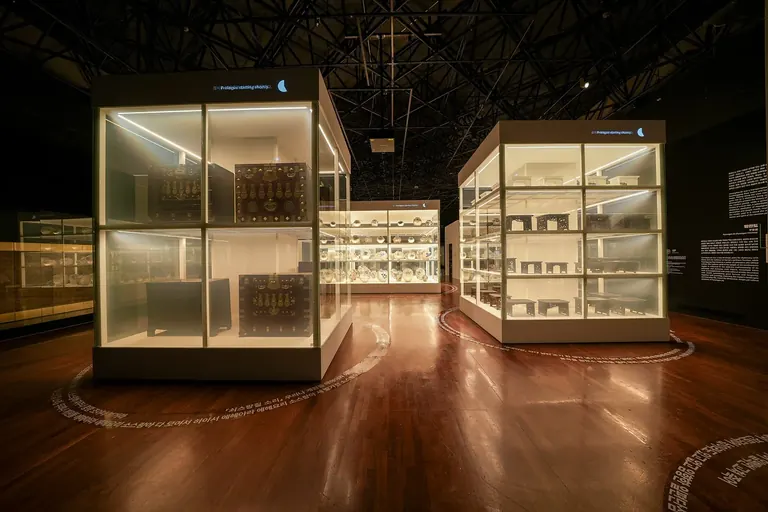
You walk into a dark room, and huge structures come out of it slowly as the light rises. At the centre is a four-tier tower of 88 Haeju jars from Hwanghae Province, painted with peonies, fish and chrysanthemums. One has "kimchi jar" written on it in hangul.
This is the museum's first exhibition of North Korean folk material: 316 objects from before 1945, from Gaeseong, Hwanghae, Pyeongan and Hamgyeong, set in six see-through towers modelled on its Paju open-storage depot. You move from regional masks, chests and scholars' desk objects to a last section on Geumgangsan, with travel journals, paintings, postcards and 1930s tourist footage never shown in public before. Seoul Economic Daily reported some asking whether objects made before the 1945 division can be called "North Korean" at all.
Entry is free, like everything at the museum, and the show is in Special Exhibition Hall 1. On Wednesdays the museum stays open until 8pm. Nine workshops run alongside it, including indigo-dyed pouches and Haeju-pattern crafts.
Editor's pick
North Korean folk culture through regional memories of Gaeseong, Hwanghae-do, Pyeongan-do and Hamgyeong-do, with Geumgangsan Mountain as a memory both Koreas share.
Look for
The Haeju jar tower
Look for 88 jars stacked four tiers high in the middle of the room, painted with peonies, fish and chrysanthemums, and find the one labelled "kimchi jar" in hangul.
The Pyongyang folding screen
An eight-panel screen lays out the landmarks and streets of Pyongyang as they looked in the late Joseon period.
Portrait of Gyewolhyang
A portrait of the gisaeng Gyewolhyang, one of the rare Joseon-era portraits of a woman.
The mask-dance masks
Masks from the Bongsan, Gangnyeong and Haeju mask dances and the Bukcheong lion dance, the performances each region staged at its community festivals.
Geumgangsan on film
1930s tourist footage of the Diamond Mountains from the Korean Film Archive, shown in public for the first time, beside American painter Lillian Miller's sketches from her own trip.
Good for
- Cheap Culture
- Evening Visits
- Nerding Out
Also at National Folk Museum of Korea
On now nearby
Nearby
Image credits
9
- ZERO: The North KoreaCourtesy of National Folk Museum of Korea
- MMCA×LG OLED Series 2026: Christine Sun KimCourtesy of MMCA Seoul
- Korea Artist Prize 2026Courtesy of MMCA Seoul
- Do Ho SuhCourtesy of the artist; Lehmann Maupin, New York, Seoul, and London; Victoria Miro © Do Ho Suh
- National Folk Museum of KoreaGaël Chardon, CC BY-SA 2.0
- MMCA Seouljens kuu, via Wikimedia Commons, CC BY 2.0
- Art Sonje CenterBonnielou2013 / Wikimedia Commons, CC BY-SA 4.0
- National Palace Museum of KoreaJinho Jung, via Wikimedia Commons, CC BY-SA 2.0
- Seoul Museum of Craft ArtYoungjin, via Wikimedia Commons, CC BY-SA 4.0