 i
Museo Teatrale alla ScalaCentro Storico
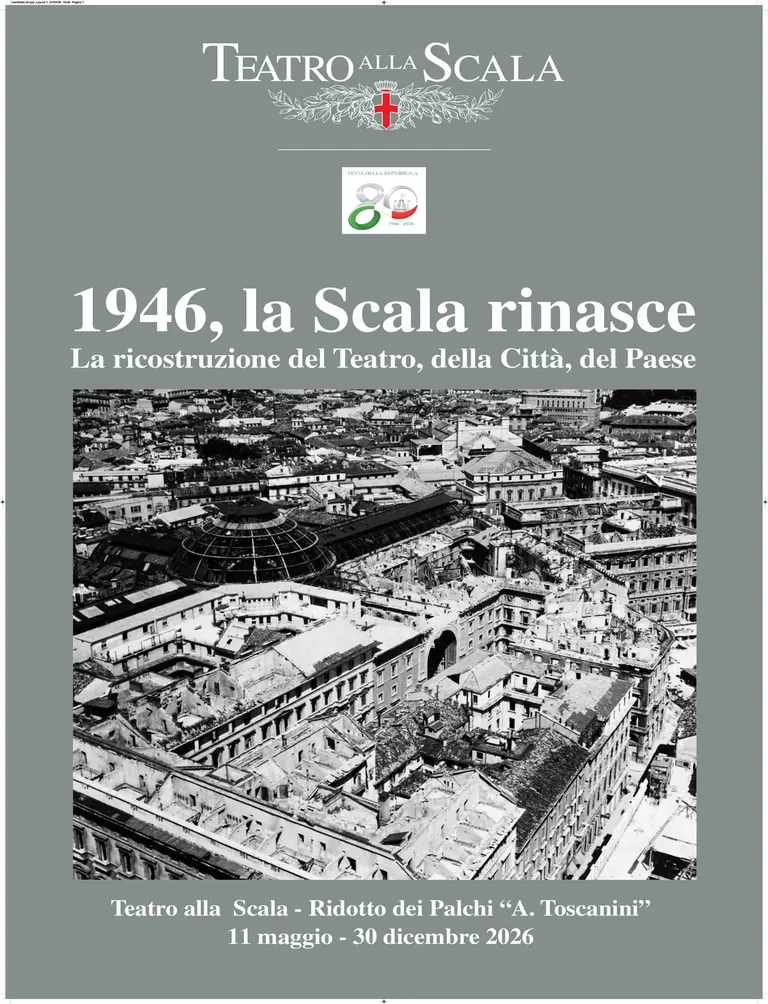
1946, La Scala rinasce
Period photographs trace La Scala's rebuilding after the 1943 bombing, up to Toscanini's historic reopening concert of 11 May 1946, 80 years on.
More in Milan
In August 1943 La Scala's chandelier, three tonnes of it, sat dismantled in a warehouse at Bovisa. The bombing found it there anyway. One photograph here shows workers in overalls bent over its pieces in the gutted hall, before its 352 lamps and Bohemian crystal chains went back up.
You see the wrecked auditorium first, then a wounded Milan around it, then scaffolding, boxes rebuilt in poplar as in Piermarini's original, and finally Toscanini back from America for the reopening concert of 11 May 1946, three weeks before Italy voted to become a republic. The material comes from La Scala's archive, Archivio Luce, the Corriere della Sera and the Politecnico. A video set to the concert's original recording has Liliana Segre, Harvey Sachs and Pier Luigi Pizzi, who remembers its rehearsals.
Il Giornale's critic praised it for skipping celebratory rhetoric and called the room almost meditative. It's in the Ridotto dei Palchi "Arturo Toscanini", open with the museum daily 9:30 to 17:30, last entry 17:00, until 30 December.
Editor's pick
La Scala's three-tonne chandelier was bombed in a Bovisa warehouse in 1943; one photograph shows workers reassembling it in the gutted hall. Il Giornale's critic praised the show for skipping celebratory rhetoric. Photographs and panels, plus one video.
Look for
Benois's sketch of the rebirth
Nicola Benois's 1946 design puts the gutted theatre at the bottom and, above it, a rebuilt La Scala on a cloud drawn by Apollo's chariot, held up by angels and Italy.
The reopening night poster
The bill for 11 May 1946 lists an all-Italian programme of Rossini, Verdi, Puccini and Boito under Toscanini, the concert that launched soprano Renata Tebaldi.
Rebuilding the chandelier
Workers reassemble the great chandelier's ornaments on a table inside the stripped auditorium, its empty tiers of boxes rising behind them.
The mayor's note
Toscanini barred mayor Antonio Greppi from giving a speech, so Greppi stayed away and wrote: Toscanini is a great artist, but before him come the Martyrs and the Heroes.
The video
Archive footage of the ruined hall and the restorers at work runs over the original recording of the 1946 concert, with Liliana Segre remembering post-war Milan.
Good for
- Going Solo
- Nerding Out
- Out-Of-Town Guests
Skip if
You want objects on display: this is photographs and text panels, plus one video.
Also at Museo Teatrale alla Scala
On now nearby

Nearby
Image credits
9
- 1946, La Scala rinasceCourtesy of Museo Teatrale alla Scala
- LIBERE! 1946-2026. Le conquiste delle donneGianni Berengo Gardin / Contrasto
- Un Tiziano per MilanoCourtesy of Museo Poldi Pezzoli
- Carlo Maria Mariani. The Eternity of PaintingCourtesy of Palazzo Citterio
- Museo Teatrale alla ScalaDaniel Case / Wikimedia Commons, CC BY-SA 3.0
- Gallerie d'Italia MilanoJwslubbock / Wikimedia Commons, CC BY-SA 3.0
- Museo Poldi PezzoliPaolobon140 / Wikimedia Commons, CC BY-SA 4.0
- Palazzo CitterioGiovanni Dall'Orto / Wikimedia Commons
- Museo del NovecentoFred Romero / Wikimedia Commons, CC BY 2.0