 i
British Museum · Bloomsbury
Multiplied wonders: Italian Renaissance woodcuts
The first display devoted to Italian Renaissance woodcuts, from early devotional prints to chiaroscuro designs by Titian and Parmigianino, in Rooms 90 and 90a.
In the smaller room there's a devil from a Bolognese tarot deck of the 1500s. Its back, from another deck, gives you a man seen from behind and the line "whoever loses scratches his backside".
Cards like that were made to be used up, which is why so few survive. The museum calls this the first display ever devoted to Italian Renaissance woodcuts, all from its own collection and many never shown before. The main room goes region by region, Venice, Rome, Tuscany and Emilia, from hand-coloured devotional sheets to designs by Titian and the two-tone chiaroscuro prints Parmigianino made in Bologna. The smaller room covers everyday uses: paper fans, card backs, wallpaper and big allegories of Fortune meant for walls.
It's a print-room show, with small sheets and long labels about cutters, blocks and printing privileges. No reviews have appeared yet. Entry is free, in Rooms 90 and 90a, and the full label text is online as a large-print guide.
Look for
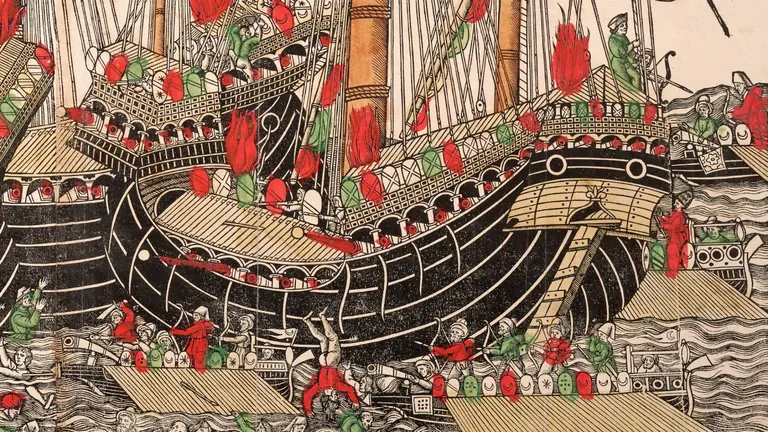
The Battle of Zonchio
The only known impression of this 1499 sea battle Venice lost to the Ottomans, stencil-coloured in red, green and yellow, with the Ottoman admiral labelled 'CHMALI' at the centre.
Dürer's block beside its print
Adam and Eve with the Serpent hangs next to the actual 1510 woodblock it was printed from, so you can compare the cut wood with its mirror image on paper.
De' Barbari's Bird's Eye View of Venice
Six joined sheets from 1500 show the city from above, with the Rialto Bridge still made of wood.
Titian's Saint Jerome
A twisting saint in grey-brown and black that Ugo da Carpi may have used as evidence when he claimed to have invented chiaroscuro woodcut, actually a German invention.
Mice and dogs besieging the cats' castle
Cats defend their stronghold against mice who have teamed up with dogs, in the earliest known Italian print of the subject.
Good for
- Cheap Culture
- Locals Who've Seen It All
- Nerding Out
Skip if
You want paintings: everything here is a print on paper or a woodblock.
Also at British Museum
On now nearby

Nearby
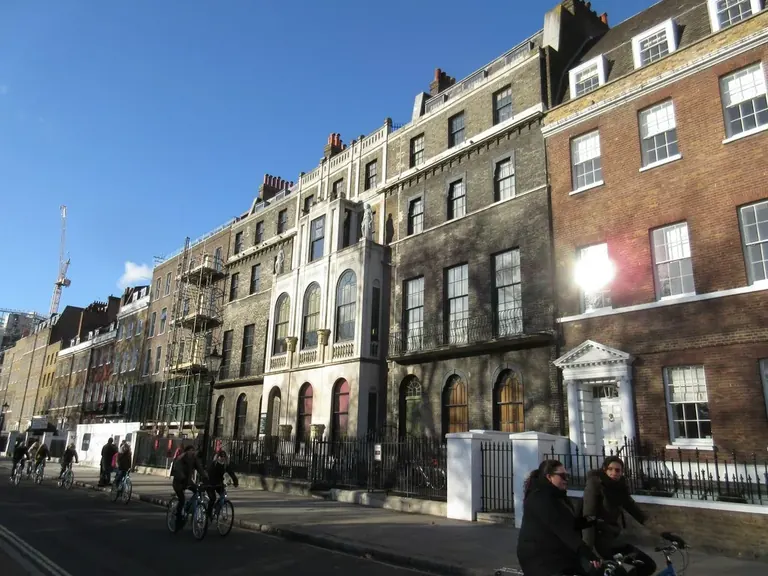
Image credits
9
- Multiplied wonders: Italian Renaissance woodcutsCourtesy of British Museum
- Michael Landy: Future Ruins© Michael Landy. Courtesy the artist and Thomas Dane Gallery. Photo: Prudence Cuming Fine Art Photography.
- The Coming of AgePhoto: Steven Pocock. Source: Wellcome Collection
- Rudy Loewe: Intimacies of Care – Spaces of Grief and PossibilityCourtesy of Wellcome Collection
- British MuseumHam / Wikimedia Commons, CC BY-SA 4.0
- Sir John Soane's MuseumSarah Smith / Wikimedia Commons, CC BY-SA 3.0
- Wellcome CollectionOsama Shukir Muhammed Amin FRCP(Glasg) / Wikimedia Commons, CC BY-SA 4.0
- London Transport MuseumColin Park / Wikimedia Commons, CC BY 2.0
- The Photographers' GalleryThe wub / Wikimedia Commons, CC BY-SA 4.0