 i
British MuseumBloomsbury
Declaring Independence: USA 250
Marking 250 years since the Declaration of Independence, this Room 3 display uncovers the Indigenous and global histories behind the founding of the United States through treaties, diplomatic gifts and resistance.
Guided tours of British Museum
More in London
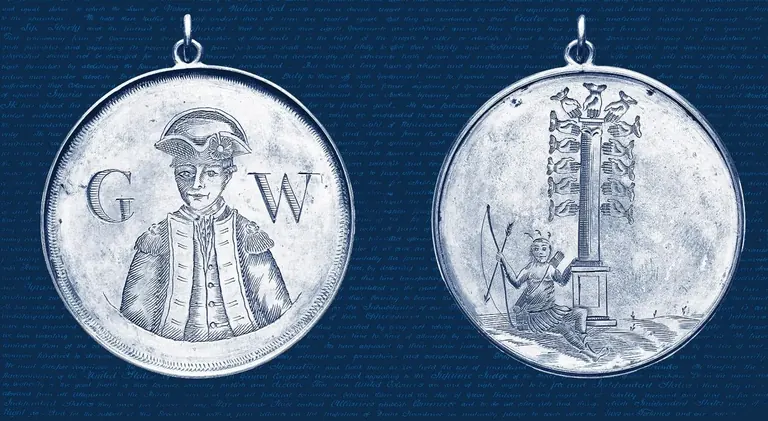
Just inside the main entrance, a silver medal turns slowly in its case so you can see both faces: George Washington in uniform on one, thirteen linked hands circling a column on the other. Paul Revere engraved it in Boston in 1777 as a gift to the Wabanaki Confederacy for a treaty of alliance. British forces then took it under threat of force and gave it to George III as a war trophy.
Having passed through all three sides of the war, the medal anchors a one-room display about alliances made with objects. Beside it are a 1712 Lenape wampum belt and a pipe tomahawk given to the Mohawk leader Joseph Brant. The museum said the Sussex Declaration, a handwritten parchment copy lent by West Sussex Record Office, would join from the middle of the run.
It's free, in Room 3, and small enough to see on the way to a ticketed show.
Look for
The Washington Peace Medal
It rotates in its case: Washington as Continental Army commander on one side, thirteen linked hands around a classical column on the reverse.
The Lenape wampum belt
A belt from 1712 that recorded diplomacy between the Lenape (Delaware) and the Haudenosaunee Confederacy, decades before the Revolution.
Joseph Brant's pipe tomahawk
Look for the inscription: "Given to my friend Joseph Brant from the Duke of Northumberland 1805", a gift marking Mohawk alliance with Britain.
Good for
- An Hour Or Less
- Cheap Culture
- Rainy Days
Skip if
You want a full exhibition: this is a handful of objects in one room by the entrance.
Also at British Museum
On now nearby

Nearby
Image credits
9
- Declaring Independence: USA 250Courtesy of British Museum
- Michael Landy: Future Ruins© Michael Landy. Courtesy the artist and Thomas Dane Gallery. Photo: Prudence Cuming Fine Art Photography.
- The Coming of AgePhoto: Steven Pocock. Source: Wellcome Collection
- Rudy Loewe: Intimacies of Care – Spaces of Grief and PossibilityCourtesy of Wellcome Collection
- British MuseumHam / Wikimedia Commons, CC BY-SA 4.0
- Sir John Soane's MuseumSarah Smith / Wikimedia Commons, CC BY-SA 3.0
- Wellcome CollectionOsama Shukir Muhammed Amin FRCP(Glasg) / Wikimedia Commons, CC BY-SA 4.0
- London Transport MuseumColin Park / Wikimedia Commons, CC BY 2.0
- The Photographers' GalleryThe wub / Wikimedia Commons, CC BY-SA 4.0