 i
National Museum of Mexican ArtPilsen
¡Tinta Ardiente!: Igniting Community Through Collective Action
Prints, objects and archive from Chicago's Latinx printmaking collective Instituto Gráfico de Chicago, shown with Mexican and Chicago print history from the museum's collection.
More in Chicago
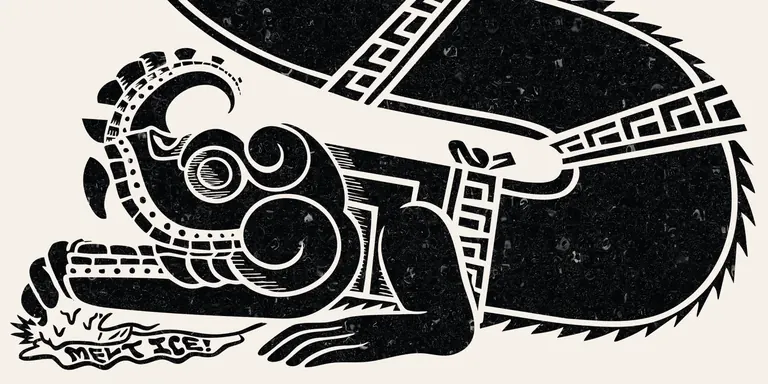
Milenio picked out one of the show's most forceful works: a black-and-white linocut on Kitakata paper that Ricardo Xavier Serment cut with fellow collective members. It shows Xiuhcóatl, the Mexica fire serpent, its body packed with faces, migrant mothers and protest scenes. The fire has a target, Serment said: "We have to melt the ICE."
The Instituto Gráfico de Chicago is a volunteer collective that has published eight print portfolios since 2010 and runs Grabadolandia, the Midwest's only free Latinx-led printmaking festival. In the Xicágo Gallery, about 40 loaned prints and 14 from the museum's collection, by 52 artists, sit beside objects, event documentation and older prints by José Guadalupe Posada and Pablo O'Higgins. You don't need art training to read Serment's prints, and that's deliberate: he says his images have become more direct so anyone can recognise them.
This is printmaking as organising, and the works on separated families and deportations say so plainly. Entry is free, Tuesday to Sunday 10am to 5pm.
Editor's pick
Xiuhcóatl de Resistencia, a linocut cut by collective members, packs the Mexica fire serpent with migrant mothers and protest scenes. More than 50 prints sit beside older ones by José Guadalupe Posada. Printmaking as organising, and free.
Look for
Xiuhcóatl de Resistencia
Look for the black-and-white linocut of the Mexica fire serpent, its coiling body filled with geometric patterns, faces, migrant mothers and scenes of protests against deportation.
Good for
- Cheap Culture
- Locals Who've Seen It All
- Nerding Out
Skip if
You want a neutral survey of print technique: these works openly confront immigration enforcement.
Also at National Museum of Mexican Art
On now nearby
Image credits
5
- ¡Tinta Ardiente!: Igniting Community Through Collective Action(Detail) Instituto Gráfico de Chicago, Xiuhcóatl de Resistencia, 2026. Courtesy of the artists.
- Self, Made: Fourteen Modern Artists from the Richard and Ellen Sandor Family CollectionCourtesy of Richard and Ellen Sandor.
- A Tale of Today Presents Brendan Fernandes: In the RoundCourtesy of Richard H. Driehaus Museum
- Saint-Porchaire Ceramics: Rediscovered Treasures of the French RenaissancePrivate collection. Paul-David Young/Spektra Imaging LLC.
- National Museum of Mexican ArtSkvader / Wikimedia Commons, CC BY-SA 4.0