 i
Museum für FotografieCharlottenburg
Intermezzo: Revisiting Helmut Newton
An immersive four-screen film on Helmut Newton with unseen footage and interviews, plus a wall of nearly 100 exhibition posters, before a new permanent display in 2027.
More in Berlin
On the ground floor, eight projectors throw one film across four screens, and it never stops. The loop cuts between Carla Sozzani, Jenny Capitain, Violetta Sanchez and others talking about Newton, with home recordings by June Newton that the foundation only recently digitised. You join it wherever it happens to be.
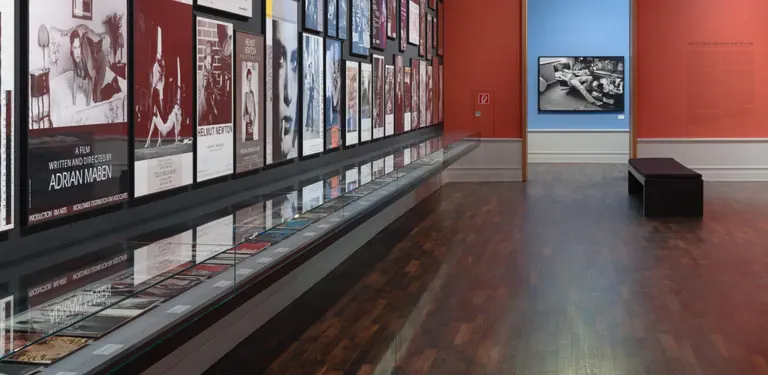
The foundation calls this a deliberately temporary in-between state, while the permanent display that ran for 20-odd years is rebuilt for 2027. A "temporary intermediate state" running 20 months is, by Berlin standards, practically a pop-up. In the rear gallery, nearly 100 posters from Newton's and Alice Springs' exhibitions fill a wall above a 16-metre case of Vogue, Elle, Stern and Paris Match from the late 1950s to the early 2000s. Opposite, a new series takes one photograph apart with its contact sheets and Polaroids.
Come for how the pictures were made rather than a greatest-hits hang. Entry is €12 (€6 concessions), and the museum closes from 16 November to 2 December 2026 for refurbishment.
Look for
The four-screen film
Look for June Newton's own home recordings, newly digitised, cut in between interviews with Philippe Garner, Carla Sozzani and the models Jenny Capitain and Violetta Sanchez.
Rue Aubriot, Paris 1975
The first Spotlight: Behind the Frame takes Newton's Yves Saint Laurent picture for French Vogue apart, laying out its contact sheets, Polaroids, notes and the published pages.
Alice Springs' Gitanes advertisement, 1970
June Newton's cigarette ad, shown with the shoot's contact prints and the places it was published.
The poster wall
Nearly 100 posters from Newton's exhibitions, now joined by several from Alice Springs' solo shows, covering one wall of the rear gallery.
The 16-metre magazine case
Under the posters, issues of Vogue, Egoïste, The New Yorker, Stern and Jardin des Modes show the couple's editorial work from the late 1950s to the early 2000s.
Good for
- Nerding Out
- Out-Of-Town Guests
Skip if
You want a Newton retrospective: the foundation calls this a temporary in-between state of film, posters and magazines.
Also at Museum für Fotografie
On now nearby
Nearby
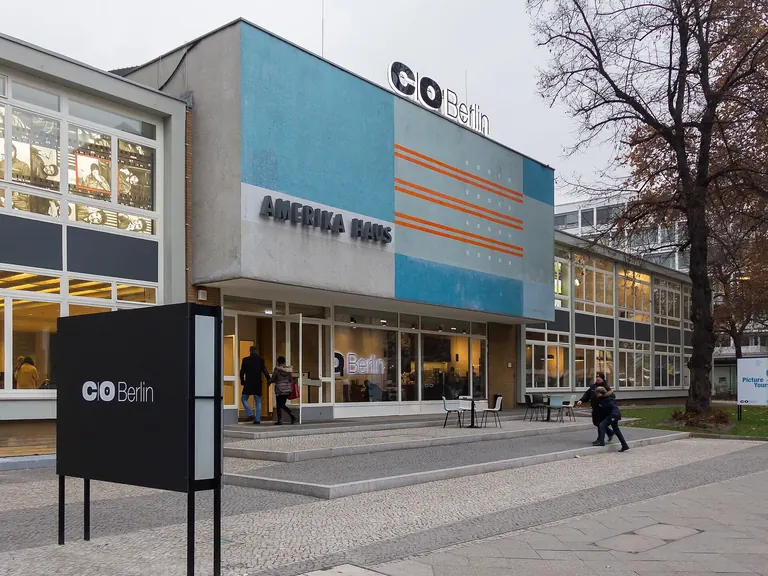
Image credits
6
- Intermezzo: Revisiting Helmut Newton© Newton Foundation / Photo: Gerhard Kassner
- Stelios Kallinikou: Cliffs Among Dreams© Stelios Kallinikou
- Susanne Kriemann: In the Sun's Fever Flutter Butterflies in the Stomach© VG Bild-Kunst, Bonn, 2026
- Carrie Mae Weems: The Heart of the Matter© Carrie Mae Weems. Courtesy the artist and Gladstone, New York, Fraenkel Gallery, San Francisco, and Galerie Barbara Thumm, Berlin
- Museum für FotografieA.Savin / Wikimedia Commons
- C/O BerlinRaimond Spekking / Wikimedia Commons, CC BY-SA 4.0