 i
C/O BerlinCharlottenburg
Susanne Kriemann: In the Sun's Fever Flutter Butterflies in the Stomach
After Nature Prize 26: Berlin artist Susanne Kriemann traces the atomic age's remnants at former uranium mines, using autoradiography in her Pechblende (Fever) series.
More in Berlin
When the floor of Susanne Kriemann's new Berlin studio came up, the room filled with slag. Her Geiger counter found nothing, but the slag smelled of horse, with horseshoes and buckles in it. That slag is now pigment for screen prints on paper made from the floorboards' shavings, and the old spruce boards are part of the set.
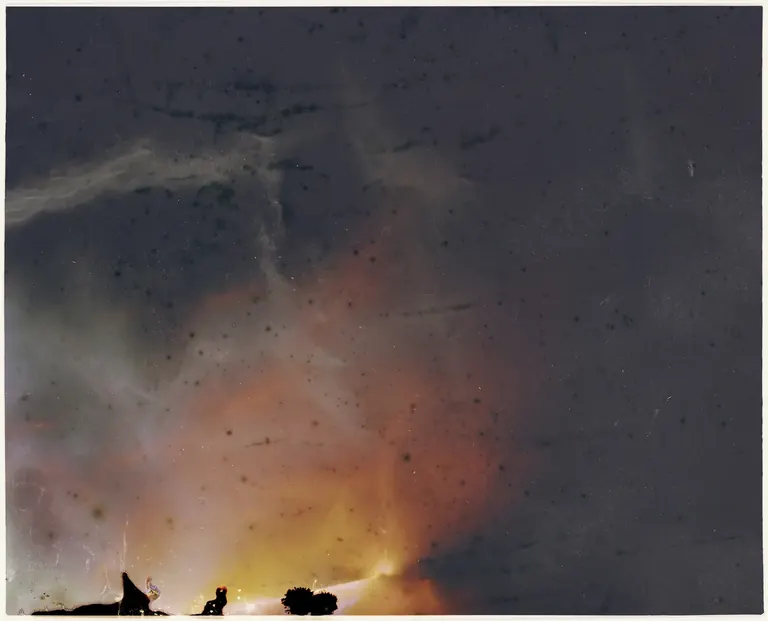
The core is Pechblende (Fever), made without a camera: uranium ore laid on dried plants from remediated Saxon and Thuringian mining heaps on sheet film for at least 14 days. You walk into rooms hung with a few large, dark, veined prints, and Kriemann says at first you won't know what you're looking at. Film photographers who beg for a hand check at BER are guarding against exactly this; she invites it.
Come for slow looking, not mushroom clouds. Tickets are €15, free up to 18, and free for all on Monday 2 November. German after-work tours with a drink run 7 to 9pm on 22 October, 19 November and 17 December.
Look for
Pechblende (Fever)
Look for the veined images on greatly enlarged sheet film, made by laying uranium ore over dried plants from former uranium mining sites, with no camera or light.
The studio floorboards
Old spruce boards lifted from Kriemann's Berlin studio, laid into the set as a site-specific scenography that answers the Amerika Haus.
The slag prints
Screen prints whose pigment is slag dug from under those floorboards, printed on paper Kriemann made from the wood shavings.
The buried film
Unexposed sheet film that Kriemann buried in a reclaimed uranium mine waste heap near Dresden, marked by the radiation still in the ground.
Good for
- Evening Visits
- Going Solo
- Locals Who've Seen It All
- Nerding Out
Skip if
You want the atomic age as spectacle: these radiation pictures are quiet, abstract and camera-free.
With kids
Entry is free for visitors up to and including 18.
Also at C/O Berlin
On now nearby
Nearby
Image credits
6
- Susanne Kriemann: In the Sun's Fever Flutter Butterflies in the Stomach© VG Bild-Kunst, Bonn, 2026
- Rooms / Stages© Jana Sophia Nolle / © VG Bild-Kunst Bonn 2026
- Helmut Newton's One-off Album© Helmut Newton Foundation
- Intermezzo: Revisiting Helmut Newton© Newton Foundation / Photo: Gerhard Kassner
- C/O BerlinRaimond Spekking / Wikimedia Commons, CC BY-SA 4.0
- Museum für FotografieA.Savin / Wikimedia Commons