 i
Aga Khan MuseumDon Mills, North York
Spotlight: Spanish Holbein Carpet
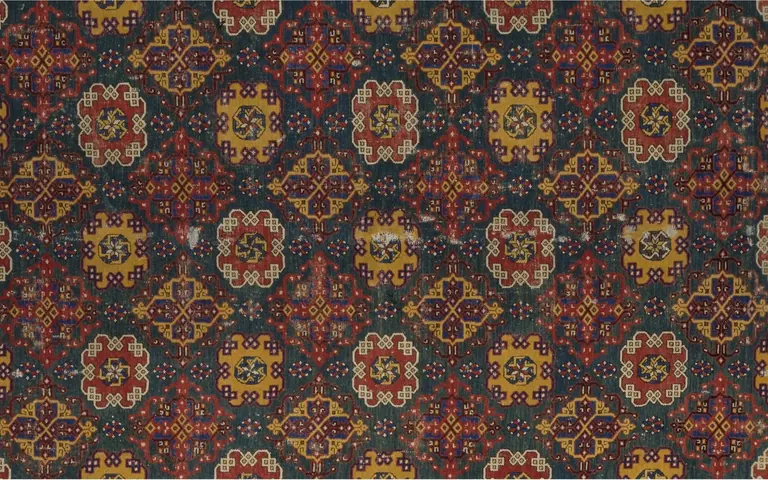
A 15th-century carpet from Alcaraz, Spain, on loan from MFA Boston, where Muslim weavers blended Turkish designs with Iberian techniques.
More in Toronto
Look at the red border closely. Its white, green, black, blue and yellow shapes imitate Kufic, the angular Arabic script, and they frame a dark green field of octagons and diamonds in yellow, red, blue and violet. The carpet is 4.6 metres long, knotted in 15th-century Spain at about 20 knots to the square centimetre.
The weavers were Mudejars, Muslims working for Christian patrons in southeast Spain, probably at Alcaraz. They took the design from the Turkish carpets that Hans Holbein the Younger painted, hence the name, but tied it with the single-warp knot then peculiar to Spain. You find it in the Museum Collections Gallery, on loan from the Museum of Fine Arts, Boston, which bought it in 1939. It was conserved in 2025, and this is its first showing since.
It is one carpet, so make it a stop on a collection visit. Entry is included with Museum admission, which is free for everyone on Wednesdays from 4 to 8pm.
Look for
The imitation-Kufic border
Look for the main border: on a red ground, white, green, black, blue, yellow and red shapes copy angular Arabic script without spelling anything out.
The small-pattern field
The dark green centre is filled with octagons and diamonds in bright yellow, red, blue, black, green, violet and white, the repeat Holbein painted.
The guard borders
Either side of the main border run narrower bands of medallions, interlaces and geometric forms.
Good for
- An Hour Or Less
- Cheap Culture
- Evening Visits
- Nerding Out
Skip if
You want a full exhibition: this is a single carpet.
Also at Aga Khan Museum
On now nearby

Image credits
5
- Spotlight: Spanish Holbein CarpetPhotograph © 2026 Museum of Fine Arts, Boston
- body — mind — distanceCourtesy of Gallery 44 Centre for Contemporary Photography
- From the Laurentian Highlands to a Higher PlaceCourtesy of Gallery 44 Centre for Contemporary Photography
- Static and NoiseCourtesy of Gallery 44 Centre for Contemporary Photography
- Aga Khan MuseumJohnOyston / Wikimedia Commons, CC BY-SA 4.0