 i
Tokyo Opera City Art GalleryNishi-Shinjuku
Seeds and Roots: How to Cultivate a City
Group show of contemporary Japanese artists exploring the ecosystems that adapt to city life, from roadside weeds to organisms coexisting with concrete.
More in Tokyo
Tokyo Opera City had announced a Dan Graham show for these dates, then cancelled it "due to unforeseen circumstances". In its place comes a group show about the nature that survives in a city: roadside weeds, plants in vacant lots, organisms getting by on concrete and plastic.
Daihara Yoko tufts wool the way carpets are made, and Suzuki Hatsune works with Jerusalem artichoke stems and lime from burnt seashells. You won't find a room per artist: the gallery is laid out as one landscape, which the museum compares to a community garden. You can sit on architect Itasaka Rui's stacked brown blocks, where a bell, insect sounds or a work song plays every 30 minutes. Weeds from vacant lots, shown inside a 54-storey office tower.
It isn't all pretty plants: the curator points to predation, war and land lost after Fukushima. Tickets are ¥1,800 (students ¥1,100, junior high age and under free) and cover both concurrent shows. Last entry 18:30; closed Mondays (open 23 November) and 24 November.
Look for
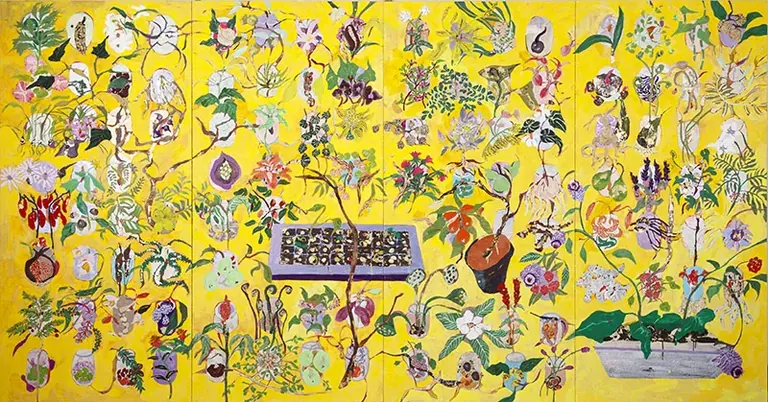
Asano Yuriko's Twisting Garden
Look for a painting more than three metres wide, in oil and mineral pigments on Japanese paper, made after a year of growing seeds she gathered on her travels.
Itasaka Rui's plaza of brown blocks
Blocks stacked from styrofoam reused from an earlier show make a square where you can sit, and a sound piece rings out every 30 minutes.
Daihara Yoko's six months of onion skins
Six knitted pieces titled by month, September 2025 to February 2026, in yarn dyed with onion skins from her own meals.
Saijo Akane's The Jar People
Large water-filled ceramic forms that recall organs; on 7 November at 16:00 five performers move them and use the water for Yasura Takeshi's mint plants.
Yasura Takeshi's distilled #restriction
Mint bred for menthol and objects laid on glass over blocks of Hokkaido soil, in a space with restricted entry that recalls Fukushima's no-return zone.
Good for
- Locals Who've Seen It All
- Rainy Days
With kids
Entry is free for junior high school age and under, so a family pays only for adults and students.
Also at Tokyo Opera City Art Gallery
On now nearby

Image credits
5
- Seeds and Roots: How to Cultivate a CityCourtesy of Tokyo Opera City Art Gallery
- The Beauty of Coolness: Edo-Tokyo Museum Glass Craft CollectionCourtesy of Edo-Tokyo Museum
- Suikoden: The Water Margin, Outlaws of the MarshCourtesy of Tokyo Station Gallery
- Masterpieces from the Itsuo Art Museum Collection: Buson, Go Shun, and the Art of TeaCourtesy of Suntory Museum of Art
- Tokyo Opera City Art GalleryKakidai / Wikimedia Commons, CC BY-SA 3.0