 i
National Hangeul MuseumYongsan-gu
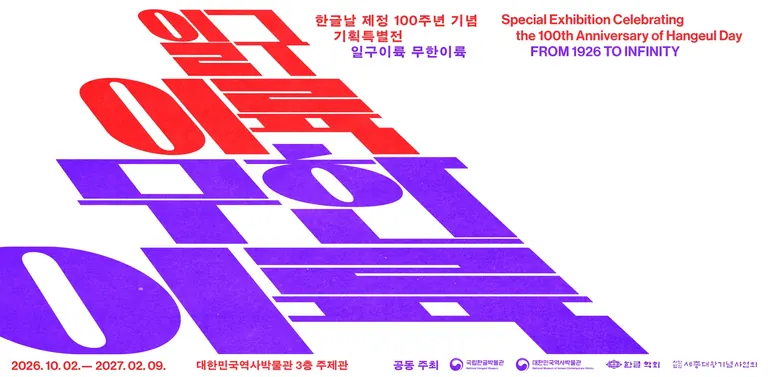
FROM 1926 TO INFINITY
Special exhibition marking Hangeul Day's 100th anniversary and the 580th anniversary of the Hunminjeongeum's promulgation, held off-site at the National Museum of Korean Contemporary History.
More in Seoul
The first Hangeul Day, in 1926, was called Gaggya Day, after 가갸거겨, the chant Koreans used to learn the alphabet's syllables in order. The show starts there, with newspapers, magazines and documents from that first commemoration, and follows how the name and the date, 9 October, were settled.
The National Hangeul Museum is closed after a fire, so the show is hosted by the National Museum of Korean Contemporary History, in its third-floor thematic hall. Among the exhibits are a Hunmong Jahoe syllabary, 19th-century sound charts, 1930s phonograph records of the Gaggya Dwipuri recitation and manuscripts of the Great Korean Dictionary. The last section is interactive, including an AI letter-writing station where you write in Hangeul and get a reply. If your last long message in Hangeul was a KakaoTalk "ㅇㅇ", this is your push.
Admission is free, and the show runs from 2 October 2026 to 9 February 2027.
Editor's pick
A birthday show for the Korean alphabet: 100 years of Hangeul Day and 580 since the Hunminjeongeum was promulgated. Held off-site, at the National Museum of Korean Contemporary History.
Look for
The Hunmong Jahoe syllabary
A printed learning chart from the era when children learned letters through the 가갸거겨 order.
Phonograph records of Gaggya Dwipuri
1930s recordings of the recitation that gave the first Hangeul Day its name.
The Great Korean Dictionary manuscript
Handwritten dictionary manuscripts from the colonial period, shown among the show's resistance-era material.
The AI letter station
You write a message in Hangeul and receive an AI-generated reply in the final section.
Good for
- Cheap Culture
- Nerding Out
- Out-Of-Town Guests
On now nearby
Nearby
Image credits
2
- FROM 1926 TO INFINITYCourtesy of National Hangeul Museum
- National Museum of KoreaJinah78 / Wikimedia Commons, CC BY-SA 3.0