 i
Horim Museum (Sinsa)Sinsa-dong, Gangnam-gu
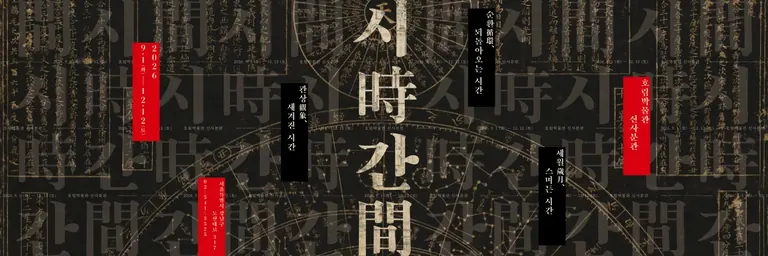
Si-gan: Time (時間)
A special exhibition on traditional East Asian concepts of time, examining cyclical time, astronomical observation and the rhythms of daily life through the museum's collection, across three galleries.
More in Seoul
The show ends on a wall of analogue clocks, each running at its own speed. Lee Wan interviewed people in different jobs around the world and set each clock to how long one of them takes to make a meal.
You start on the fourth floor and work down. First comes time as a cycle, in Yi In-seo's twelve-panel screen of a turtle, the zodiac animals and the seasons. Then the sky: an armillary sphere, a bowl-shaped sundial, and Joseon star charts that grow from the northern sky alone to both hemispheres. Last is the calendar, with a manual for picking good days to marry, sew new clothes or set out on a trip. The habit survived: Seoul movers still charge extra on son-eomneun nal, the lucky moving days.
It suits people who like reading old diagrams, and Dong-A Ilbo singled out how the star charts change. Adults pay 10,000 won, entry is free on the last Thursday of the month, and last admission is 17:00.
Look for
Lee Wan's wall of clocks
Look for the analogue clocks running at different speeds, each one timed to how long an interviewee somewhere in the world takes to prepare a meal.
Yi In-seo's twelve-panel screen
An early 20th-century screen showing a turtle with dots set into its shell, the twelve zodiac animals and the turning seasons as a picture of how the universe runs.
The armillary sphere and the bowl sundial
A ring model of the heavens beside an angbu ilgu, a concave, bowl-shaped sundial used to read the hour from the sun.
Two Joseon star charts
The early Cheonsang Yeolcha Bunyajido maps only the northern sky; the late Joseon Honcheon Jeondo adds the southern hemisphere and explains eclipses.
The ten-panel star screen
A late Joseon folding screen pairing a world map with star charts marked with the 24 solar terms.
Good for
- Cheap Culture
- Locals Who've Seen It All
- Nerding Out
On now nearby
Nearby
Image credits
2
- Si-gan: Time (時間)Courtesy of Horim Museum (Sinsa)
- Dali · Differently · DaliCourtesy of Hangaram Art Museum