 i
Berkeley Art Museum and Pacific Film Archive (BAMPFA)Downtown Berkeley, next to the UC Berkeley campus
Teaching Gallery / Artists on Colonization, Nuclear Legacies, and Climate Crisis
Collection works on the legacies of nuclear testing and colonization and their links to the climate crisis, part of the campus-wide Kõmij Mour Ijin series.
More in San Francisco
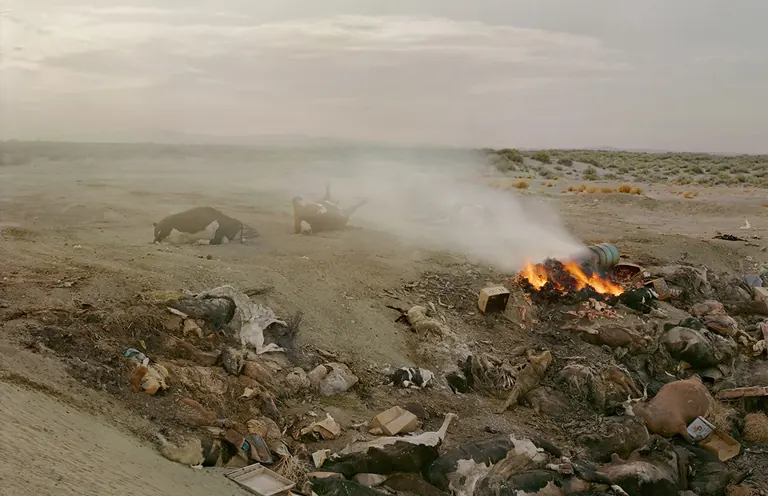
You face a photograph five feet tall: dead cattle lie in a desert pit, some on their backs with legs in the air, while a heap of rubbish burns and smoke drifts over the scrub. It's Richard Misrach's Dead Animals #93, from 1987.
The Teaching Gallery rotates collection works to go with UC Berkeley courses, this fall in art practice, history, rhetoric and performance studies. This hang starts with prints from aging slides of US Army and Navy building on Kwajalein Island in the mid-1960s. Misrach and Mark Ruwedel follow on places left deadly by radioactivity, then Enrique Chagoya, Alma Lavenson and Patrick Nagatani on Indigenous communities displaced by colonization, and it ends on Isabella Kirkland's rainforest.
It's one strand of Kõmij Mour Ijin / Our Life Is Here, a campus-wide project on the Marshall Islands, where the US ran more than sixty nuclear tests between 1946 and 1958. Entry is with the $18 gallery admission, free on first Thursdays and for under-14s, until January 24, 2027.
Look for
Dead Animals #93, from Desert Canto VI: The Pit
Misrach's five-by-six-foot colour photograph: dead cattle sprawled across a desert pit, legs up, beside a burning heap of rubbish and a drift of smoke.
The Kwajalein slides
The show opens on prints from aging slides recording US Army and Navy construction on Kwajalein Island in the mid-1960s, land and water turned to military use.
River for Sale
In David Shrigley's 1999 photograph, a hand-painted blue sign on a stick, reading RIVER FOR SALE, stands in the middle of a shallow, rushing stream.
Delta Connections
Robert Hartman's ilfochrome is all curving bands of pinkish earth, ridged with fine lines and threaded with pools of near-black water.
Good for
- Locals Who've Seen It All
- Nerding Out
Also at Berkeley Art Museum and Pacific Film Archive (BAMPFA)
On now nearby
Nearby
Image credits
5
- Teaching Gallery / Artists on Colonization, Nuclear Legacies, and Climate CrisisCourtesy BAMPFA
- Rex RayCourtesy of Minnesota Street Project
- 20 Years - Anniversary ExhibitionCourtesy of Minnesota Street Project
- Isadora Gullov-Singh: Traces We HoldCourtesy of Minnesota Street Project
- Berkeley Art Museum and Pacific Film Archive (BAMPFA)Cullen328 / Wikimedia Commons, CC BY-SA 3.0