 i
DOX Centre for Contemporary ArtHolešovice
Argus & Medusa: On Hope in Dark Times
Contemporary artists respond to Géricault's "The Raft of the Medusa," exploring hope and solidarity amid war, displacement and ecological crisis.
More in Prague
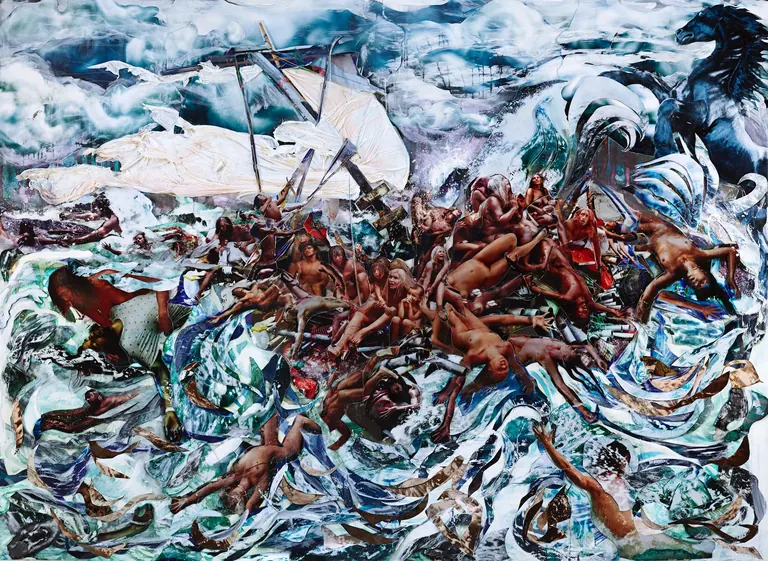
The first room holds a raft nearly five metres high and seven wide. It's a full-size copy of Géricault's The Raft of the Medusa, ordered by the Louvre in 1859 because the original was decaying, and the Musée de Picardie in Amiens has lent it abroad only once before since buying it in 1864. DOX's director Leoš Válka says it's in better shape than the one in Paris.
You stand in front of it hunting for the rescue ship Argus, a dot on the horizon that may be coming or going. In the same room hangs Jakub Špaňhel's abstract version of the raft. The rooms after that hold 25 artists from 13 countries, Banksy, Bill Viola and Paul McCarthy among them, turning the raft into war, migration, the pandemic and climate change.
Válka's pitch is the plain one: the painting people queue for at the Louvre, in Holešovice. One 360 CZK ticket covers every current DOX show, Tuesday to Sunday, 11:00 to 19:00.
Editor's pick
Contemporary artists answer Géricault's Raft of the Medusa with work on war, displacement and ecological crisis, in DOX's Holešovice factory halls.
Look for
The Amiens copy of the Raft
Look for the Argus, the tiny speck on the horizon the survivors are waving at, on a 491 by 717 cm canvas in the first room.
Jakub Špaňhel's abstract raft
In the same first room, the Czech painter answers Géricault with an abstract painting built on the original's colours.
Julian Barnes's Shipwreck, as sound
An excerpt of Barnes's 1989 essay plays as an audio installation, on why Géricault chose the moment the rescue ship was still a dot.
Margaret Atwood's poem Medusa
Atwood wrote it for this exhibition and the FALL festival, and it is shown in Marie Iljašenko's Czech translation.
Good for
- Nerding Out
- Out-Of-Town Guests
- Rainy Days
Skip if
You want something light: the story behind it is murder and cannibalism, and the rooms turn to war and migration.
With kids
Kudy z nudy lists it as suited to adults, and the story behind the painting includes murder and cannibalism. Children 7 to 15 pay 150 CZK, under-7s are free, and a family ticket is 720 CZK.
Also at DOX Centre for Contemporary Art
On now nearby

Nearby
Image credits
5
- Argus & Medusa: On Hope in Dark TimesCourtesy of DOX Centre for Contemporary Art
- Květa Kovářová – For the Shape of the FigureCourtesy of Museum Kampa
- Czech Press Photo 2025Tomáš Binter / Czech Press Photo
- DOX Centre for Contemporary ArtJan Slavík, CC BY-SA 3.0
- National Gallery Prague – Trade Fair PalaceŠJů / Wikimedia Commons, CC BY 4.0