 i
Getty Center · Brentwood
Joshua Reynolds's Portrait of Mai and 18th-Century Portraiture
Portraits by Gainsborough, Goya and David centred on the US debut of Reynolds's Portrait of Mai, the first Polynesian visitor to Great Britain.
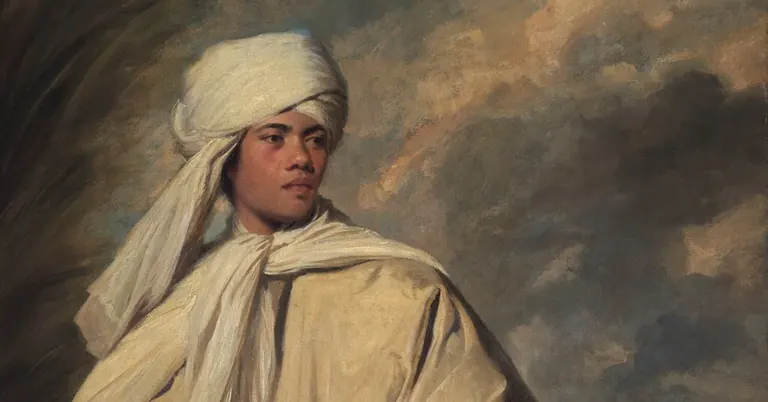
Mai stands barefoot, close to life size, in a tapa barkcloth robe and headdress, his hands tattooed and a tropical landscape behind him. The pose comes from ancient Roman statues. Reynolds painted it around 1776 on his own initiative, not on commission, while Mai, the first Polynesian visitor to Britain, was a London celebrity.
This is its first time in the US, three years after the Getty and London's National Portrait Gallery bought it jointly for about $62 million. It hangs on a red wall in the West Pavilion, alongside the Getty's own Gainsborough, Batoni and Goya portraits and busts by Houdon and Messerschmidt. You see the curator's point at once: the full-length format around him was usually kept for aristocrats.
National Review's critic called the rollout "botched" but the painting "a great acquisition". Entry is free with a timed reservation, released six weeks ahead; parking is paid, and free on Saturdays after 6pm, when the Getty stays open to 9pm. Labels are in English and Spanish.
Look for
Reynolds, Portrait of Mai, about 1776
Look for Mai barefoot in a tapa robe and headdress against a tropical landscape, nearly eight feet of canvas, posed like an ancient Roman statue.
Mai's tattooed hands
Reynolds argued portraits should avoid marks of individual difference, yet he painted Mai's tatau plainly; historian Kate Fullagar calls the tattoos a mystery.
The landscape behind Mai
The tropical background, which Tahitian dancer and researcher Hinatea Colombani was the first to read as Mai's own home.
Francis Harwood, Bust of a Man, 1758
A bare-chested man in polished black stone holds his chin high, a small scar on his face; the Getty calls it one of the earliest sculpted portraits of a Black person in European art.
Good for
- Cheap Culture
- Evening Visits
- Out-Of-Town Guests
Skip if
You want a big loan show: this is one painting among the Getty's own portraits.
Also at Getty Center
On now nearby
Image credits
5
- Joshua Reynolds's Portrait of Mai and 18th-Century PortraitureCourtesy of Getty Center
- Maker-in-Residence featuring Jackie AmezquitaPhoto courtesy of Craft Contemporary, Los Angeles. Exhibition Installation Image: Marc Walker.
- tierraPhoto courtesy of Craft Contemporary, Los Angeles. Exhibition Installation Image: Marc Walker.
- Earthen Comforts: Airing EarthCourtesy of Craft Contemporary
- Getty CenterCarol M. Highsmith / Wikimedia Commons, Public domain