 i
Museum of Fine Arts, BostonFenway
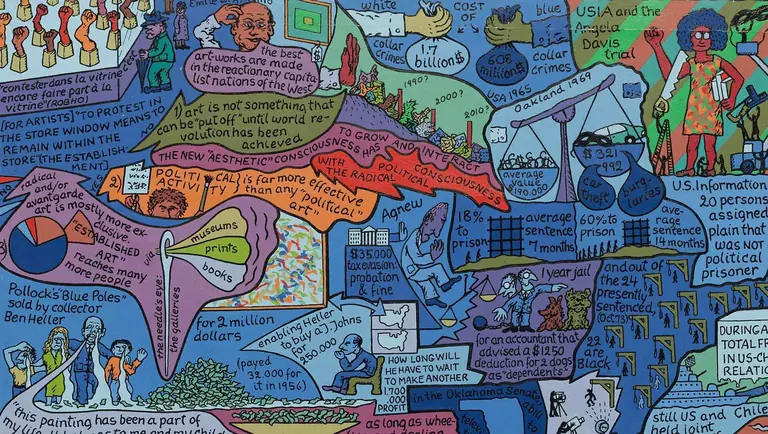
Öyvind Fahlström: Are You Happy?
The Swedish-Brazilian artist's playful, politically barbed work from 1960s–70s America, built on his idea of art as "a fusion of 'pleasure' and 'insight'" and made to be handled by its audience.
More in Boston
A reporter works a New York sidewalk in 1966, asking passersby whether they are happy. Behind him, Öyvind Fahlström and his friends march with placards of the comedian Bob Hope and Mao Zedong. That film, Mao-Hope March, runs four and a half minutes and is the centrepiece here. On Boylston Street today, anyone who stops you to ask if you're happy has a clipboard.
Fahlström (1928–1976) was born in São Paulo to Scandinavian parents, grew up in Stockholm, and worked as a poet, journalist and critic, which shaped the art he made in 1960s and 70s America. The show follows that career through multimedia works, many shaped like games or cartoons, which the MFA calls deceptively playful. He described art as "a fusion of 'pleasure' and 'insight.'"
It fills one room, the Lizbeth and George Krupp Gallery (Gallery 264), and comes with general admission ($30). The museum stays open until 10 pm on Thursdays and Fridays, and the show runs through 21 February 2027.
Look for
Mao-Hope March (1966)
Look for the black-and-white street footage of placards bearing Bob Hope and Mao Zedong, while a reporter asks New Yorkers whether they are happy.
Good for
- An Hour Or Less
- Evening Visits
Also at Museum of Fine Arts, Boston
On now nearby
Nearby
Image credits
8
- Öyvind Fahlström: Are You Happy?Museum of Fine Arts, Boston — © Sharon Avery-Fahlström / Artists Rights Society
- Michal Rovner: Esther ScrollsCourtesy of Isabella Stewart Gardner Museum
- The Book of Esther in the Age of RembrandtIsabella Stewart Gardner Museum
- Michal Rovner: Untitled/Night, 2016Isabella Stewart Gardner Museum
- Museum of Fine Arts, BostonBeyond My Ken / Wikimedia Commons, CC BY-SA 4.0
- Isabella Stewart Gardner MuseumMiguel Hermoso Cuesta / Wikimedia Commons, CC BY-SA 4.0
- MassArt Art Museumajay_suresh, via Wikimedia Commons, CC BY 4.0
- Massachusetts Historical Societyajay_suresh, via Wikimedia Commons, CC BY 4.0