 i
Berlinische GalerieKreuzberg
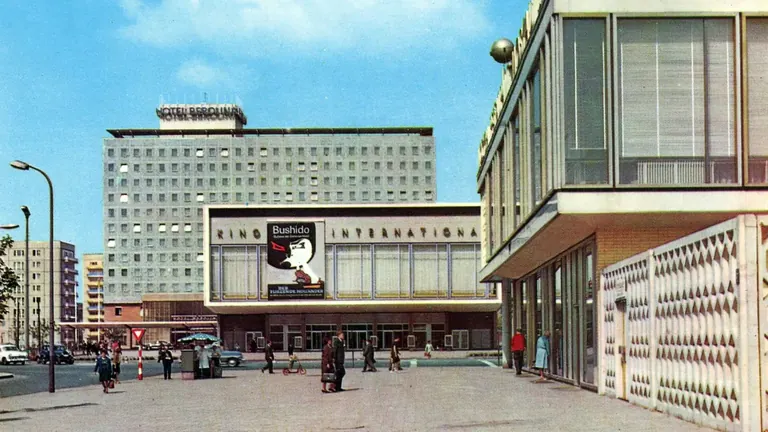
Josef Kaiser. Building for the GDR
Drawings, photographs, films and models on the GDR architect behind Karl-Marx-Allee's Kino International, with new works by three contemporary artists.
More in Berlin
Before you reach the archive, a desk-sized housing hill blinks at you. In Tracey Snelling's Grosshuegelhaus a tiny film plays in every window, and cardboard men with tanned six-packs lounge by the pool. It reimagines Kaiser's late-1960s plan for a terraced block mixing homes, work and shared facilities, which was never built.
Behind it, about 100 drawings, collages, photographs, models and films fill 200 square metres in four sections, most from Kaiser's own estate and some never shown before. They follow a career across three political systems: Nazi-era offices, five years singing operetta, then the GDR's showpieces, from the neo-classical Maxhütte clubhouse to the Kino International.
The taz called it small and very revealing, though its critic felt much of what drove Kaiser stays in the fog. Der Freitag wanted less facade and more on how the buildings were used. Tickets are €14 (€7 reduced, free under 18), with a €7 Happy Wednesday on the first Wednesday of the month. Closed Tuesdays.
Look for
Tracey Snelling's Grosshuegelhaus (2026)
Look for the desk-sized terraced housing hill outside the main room, with a small film flickering in each window and cardboard residents lounging by the pool.
The Kino International's sequin curtain
A piece of the cinema's original sequin curtain, shown with a film clip from its 1963 opening, in the section on Kaiser's best-known Berlin buildings.
The Kosmos cinema drawing
Kaiser's drawing of the Kosmos, with its egg-shaped auditorium, shown alongside a reconstructed model of the 1,001-seat cinema.
Two versions of the Maxhütte clubhouse
Kaiser's first, modern plans, influenced by Mart Stam and Hans Poelzig, sit beside the neo-classical clubhouse the GDR leadership had him build instead.
Sibylle Bergemann's demolition photograph
Bergemann photographed the GDR Foreign Ministry being torn down in 1995/96, and it hangs with rarely seen designs for the building.
Good for
- Locals Who've Seen It All
- Nerding Out
Skip if
You want to know how spaces were lived in: Der Freitag found it heavy on facades, light on use.
With kids
Under-18s get in free.
Also at Berlinische Galerie
On now nearby


Nearby
Image credits
9
- Josef Kaiser. Building for the GDR© Foto Schlegel, digitized by A. E. Witte
- Between the Lines: Daniel Libeskind and the Jewish Museum BerlinCourtesy of Jewish Museum Berlin
- The Opposite of NowCourtesy of Jewish Museum Berlin
- The Holocaust – What Did the Germans Know?© Medienzentrum Hanau Bildarchiv
- Berlinische GalerieChristoph Rehbach / Wikimedia Commons, CC BY-SA 3.0
- Jewish Museum BerlinMarek Śliwecki / Wikimedia Commons, CC BY-SA 4.0
- Topography of TerrorStiftung Topographie des Terrors / Wikimedia Commons, CC BY-SA 3.0 DE
- Gropius BauManfred Brückels / Wikimedia Commons, CC BY-SA 3.0
- Deutsches TechnikmuseumSpyrosdrakopoulos / Wikimedia Commons, CC BY-SA 4.0