Colosseum and Roman Forum · Celio / Monti
Troia and Roma: Myths, Legends and Stories from the Ancient Mediterranean
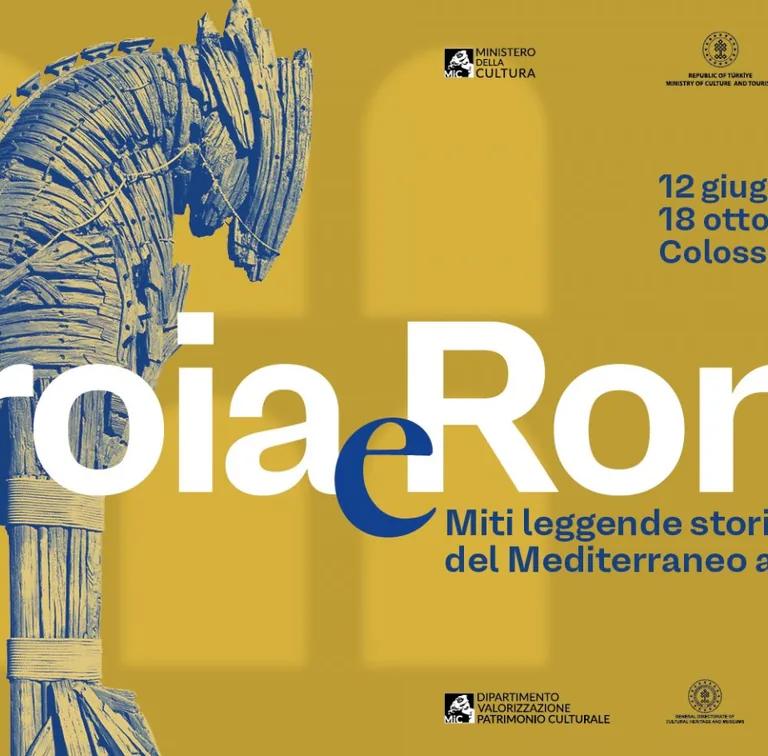
Over 300 artefacts from Italian museums alongside more than 220 works on loan from 19 Turkish museums trace the mythological and historical ties between Troy and Rome. The itinerary, introduced by a monumental replica of the Trojan Horse, connects the heritage of ancient Ilion with the myth of Aeneas and the founding of Rome.
A full-scale replica of the Trojan Horse stands on the Colosseum's first level, and you pass it on the way up to the real objects: more than 300 pieces on the second level, over 220 lent by 19 Turkish museums, many shown in Italy for the first time.
The route starts with Troy's archaeology, Anatolian pottery and gold from the third and second millennia BCE, then tells the war from the Trojan side, follows Aeneas out of the city and ends with Rome's claim to be a city of new Trojans. The Trojans wheeled a giant wooden horse inside because it was a gift. Your cousin's "just two nights" on your sofa in Monti ran on the same logic.
Art a Part of Cult(ure) called it fundamentally successful but found misspelled labels (the Iliad with a double L), undated objects and wall quotes from 18th and 19th-century Italian translations of Homer. It is included in the standard €18 Colosseum ticket and closes on 18 October, at 18:30.
Editor's pick
A monumental Trojan Horse replica leads into over 500 objects, including more than 220 loans from 19 Turkish museums, linking Troy, Aeneas and the founding of Rome. Included with the standard Colosseum ticket.
Look for
The Kleophrades hydria
A red-figure vase showing King Priam killed on an altar, with Cassandra clutching the Palladium, the sack of Troy as an Athenian painter drew it.
Gold earrings from Troy II
Bronze Age jewellery dated to roughly 2400 to 2200 BCE, lent from the Turkish museums, in the opening section on Troy's archaeology.
The Aphrodisias relief of Aeneas
Aeneas flees Troy carrying his father Anchises, an image the Julian-Claudian family used to claim Trojan ancestry.
The Hattusa treaty tablet
A cuneiform tablet recording a treaty between the Hittite king Mutawalli II and Wilusa, the name the show ties to Homer's Ilios.
Good for
- First-Timers
- Nerding Out
- Out-Of-Town Guests
Skip if
You want easy labels: wall texts quote 18th and 19th-century Italian translations of Homer, and some objects are undated.