 i
Musée de Cluny - musée national du Moyen ÂgeQuartier latin
Nicolas Flamel, alchimiste de papier
The real Nicolas Flamel: not the immortal alchemist of legend but a 15th-century Parisian scribe, donor and property investor, traced through his tombstone and archives held at Cluny.
More in Paris
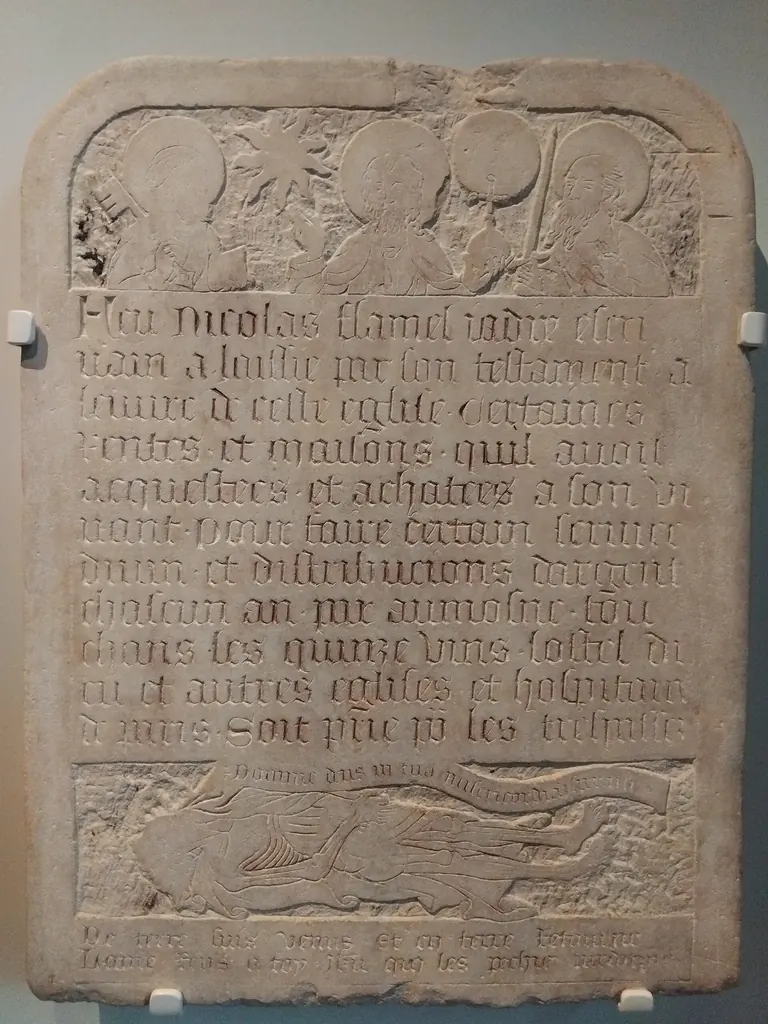
After the church of Saint-Jacques-de-la-Boucherie was pulled down, Nicolas Flamel's tombstone ended up at a fruit seller's, who laid out her spinach on it. The City of Paris bought it in 1839. The show starts at that stone. Its inscription calls Flamel "jadis écrivain", a scribe, and lists the houses and rents he left to churches and hospitals. Not a word about the philosopher's stone.
About fifty books, archives, objects, videos and music follow in three parts: the real man, documented by a will over a metre long; the legend, spread by books falsely signed with his name; and his afterlife, from Victor Hugo to Harry Potter. If that's where you met him, you walk in expecting an immortal alchemist and find a property portfolio.
It fills one room, and Sortir à Paris found the route "very short but effective". Museum entry covers it: €14, €12 reduced, free for under-18s and EU residents under 26. Booking is advised, not required, and the 1st and 3rd Thursdays run to 21:00.
Look for
Flamel's tombstone
Look for the carved line calling him "jadis écrivain", a former scribe, above the list of houses and rents he left to Paris churches and hospitals.
Flamel's will
A document more than a metre long, lent by the Archives nationales, recording his gifts to the blind poor of the Quinze-Vingts hospital.
The Livre Flamel
Lent by the university library in Bologna, it is the first text to tie Flamel's name to alchemy, decades after he died.
The Livre des Figures hiéroglyphiques
Published in 1612 under Flamel's name, nearly two centuries after his death, one of the forged texts that spread the legend.
The closing reading room
The route ends in a space with videos, music and a shelf of books for sitting down with the legend.
Good for
- An Hour Or Less
- Evening Visits
- Locals Who've Seen It All
- Nerding Out
Skip if
You came for the wizard: the show argues Flamel never practised alchemy and leans on archives and old books.
With kids
Under-18s get in free, as do EU residents up to 25, so most families pay only for the adults.
Also at Musée de Cluny - musée national du Moyen Âge
On now nearby


Nearby
Image credits
9
- Nicolas Flamel, alchimiste de papierHypsibius / Wikimedia Commons, CC BY-SA 4.0
- Mungo Thomson: Monument© Mungo Thomson. Courtesy l'artiste, galerie frank elbaz, and Karma.
- Nanténé Traoré — pays des merveillesCourtesy of Maison Européenne de la Photographie (MEP)
- La saison américaine du musée de l'ArméeCourtesy of Musée de l'Armée (Les Invalides)
- Musée de Cluny - musée national du Moyen Âgectj71081 / Wikimedia Commons, CC BY-SA 2.0
- Crypte archéologique de l'île de la CitéBrokenSphere, Wikimedia Commons, CC BY-SA 3.0
- PanthéonMoonik / Wikimedia Commons, CC BY-SA 3.0
- Conciergeriexandru / Wikimedia Commons, CC BY-SA 4.0
- Musée national Eugène-DelacroixMbzt / Wikimedia Commons, CC BY 3.0