 i
Museo AnahuacalliCoyoacán
River Rouge — Yeni Mao
Yeni Mao's bronze and metal sculptures and architectural interventions link Ford's River Rouge plant, which shaped Rivera's Detroit murals, to the Anahuacalli's volcanic stone.
More in Mexico City
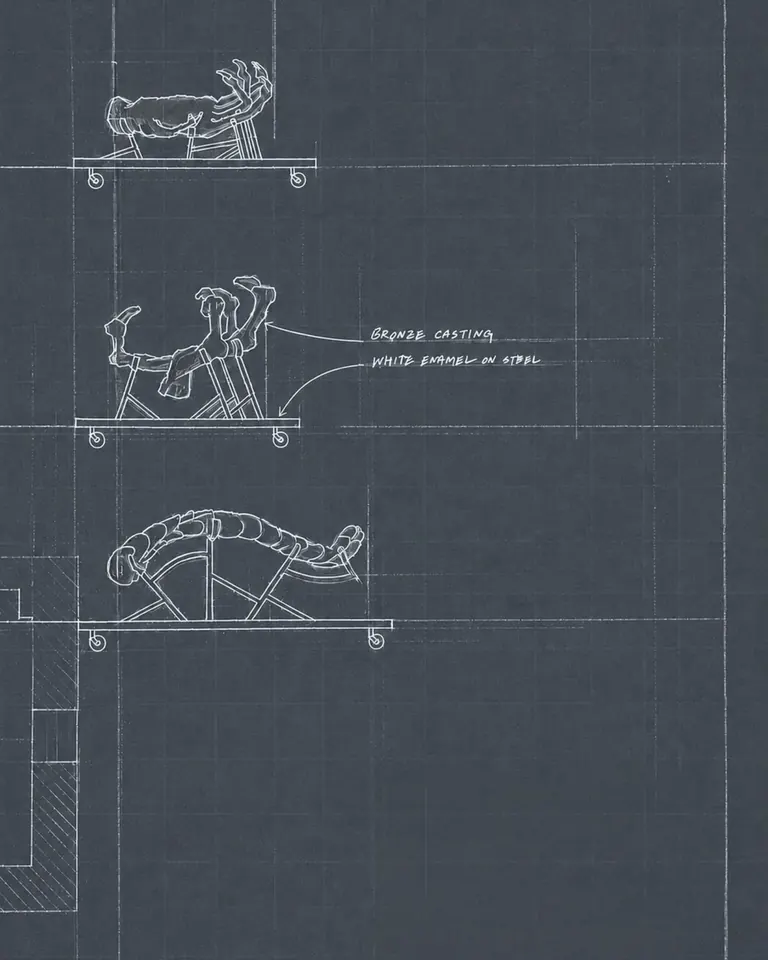
In one room, seven bronzes rest on yellow metal stands: claws, tails, nails and scales, but never a whole creature. Yeni Mao trained in foundry work, and he leaves every support and joint in plain view.
The title is Ford's River Rouge plant, which Diego Rivera studied for his 1930s Detroit murals of workers and machines. Mao grew up with those murals, in a region later hit by recessions and labour disputes, and has brought that memory into the volcanic-stone museum Rivera built for his pre-Hispanic collection. Upstairs, a structure in an everyday building material changes the route you normally take through the building.
The works are spread through the museum rather than kept in one gallery, so you meet the metal among the stone walls and Rivera's collection. That makes it a good reason for a second visit. The general ticket covers it (130 MXN, 100 MXN for Mexican nationals), Tuesday to Sunday, 11:00 to 17:30. Photos inside the galleries need a 30 MXN permit.
Editor's pick
Yeni Mao's bronze and metal sculptures sit among Rivera's volcanic-stone halls, linking Ford's River Rouge plant, the subject of his Detroit murals, to the Anahuacalli itself.
Look for
Seven bronze fragments on yellow steel
Look for claws, tails, nails and scales cast in bronze and held up on yellow metal structures, parts of creatures that never add up to a whole body.
The structure upstairs
On the upper floor, a construction in a common modern building material stands inside the volcanic-stone building and changes the usual route through it.
Good for
- Cheap Culture
- Locals Who've Seen It All
Also at Museo Anahuacalli
On now nearby

Image credits
5
- River Rouge — Yeni MaoCourtesy of Museo Anahuacalli
- Alexandre Estrela. RedSkyFalls: RéplicaCourtesy of Museo Universitario Arte Contemporáneo (MUAC)
- El Códice de AzcatitlanCourtesy of Museo Nacional de Antropología
- Julian Rosefeldt. ManifestoCourtesy of Museo Universitario Arte Contemporáneo (MUAC)
- Museo AnahuacalliAlejandroLinaresGarcia / Wikimedia Commons, CC BY-SA 4.0