 i
The Huntington Library, Art Museum, and Botanical GardensSan Marino
"This Land Is ..." Exhibition
Marking the 250th anniversary of the Declaration of Independence, diverse perspectives on nature, nation, and the ideals of life, liberty, and the pursuit of happiness.
More in Los Angeles
The first thing you meet is a slice of oak. The tree stood on the Huntington's lawn for about 250 years until a 1993 windstorm pulled it up, and its jagged cracks are held together with wooden joints.
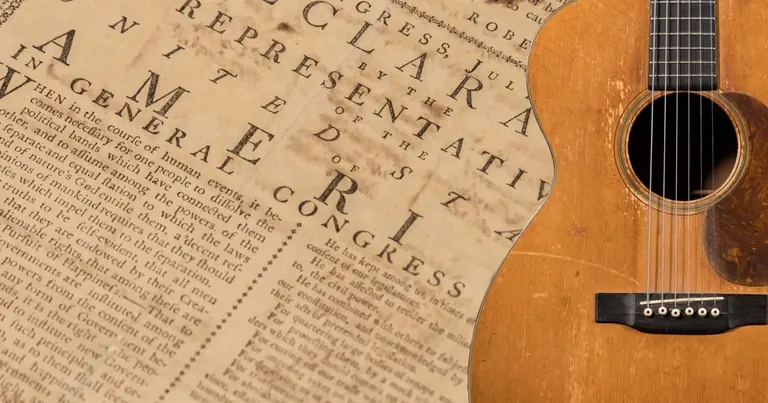
You move through six sections in the MaryLou and George Boone Gallery, named for ecological ideas from Roots to Regenerations. Two annotated July 1776 printings of the Declaration sit near Woody Guthrie's 1936 guitar and his lyrics sheet for "This Land Is Your Land". Around them are hand-drawn estate plans by Washington and Jefferson, manuscripts by Whitman, Langston Hughes and Octavia E. Butler, and photographs of the Kuromi family, taken from their Los Feliz flower farm to an Arizona camp during World War II.
Time Out gave it four stars and called the land lens "insightful and profound". Entry is included with general admission ($29 Monday to Thursday, $34 at weekends), reservations are required Friday to Sunday, the Huntington is closed Tuesdays, and the show closes on 11 January.
Look for
The 250-year-old oak
Look for the cross section near the entrance: the tree grew on the Huntington's lawn until a 1993 windstorm, and wooden joints now hold its jagged cracks together.
Woody Guthrie's guitar
A 1936 Martin with "This Machine Kills Fascists" carved, now faded, into its back, shown beside a Declaration printing annotated by New York's John McKesson in July 1776.
The Kuromi flower farm
A panoramic photograph of the family posing in their flower fields where Los Feliz Boulevard now runs, with a watercolor of the Gila River camp in Arizona where they were held.
Harriet Bailey's etched seeds
Beside O'Sullivan's 1863 Gettysburg photograph A Harvest of Death, a letter to her uncle at the front holds seeds etched with tiny drawings of a ship, faces and a dog.
Dock Marston's Colorado River binders
A slice of the river runner's archive, where photographs sit on cut-out maps of where they were taken, organized mile by mile down the river.
Good for
- Nerding Out
- Out-Of-Town Guests
Skip if
You want a celebration of 1776: the show gives as much room to dispossession, incarceration and war dead.
Also at The Huntington Library, Art Museum, and Botanical Gardens
On now nearby
Image credits
5
- "This Land Is ..." ExhibitionCourtesy of The Huntington Library, Art Museum, and Botanical Gardens
- Sculpted Portraits from Ancient Egypt© The Trustees of the British Museum. All rights reserved
- Charles Ross: Spectrum 14Courtesy of Getty Center
- The Egyptian Book of the DeadCourtesy of Getty Villa
- The Huntington Library, Art Museum, and Botanical GardensAaron Logan / Wikimedia Commons, CC BY 1.0