 i
Fondazione PradaPorta Romana / Largo Isarco
Mona Hatoum: Over, under and in between
Site-specific project in the Cisterna: three installations built on Hatoum's web, map and grid motifs, reflecting on the turmoil of our times and the precariousness of existence.
More in Milan
In the last room, a tower of stacked metal cubes 8.6 metres tall slowly sags and zigzags towards the floor, creaking and clanking, then hauls itself upright and shivers before going still. e-flux's critic watched a small child cry in horror, run out, then rush straight back in, delighted.
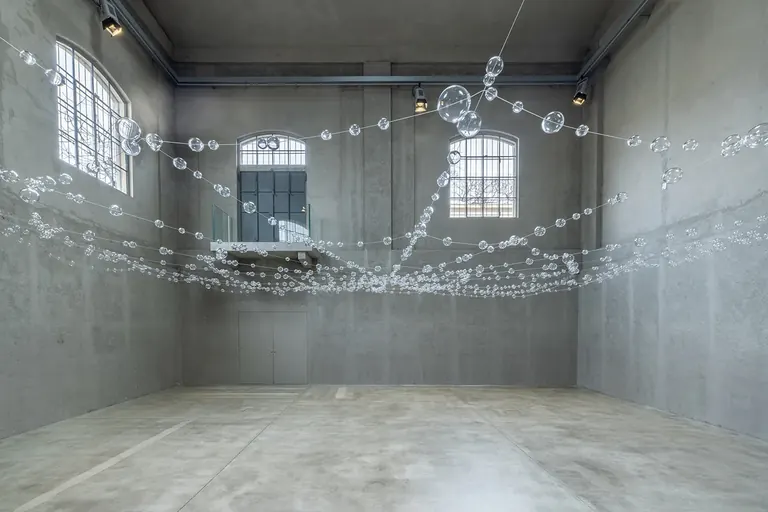
That's all of a quiver, one of three works Hatoum set in the Cisterna, the building that held the old distillery's silos. You walk in under Web, hand-blown glass spheres strung on steel wires overhead. The middle room's floor holds Map (red): over 30,000 loose red glass balls laid out as borderless continents in the Gall-Peters projection, so Africa appears at its true size beside Europe. Nothing is fixed down, and Canvas saw strays spilling past the coastlines.
e-flux called it Hatoum "at her alchemical best". Daylight through the Cisterna's windows throws grid-shaped shadows across the floor. It closes on 9 November.
Editor's pick
Webs, maps and grids, Mona Hatoum's recurring forms, become three site-specific installations in Fondazione Prada's Cisterna. The Beirut-born artist has spent four decades making ordinary structures look precarious, and here she works at the scale of whole rooms.
Look for
Web, overhead in the entrance room
Look up: hand-blown glass spheres threaded on steel wires hang as a huge spider's web, which Hatoum likens to dew drops and a constellation.
Map (red) on the central room's floor
More than 30,000 loose red glass balls form a borderless world map in the Gall-Peters projection, with strays rolling past the edges.
all of a quiver in the tallest room
A nine-level grid of metal cubes sags, sways and creaks towards the floor, then rises and quivers back up to its full 8.6 metres.
Good for
- Dates
- Going Solo
- Out-Of-Town Guests
Skip if
You can't stand loud mechanical noise: the last room's tower creaks and clanks as it collapses.
Free in the same building
Plan a visit to Fondazione PradaAlso at Fondazione Prada
On now nearby
Image credits
5
- Mona Hatoum: Over, under and in betweenPh. Roberto Marossi, Courtesy Fondazione Prada
- Pina Bausch, Le Sacre du printempsCourtesy of Museo Teatrale alla Scala
- Photo Grant Deloitte 2026Courtesy of Triennale Milano
- Piero Portaluppi: l'arte del disegnoCourtesy of Villa Necchi Campiglio
- Fondazione PradaSailko / Wikimedia Commons, CC BY 3.0