 i
Natural History Museum of Los Angeles CountyExposition Park
The Declaration in Progress
A reproduction of a hand-edited draft of the Declaration of Independence, paired with artifacts from 250 years of American civil rights history.
More in Los Angeles
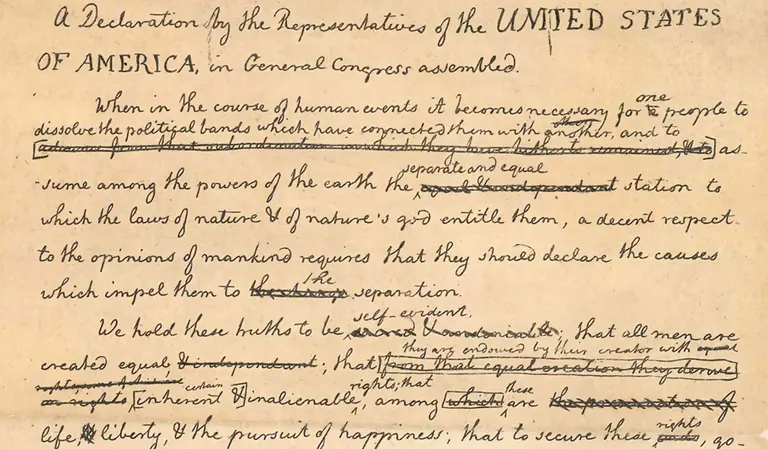
One passage in this draft never made it into the signed Declaration: a section condemning the slave trade. The copy is an 1829 engraving of an early handwritten draft, edits and all, from the museum's Seaver Center for Western History Research.
It's a small installation for the 250th anniversary, and the objects around it follow the people the promise of equality left out. Frederick M. Roberts, the first Black member of the California State Assembly, links the founding era to civil rights. Suffrage posters and postcards mark 1911, when many California women won the vote. A school desk stands for Sylvia Mendez, turned away from an Orange County school. If your main memory of the Declaration is Nicolas Cage stealing it, there's a prop from National Treasure too.
The Declaration itself is a reproduction, so you're here for what L.A. kept of the fights that followed: the posters, postcards and buttons come from the museum's collections. It's free with paid museum admission and for members, through January 11, 2027.
Look for
The 1829 draft engraving
Look for the handwritten edits and the passage condemning the slave trade, which was removed before the Declaration was signed.
The National Treasure Declaration
A prop version of the document made for the film, shown alongside the draft.
The "Los Angeles Equality" poster
A suffrage poster from about 1911, the year many California women won the right to vote.
The school desk
A desk from about 1900 that tells the story of Sylvia Mendez, whose family went to court when an Orange County school refused her.
The political buttons
Twentieth-century buttons from the campaigns for gender equality at work and in public life that continued after women won the vote.
Good for
- Nerding Out
- Rainy Days
Skip if
You want an original 1776 document: the draft here is an 1829 engraved reproduction.
Also at Natural History Museum of Los Angeles County
On now nearby

Nearby
Image credits
7
- The Declaration in ProgressCourtesy of Natural History Museum of Los Angeles County
- GAME ON! Science, Sports & PlayCourtesy of California Science Center
- Sculpted Portraits from Ancient Egypt© The Trustees of the British Museum. All rights reserved
- Charles Ross: Spectrum 14Courtesy of Getty Center
- Natural History Museum of Los Angeles CountyDavid Leigh Ellis / Wikimedia Commons, CC BY-SA 3.0
- California Science CenterPrayitno / Wikimedia Commons, CC BY 2.0
- Lucas Museum of Narrative ArtJeremy Thompson / Wikimedia Commons, CC BY 2.0