 i
Institute of Contemporary Art, Los AngelesArts District
Carl Cheng: Nature Never Loses
Six-decade retrospective of ~50 rarely seen works by LA artist Carl Cheng, exploring environmental change and technology at the intersection of ecology and identity.
More in Los Angeles
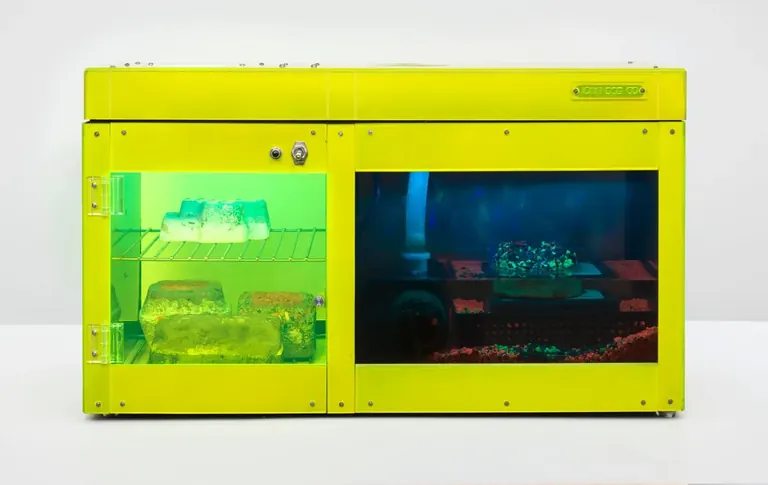
In an acid-yellow cabinet, water pounds a single rock into a new shape while the next stones wait on racks beside it, "like scones cooling after a bake," as one essay on Cheng puts it. That's Erosion Machine No. 4, begun in 1969.
About 50 rarely shown works and archival pieces fill ICA LA's main galleries, under the line Cheng keeps repeating about people and the planet: "nature never loses." You look down at what reads as farmland from a plane window, and it's printed circuit boards riveted to aluminum. Nearby, a translucent tower turns two projectors like a lighthouse while a radio picks up maritime channels. The show toured Austin, Philadelphia, Maastricht and Basel before this homecoming, and ICA LA has added a new commission built around water.
Broad Street Review, covering the Philadelphia stop, called the work prescient. Admission is free, Wednesday to Sunday 11am to 6pm, with free parking on site.
Look for
Erosion Machine No. 4
Look for the acid-yellow appliance: in the right compartment water batters one rock, while the stones waiting their turn sit on metal racks on the left.
Anthropocene Landscape 2
From a step back it's farmland seen from a plane; up close it's a tight grid of printed circuit boards and rivets on aluminum.
Early Warning System
A translucent cube with an antenna, a radio tuned to short-wave maritime channels and two lighthouse-like projectors turning film of human-made waste and the ocean.
Good for
- Cheap Culture
- Nerding Out
- Rainy Days
Also at Institute of Contemporary Art, Los Angeles
On now nearby
Image credits
5
- Carl Cheng: Nature Never LosesCourtesy the artist and Philip Martin Gallery, Los Angeles Photo: Jeff McLane, Los Angeles, California
- Sculpted Portraits from Ancient Egypt© The Trustees of the British Museum. All rights reserved
- Charles Ross: Spectrum 14Courtesy of Getty Center
- Stories from the Library: The Mirror of the MoonCourtesy of The Huntington Library, Art Museum, and Botanical Gardens
- Institute of Contemporary Art, Los AngelesDocFreeman24 / Wikimedia Commons, CC BY-SA 4.0