 i
John F. Kennedy Presidential Library and MuseumColumbia Point, Dorchester
Declaring the Revolution: America's Printed Path to Independence
Rare pamphlets, broadsides, maps and engravings from David M. Rubenstein's Americana collection trace how print carried the ideas behind the Declaration of Independence, marking its 250th anniversary.
More in Boston
One 1775 broadside from Salem reports Lexington and Concord under a masthead of forty woodcut coffins. Nearby, a London print shows a Boston mob tarring and feathering the customs man John Malcolm while the Tea Party goes on behind him.
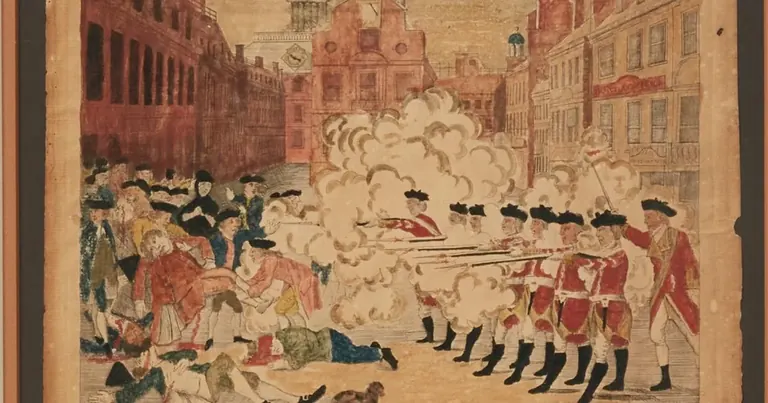
The idea is that independence travelled by print, the 18th century's only mass medium, and every piece comes from David M. Rubenstein's Americana collection. You pass Paul Revere's Boston Massacre engraving, a Boston edition of Paine's Common Sense, and Phillis Wheatley's 1773 poems, published in London because she couldn't find an American publisher. There's a 1773 petition from enslaved Bostonians, and one of fewer than 50 known 1823 Stone engravings of the Declaration.
Expect printed paper, not JFK; no critic has reviewed it yet. It's included with Museum admission ($24 adults, free for 17 and under), parking is free, and a free shuttle runs from JFK/UMass on the Red Line. It closes 29 November.
Look for
The forty-coffin broadside
A 1775 Salem broadside on Lexington and Concord, topped with a woodcut row of forty coffins for the dead.
Bostonian's Paying the Excise Man
A 1776 London print of a Boston mob tarring and feathering customs officer John Malcolm, with the Tea Party under way in the background.
Revere's Boston Massacre
Paul Revere's 1770 engraving of the King Street shooting, made and sold by Patriot Bostonians as propaganda.
Romans's map of the Seat of Civil War
The first American-printed map of the Revolution, made in 1775 by Bernard Romans, a Dutch surveyor who also fought in the Continental Army, and dedicated to John Hancock.
The 1773 petition of enslaved Bostonians
A printed broadside asking for gradual emancipation on the same grounds the colonists used for their own freedom, three years before the Declaration.
Good for
- Nerding Out
- Out-Of-Town Guests
Skip if
You came for JFK: this is 18th-century print, pamphlets, broadsides, maps and engravings.
With kids
Under-18s get in free. Backpacks and large bags aren't allowed inside, only one purse or diaper bag per person.
Also at John F. Kennedy Presidential Library and Museum
On now nearby

Image credits
4
- Declaring the Revolution: America's Printed Path to IndependenceCourtesy of John F. Kennedy Presidential Library and Museum
- Swimming with Sharks: A Deep Dive into Shark Biology and BehaviorHarvard Museum of Natural History
- Imagined NationBoston Athenæum
- John F. Kennedy Presidential Library and MuseumFcb981, cropped and corrected by mixpix, via Wikimedia Commons, CC BY-SA 3.0