 i
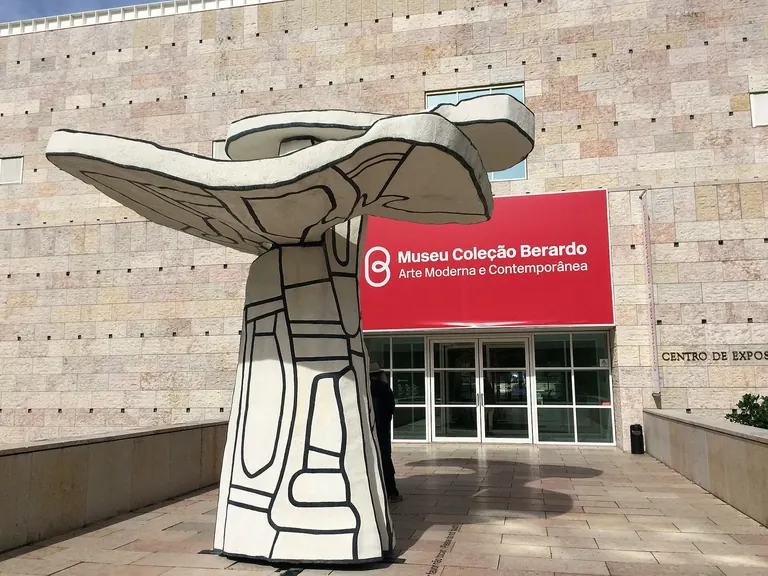
MAC/CCB – Museum of Contemporary Art and Architecture CentreBelém
Multiple Eyes: Patricia Domínguez, Ines Doujak, Lubaina Himid
Η έκθεση έχει λήξει.
Three artists from different generations treat storytelling as a collaborative, political practice, fusing the ancestral and spiritual with the carnivalesque, magical and abject.
Ιστότοπος μουσείουΠερισσότερα: Λισαβόνα
A three-metre woman cradles a child, in a pose lifted from Goya's Saturn Devouring His Son. That's Ines Doujak's Walking Cemetery, and near it she has pitched a tent patched with photographs of abused horses, where puppets and shadows act out the old court trials of animals.
Three artists from three generations share Level -1. Lubaina Himid, the UK's artist at this year's Venice Biennale, brings A Fashionable Marriage (1988), Hogarth restaged with Thatcher, Reagan, critics and dealers as the cast. Patricia Domínguez shows A Planet for Abu, a carpet woven over two years in Rajasthan and crowded with drones, black holes and hybrid creatures. You move between disease atlases, carnival and botany, and Umbigo's critic read the whole floor as a lesson in unlearning categories like race and species.
Go for the Himid and stay for Doujak's tent, but expect heavy material throughout. It's on the €15 museum ticket and closes 25 October.
Μην χάσετε
Walking Cemetery (Ines Doujak, 2023)
Look for the three-metre female figure cradling a child, posed after Goya's Saturn Devouring His Son.
The Animal Trials tent
Doujak's tent is covered in a patchwork of archive photographs of abused horses, and inside, puppets and shadow theatre restage historical court cases against animals.
A Fashionable Marriage (Lubaina Himid, 1988)
Himid's answer to Hogarth's series, with Thatcher, Reagan, art critics, dealers and patrons recast as characters in a political farce.
A Planet for Abu (Patricia Domínguez)
A carpet hand-woven over two years by Rajasthan artisans using Mughal methods, filled with animals, drones, portals, horses, black holes and hybrid creatures.
Ghost Population (Ines Doujak, 2015)
Collages cut from 19th-century medical atlases of skin diseases, recombined so human bodies meet roots, feathers, shells and plants.
Ιδανικό για
- Εμβάθυνση
- Βροχερές μέρες
Παραλείψτε το αν
You want a light afternoon: abused animals, disease atlases and colonial violence run through the show.
Επίσης στο MAC/CCB – Museum of Contemporary Art and Architecture Centre
Τώρα, εδώ κοντά
 i
Life is the Game – An immersive experience by Paulo Furtado
MAAT – Museum of Art, Architecture and Technology
 i
Γυρίστε γύρω. Μια ματιά στην EDP Foundation Art Collection (Turn Around. A Look at the EDP Foundation Art Collection)
MAAT – Museum of Art, Architecture and Technology
 i
Pedro Cabrita Reis – “without sorrow of heart”
MAAT – Museum of Art, Architecture and Technology
Εδώ κοντά
Πηγές εικόνων
8
- MAC/CCB – Museum of Contemporary Art and Architecture CentreHerbert wie, via Wikimedia Commons, CC BY-SA 4.0
- Life is the Game – An immersive experience by Paulo FurtadoMAAT, 2026
- Γυρίστε γύρω. Μια ματιά στην EDP Foundation Art Collection (Turn Around. A Look at the EDP Foundation Art Collection)Photos: Bruno Lopes
- Pedro Cabrita Reis – “without sorrow of heart”Photo: João Ferrand, courtesy of the artist
- Museu Nacional de ArqueologiaJose Luis Filpo Cabana, CC BY 3.0
- Museu de MarinhaNan Palmero, CC BY 2.0
- Museu Nacional dos CochesBosc d'Anjou / Wikimedia Commons, CC BY 2.0
- MAAT – Museum of Art, Architecture and TechnologyStefan Bethke / Wikimedia Commons, CC BY-SA 4.0
Δική σας εικόνα; Ζητήστε μας να τη διορθώσουμε ή να την αφαιρέσουμε.