 i
Brooklyn MuseumProspect Heights, Brooklyn
Hopi Kachina Dolls: Blessings for a Balanced World
The first exhibition to examine the Hopi kachina doll tradition from the perspective of the women and girls who receive them, presented at the Center for Feminist Art.
Περισσότερα: Νέα Υόρκη
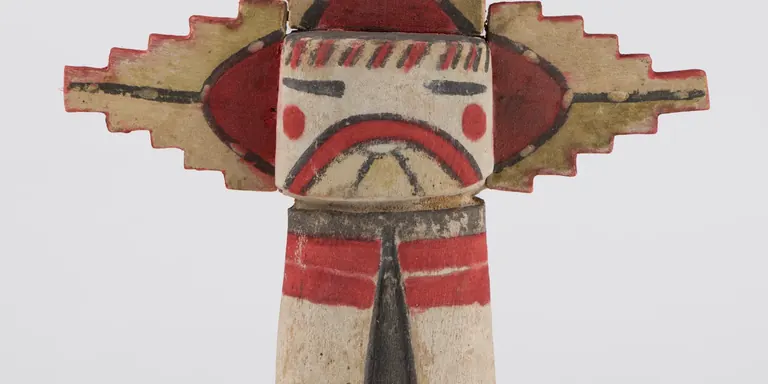
A Hopi girl's first kachina doll is flat. It arrives at her baby-naming ceremony, where female relatives give her a name and a quilt and the Katsina spirits give her that doll and a wicker plaque. You start the show at that ceremony, and the dolls get more elaborate as she grows up.
Fifty-three tithu, carved from cottonwood and painted, are among more than 120 works from the 19th century to now. They represent Katsinam, spirits who bring rain to the Hopi in arid northeastern Arizona, and they are given mainly to girls and women. Sections follow the corn-grinding ceremony, marriage and the summer Butterfly Dance. The last holds thirty pots, baskets and pieces of jewelry by Hopi women, and a video of six artists.
It fills the Center for Feminist Art on the 4th floor and is included in general admission: pay what you can at the desk (suggested $20, free for 19 and under). The audio guide is on Bloomberg Connects. It runs through June 27, 2027.
Μην χάσετε
Henry Shelton's Mudhead
Look for a Kooyemsi doll carved from cottonwood root in the 1960s and finished with feathers, yarn and iron.
Shelton's Father Sun
Taawa, the Father Sun, carved by the same hand and dressed in silver discs, fur, beads and silk ribbon.
The Butterfly Dance ensembles
A boy's historical kilt whitened with Hopi clay beside a ribbon shirt, and a girl's kopatsoki tablita headdress with a handmade dress and cape.
The groom's wedding plaque
A hahawpi given to the groom, shown with photographs of a Hopi bride's wedding attire.
Verma Nequatewa's Hopi Maiden Pendant
A 1997 pendant in 14-karat gold, set with opal, fossilized ivory, coral, sugilite and turquoise.
Ιδανικό για
- Οικονομική επιλογή
- Εμβάθυνση
- Βροχερές μέρες
Με παιδιά
Entry is free for anyone 19 and under, because the show is included in general admission.
Επίσης στο Brooklyn Museum
Τώρα, εδώ κοντά

Πηγές εικόνων
5
- Hopi Kachina Dolls: Blessings for a Balanced WorldCourtesy of Brooklyn Museum
- Splendido, όπως το βλέπει ο Chris Rhodes (Splendido, As Seen by Chris Rhodes)Courtesy of Aperture
- Pierre Huyghe: UUmweltCourtesy of Museum of Modern Art (MoMA)
- Brice Marden: I Am Plane ImageArtwork © 2026 Estate of Brice Marden/Artists Rights Society (ARS), New York. Photo: Owen Conway
- Brooklyn MuseumJim Henderson via Wikimedia Commons, Κοινό κτήμα
Δική σας εικόνα; Ζητήστε μας να τη διορθώσουμε ή να την αφαιρέσουμε.