 i
Art Institute of Chicago · Grant Park / Loop
Embroidered Traditions from Morocco to Afghanistan
The museum's first exhibition devoted to the artistic traditions of the SWANA region, with more than 70 embroidered works from the 18th through the 20th century.
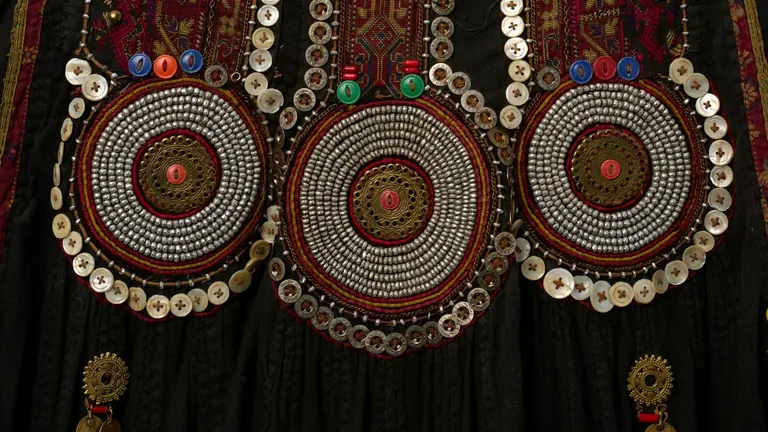
Kohistani women wore the jatho to weddings and festivals, and it was made to be heard. The black cotton dress is sewn with beads, buttons, buckles, coins, bells and metal amulets, and the label explains that they jingled when the wearer danced, to scare away evil spirits.
You walk through 75 objects in the lower-level textile galleries, 57 to 59, nearly all from the museum's own collection and most never shown before. It is the Art Institute's first show on Southwest Asia and North Africa, arranged by theme rather than country, with four face veils from a Riyadh collector on public view in the US for the first time. In 19th-century Turkey an embroidered bath towel announced your social status; the one in your bathroom announces Target.
Newcity's Elisa Shoenberger called it "a treasure trove of artistry". Her one catch: it stops at the 20th century and says little about how these crafts are made or worn today. It runs until 25 January 2027.
Nicht verpassen
The Kohistani jatho
In Gallery 57, a black cotton wedding and festival dress heavy with beads, buttons, bells and coins, with a beaded triangular amulet dangling at the front of the skirt.
The Amazigh akhnif cape
Look at the back of this Moroccan wool cape, woven to shape from the hood down, for the big red motif called the eye, placed to protect the wearer's back.
Two Yemenite Jewish gargush hoods
Cone-shaped bridal hoods covered in metal-wrapped embroidery, whose silver triangles the curator says are meant to look like a tiered cake.
The Marsh Arab izar
On this Iraqi wool wedding blanket, rows of triangles stand for hills, diamonds for the reed platforms people live on, and wavy lines for the water around them.
The Turkish towel ends
The cut-off borders of 19th-century bath towels, embroidered in silk and metallic thread with rosewater bottles, ships and buildings.
Gut für
- Allein unterwegs
- Stadtkenner
- Detailverliebte
Nichts für dich, wenn
You want to see how these crafts live on today: the show stops at the 20th century.
Mehr Ausstellungen: Art Institute of Chicago
Jetzt in der Nähe
 i
Flyway City: Architektur für ein blühendes Ökosystem (Flyway City: Architecture for a Flourishing Ecosystem)
Chicago Architecture Center
 i
Chicago's Living Habitat
Chicago Architecture Center
 i
Strömungen: 60 Jahre Chicago Architecture Center (Currents: 60 Years of the Chicago Architecture Center)
Chicago Architecture Center
In der Nähe




Bildnachweise
9
- Embroidered Traditions from Morocco to AfghanistanCourtesy of Art Institute of Chicago
- Flyway City: Architektur für ein blühendes Ökosystem (Flyway City: Architecture for a Flourishing Ecosystem)Photo by Steve Hall, courtesy of Studio Gang.
- Chicago's Living HabitatPhoto by Madison Smith
- Strömungen: 60 Jahre Chicago Architecture Center (Currents: 60 Years of the Chicago Architecture Center)Courtesy of Chicago Architecture Center
- Art Institute of ChicagoDiego Delso, via Wikimedia Commons, CC BY-SA 3.0
- Chicago Architecture CenterAlanscottwalker / Wikimedia Commons, CC BY-SA 4.0
- Museum of Contemporary PhotographyAjay Suresh via Wikimedia Commons, CC BY 2.0
- Shedd AquariumDiego Delso, via Wikimedia Commons, CC BY-SA 3.0
- Field MuseumPaul Sableman via Wikimedia Commons, CC BY 2.0