 i
La Biennale di Venezia (Giardini & Arsenale) · Castello
German Pavilion: Ruin – Henrike Naumann & Sung Tieu
Henrike Naumann and Sung Tieu use vanished East German sites as blueprints; Tieu wraps the facade in a trompe-l'oeil mosaic of a ruined Berlin housing block.
Walk up to the German Pavilion and the 1938 portico with GERMANIA over it is hidden. In its place is a graffitied East Berlin prefab, made from more than three million marble mosaic stones. Sung Tieu copied it 1:1 from the block on Gehrenseestraße where she lived as a child, a home for Vietnamese contract workers now being demolished.
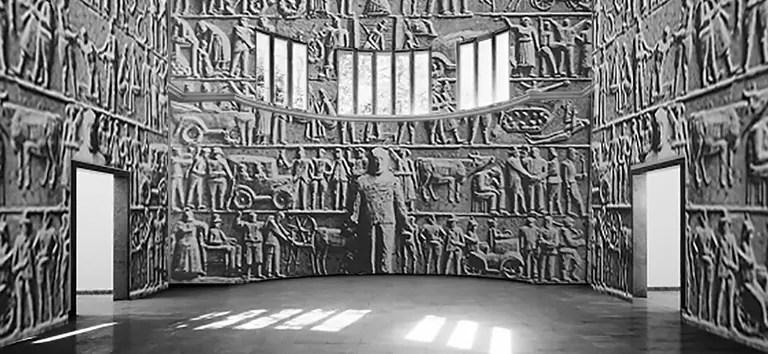
Inside, the central hall belongs to Henrike Naumann, who died in February at 41 with the work mostly complete. On walls the mint green of Soviet army barracks, furniture is mounted in relief: midcentury chairs cut in half along the top, a semi-flattened living room in greys and blacks. Tieu's side rooms are spare, built around aluminium outlines of her mother's body.
Studio International called it one of the strongest pavilions. At times the vertical dancers of Il Posto drop from the high windows to the floor. It's in the Giardini, covered by the €30 Biennale ticket, Tuesday to Sunday, 10am to 6pm, until 22 November.
No et perdis
Human Dignity Shall Be Inviolable, the facade
Look up at the pavilion's front: over three million marble stones reproduce the graffitied, balconied Gehrenseestraße housing block, with curtained windows glowing from inside.
The half-sunk chairs
Midcentury chairs, cut in half and fixed along the upper wall of the central hall, look as if they are sinking into the marble.
The flattened living room
Naumann renders a whole living room in Neues Deutsches Design style as a semi-flattened relief, entirely in greys and blacks.
Tieu's aluminium mother
Refined aluminium bars arrange and rearrange the outline of her mother's body, while bars on the floor have cutouts measured to Tieu's own neck and wrists, like a pillory.
The ladybird wall
One gallery's walls are covered in small aluminium recasts of chocolate ladybirds.
Ideal per a
- Friquis
- Visites de fora
També a La Biennale di Venezia (Giardini & Arsenale)
Ara a prop


A prop
Crèdits de les imatges
9
- German Pavilion: Ruin – Henrike Naumann & Sung TieuCourtesy of La Biennale di Venezia (Giardini & Arsenale)
- Alfred Eisenstaedt. La fotografia era nell'aire (Alfred Eisenstaedt. La fotografia era nell'aria)Courtesy of Museo Storico Navale
- EMPORION – Andrea ValleriCourtesy of Museo Storico Navale
- Amoako BoafoCourtesy of Museo di Palazzo Grimani
- La Biennale di Venezia (Giardini & Arsenale)AlMare / Wikimedia Commons, CC BY-SA 2.5
- Museo Storico NavaleGiovanni Dall'Orto / Wikimedia Commons, CC BY-SA 2.5 IT
- Ocean Space (Chiesa di San Lorenzo)Didier Descouens / Wikimedia Commons, CC BY-SA 4.0
- Palazzo Ducale (Doge's Palace)Didier Descouens / Wikimedia Commons, CC BY-SA 4.0
- Museo di Palazzo GrimaniSailko / Wikimedia Commons, CC BY-SA 4.0