 i
de Young Museum · 金门公园
Arts of Indigenous America
The biggest reinstallation of the Indigenous American collection in 20 years: four galleries on 'Relationship to Place', developed with Native scholars and communities.
The co-curators chose the goldenrod on the first gallery's walls to match Wiyot land in Humboldt County, and painted the room of Southwestern art desert sagebrush green. That care runs through the most extensive rehang of the de Young's Indigenous American collection in 20 years, planned with four Native co-curators from the start.
You go in through a new walled doorway off Wilsey Court. Gallery 1, Rooted in Place, covers northwestern California until December 2026, then rotates to another region of the state. Galleries 2 and 3 hold Ancestral Maya ceramics and mural fragments from Teotihuacan. Gallery 4, Home and Away, sets new commissions beside historic work from the US, Canada and Mexico. Every label has a named author, and objects went on view only with their communities' permission.
KQED's critic found it "a pleasure to linger" and wanted only more: maps, another gallery, and no contemporary glass gallery "disorientingly sandwiched" into the route. General admission covers it: $25, free for 17 and under.
看点
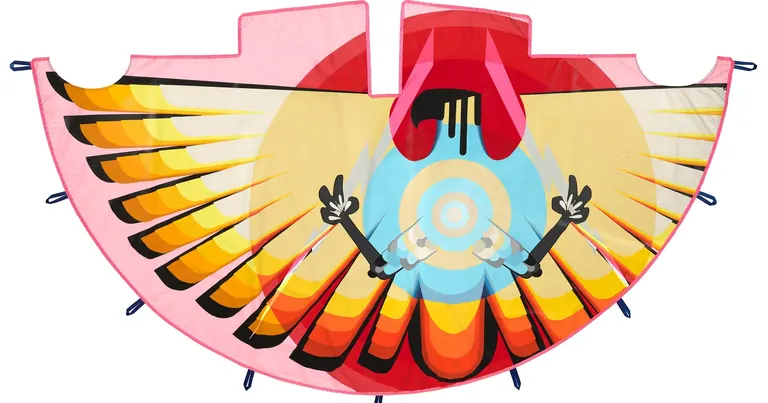
Cannupa Hanska Luger, Special Forces (2025)
A half-circle of pink canvas about 16 feet wide, filled by a bird with fanned orange and yellow wings and a target at its centre, one of Gallery 4's new commissions.
The Tlingit Thunderbird Screen (1907)
James Rudolf's large house screen, made for the Thunderbird House of the Wooshkeetaan Clan, hangs in the fourth gallery; KQED's critic called it particularly arresting.
Maria Martinez's black-on-black pottery
Look for the San Ildefonso potter's famous black-on-black glaze, then find Rose B. Simpson's El Camino lowrider in Wilsey Court, named Maria in her honour.
Haida robe by Dorothy Grant and Robert Davidson (1992)
A cashmere wool robe worked in appliqué and reverse appliqué, finished with mother-of-pearl buttons and glass beads.
Teotihuacan mural fragments
Painted fragments that once lined the inside walls of elite homes in the ancient Mexican city, shown with the story of their joint conservation with Mexico's government.
适合
- 独自前往
- 深度爱好者
带孩子
Visitors 17 and under get in free.
de Young Museum的其他展览
附近正在展出
附近
图片来源
6
- Arts of Indigenous America© Cannupa Hanska Luger; photograph by Randy Dodson
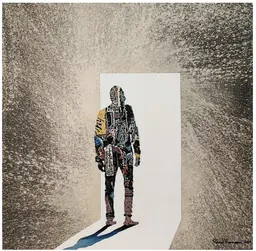
- Unfinished LinesCourtesy of Minnesota Street Project
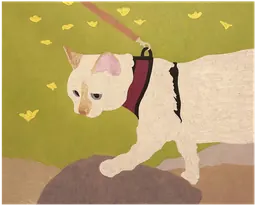
- Flora + FaunaCourtesy of Minnesota Street Project
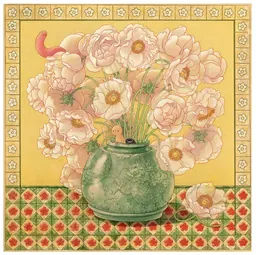
- Felicia Chiao: Not Too SweetCourtesy of Minnesota Street Project
- de Young MuseumGuilhem Vellut / Wikimedia Commons, CC BY 2.0
- California Academy of SciencesWolfmanSF / Wikimedia Commons, CC BY-SA 3.0