 i
BMW Museum · Am Riesenfeld / Olympiapark
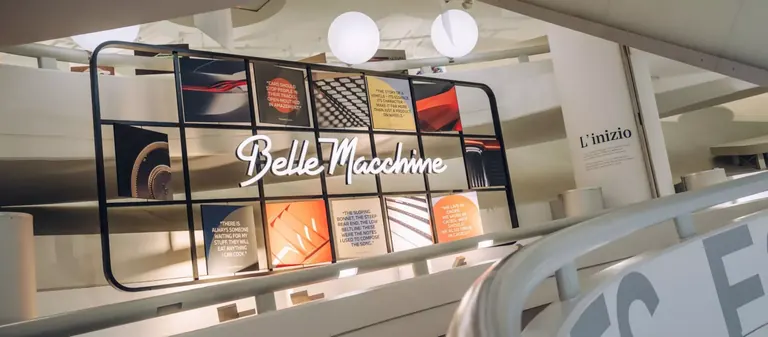
Belle Macchine. Italian Automotive Design at BMW
Explores how Italian coachbuilding and automotive design influenced BMW's design language, with iconic vehicles, design studies and a 360-degree projection.
Marcello Gandini drew the BMW Garmisch as a wedge of clear, straight lines, and it fed into the first 3 Series and 5 Series of the 1970s. It is one of 23 historic cars here that Italian studios such as Bertone, Pininfarina, Frua and Italdesign shaped for BMW.
You start with Italian fashion and product design, then climb the spiral ramps of the museum's round "Bowl" past production cars, one-offs and archive sketches, while a 360-degree projection of Giorgio de Chirico's paintings wraps the walls. Related cars sit close together: the Italdesign-built M1 is a short walk down the ramp from the Nazca M12, a show-car idea for a modern M1.
Steve Saxty, who wrote a trilogy on BMW's design history, called it the most compelling show he'd seen in the Bowl, with "just enough" text. His one instruction: don't race past the opening panels on the seven studios, because they explain who did what. Entry is included in the BMW Museum ticket, until the end of 2026.
看点
The BMW Garmisch
Look for Gandini's wedge-shaped concept with its clear geometric lines, the car that shaped the original 3 Series and 5 Series.
The "Glaserati"
The BMW 3000 V8, affectionately nicknamed the "Glaserati", heads a three-car line-up from BMW's takeover of the carmaker Glas.
Three takes on the M1
Up the ramp from the Italdesign-built M1 stands the Nazca M12, Fabrizio Giugiaro's first design, with the 2008 M1 Hommage and its ultra-slim headlights nearby.
The one-offs platform
Single cars commissioned or pitched by Italian studios, including the BMW 2800 GTS Frua and the Pininfarina Gran Lusso Coupé.
The de Chirico projection
Giorgio de Chirico's paintings are projected 360 degrees around the walls of the Bowl; the Italian painter learned part of his craft in Munich.
适合
- 深度爱好者
- 雨天
BMW Museum的其他展览
附近正在展出
图片来源
4
- Belle Macchine. Italian Automotive Design at BMWCourtesy of BMW Museum
- Museo Aero SolarCourtesy of Haus der Kunst
- Ragnar Axelsson. Greenland© Ragnar Axelsson
- BMW MuseumMaximilian Dörrbecker (Chumwa), Wikimedia Commons, CC BY-SA 2.5