 i
The Huntington Library, Art Museum, and Botanical Gardens · San Marino
Stories from the Library: Damaged Goods
How damaged objects, visible mistakes, and imperfections make library materials more compelling, beautiful, and revealing.
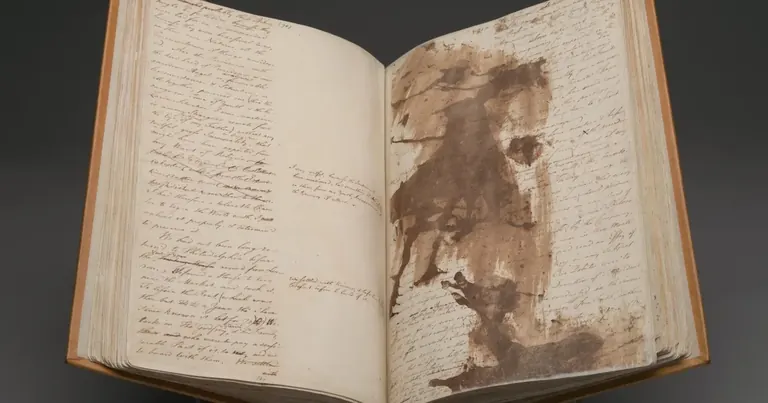
A large ink stain spreads across a page of Benjamin Franklin's draft autobiography, and the long-held story is that he knocked over the inkwell himself. It is the show's centrepiece.
You walk into the Large Library, on the Huntington Art Gallery's first floor, among library pieces marked by nature, human error or censorship. Bookworms tunnelled through the mulberry-paper pages of an Edo-period Japanese arithmetic guide. Alexander Gardner's portrait from his last official sitting with Abraham Lincoln was printed from a glass negative that had cracked in two: he fitted the halves together, made one print and discarded the negative. In Alexander Wilson's 1808 American Ornithology, ink has bled onto the facing page as a brown ghost of an ivory-billed woodpecker.
It is one room, with a companion Spotify playlist, and The Mirror of the Moon is upstairs. Entry is included with general admission ($29 Monday to Thursday, $34 at weekends), reservations are required Friday to Sunday, the Huntington is closed Tuesdays, and the show closes on 30 November.
לא לפספס
Franklin's ink stain
Look for the large stain across a page of Franklin's draft autobiography, long believed to come from an inkwell he knocked over himself.
The bookworm holes
In Hirose Tomoshige's Edo-period guide to commercial arithmetic, insects drawn to the mulberry paper have bored holes straight through the text.
The cracked-plate Lincoln
Alexander Gardner's portrait of Lincoln, made weeks before the assassination, shows the crack where the glass negative broke and he pieced the two halves together.
The ghost woodpecker
In Wilson's American Ornithology, ink from an illustration has reacted with the facing page, leaving a brown ghost image of an ivory-billed woodpecker.
מתאים ל
- שעה או פחות
- צלילה לעומק
The Huntington Library, Art Museum, and Botanical Gardens: עוד תערוכות
עכשיו בסביבה
 i
יוצרת-אמנית בתוכנית שהות: Jackie Amezquita (Maker-in-Residence featuring Jackie Amezquita)
Craft Contemporary
 i
נוחות מן האדמה: לאוורר את האדמה (Earthen Comforts: Airing Earth)
Craft Contemporary
 i
חמש מאות שנים של יצירות על נייר: מרכז גרונוואלד מציין 70 שנה, חלק שני (Five Centuries of Works on Paper: The Grunwald Center at 70, Part II)
Hammer Museum
קרדיט לתמונות
5
- Stories from the Library: Damaged GoodsCourtesy of The Huntington Library, Art Museum, and Botanical Gardens
- יוצרת-אמנית בתוכנית שהות: Jackie Amezquita (Maker-in-Residence featuring Jackie Amezquita)Photo courtesy of Craft Contemporary, Los Angeles. Exhibition Installation Image: Marc Walker.
- נוחות מן האדמה: לאוורר את האדמה (Earthen Comforts: Airing Earth)Courtesy of Craft Contemporary
- חמש מאות שנים של יצירות על נייר: מרכז גרונוואלד מציין 70 שנה, חלק שני (Five Centuries of Works on Paper: The Grunwald Center at 70, Part II)Courtesy of Hammer Museum
- The Huntington Library, Art Museum, and Botanical GardensAaron Logan / Wikimedia Commons, CC BY 1.0