Do different museum types need completely different audio guide scripts?
Traditionally, yes. Art museums, heritage sites, and history museums each required custom scripts with different tones and structures. With AI-powered audio guides, the system adapts delivery to the visitor and context, so you design a persona and load your data rather than writing separate scripts for each institution type.
Do audio guides work for science centers and interactive museums?
Not well. When the experience depends on touching, pulling, or interacting with an exhibit, an audio guide has little to add. The context comes from doing, not listening. This applies to all audio guides, AI or otherwise.
Can AI audio guides handle outdoor heritage sites?
Yes. Modern AI audio guide platforms support both indoor and outdoor navigation using GPS, visual anchor points, and floor plans. Heritage sites with walking trails, ruins, or open-air exhibits can deliver location-aware guided tours without fixed infrastructure.
What's the difference between a static audio guide and an AI tour guide?
A static audio guide plays pre-recorded clips at each stop. An AI tour guide adapts in real time, adjusting depth, language, and focus based on what the visitor asks, how long they linger, and what they've already heard. The shift is from scripted playback to conversational guidance.
The standard advice goes like this: art museums need contemplative, interpretive content. History museums need narrative arcs. Heritage sites need wayfinding woven into the story. Science centers need interactivity above all.
This is true. It's also increasingly irrelevant.
The old approach of writing entirely separate scripts for each institution type assumed a constraint that no longer applies. Static audio guides forced you to choose one voice, one depth, one pace. Every visitor heard the same thing. So naturally, you had to carefully match that single output to your specific institution type.
AI changes the equation. When the system adapts to each visitor, most of those institution-specific content strategies collapse into a single question: what data do you have, and how do you want it delivered?
The Old Playbook
For decades, creating an audio guide meant hiring a scriptwriter who understood your specific institution type. An art museum script looked nothing like a heritage site script, and both looked nothing like what you'd write for a natural history collection.
The art museum script was object-focused. Stand here, look at this painting, here's what the artist was doing with light. Sixty to ninety seconds per stop, contemplative pacing, room for silence.
The heritage site script was spatial. Walk thirty meters down this path. To your left, the remains of the Roman bathhouse. The guide had to work as navigation and narrative simultaneously, moving people through physical space while keeping the story coherent.
The history museum script was chronological. Each room was an era. The narrative had to build momentum through time, connecting objects to events to people.
These were genuinely different disciplines. Writing a good heritage site script required skills that didn't transfer to writing a good art museum script. Institutions hired different people, ran different processes, and ended up with content that was hard to update because any change risked breaking the carefully constructed flow.
Why Most of Those Differences Dissolve
The differences between institution types were real, but they were magnified by a technical limitation: every visitor got the same content. When you can only say one thing at each stop, you have to pick exactly the right thing. That's hard, and the right thing varies enormously by institution.
With an AI museum guide, visitors don't all get the same content. Someone who asks about architectural details at a heritage site gets architectural depth. Someone who asks about the people who lived there gets social history. A child gets a simpler version. A repeat visitor gets new angles on objects they've already heard about.
The practical result: instead of designing institution-specific content strategies from scratch, you design a persona, load your data, and let the system adapt. The underlying differences between a Baroque painting and a Roman ruin still matter, but they're encoded in the data itself, not in a rigid script that has to anticipate every visitor's needs.
We've seen this play out across dozens of sites. A historic house and an art gallery both loaded their curatorial data, designed their guide persona, and launched within the same timeframe. The house's guide naturally tells stories about the family who lived there. The gallery's guide naturally discusses technique and composition. The data is different, and the AI follows the data. Nobody had to write separate strategies.
Where Each Type Still Shines
The differences haven't disappeared entirely. They've just moved upstream, from scripting to curation.
Art museums remain the cleanest fit for audio guides of any kind. The format is natural: stand in front of an object, learn about it. AI adds the ability to answer questions mid-tour, go deeper on technique for visitors who care, and skip context for those who just want the highlights. The interpretive layer that makes art museums special (helping people see what they wouldn't notice alone) works better when it's responsive rather than one-size-fits-all.
History museums benefit from AI's ability to handle branching narratives. A static script forces a linear path through time. An AI guide can let visitors follow threads: start with a World War II artifact and end up learning about the local families who were affected, or the industrial processes that produced the weapon, depending on what they ask. The chronological backbone is still there. But visitors aren't trapped on it.
Heritage sites have specific operational needs that go beyond content strategy. Navigation matters. Visitors are outdoors, moving through large spaces, sometimes without clear signage. A guide needs to know where they are and direct them to the next point of interest. Musa handles both indoor and outdoor navigation (GPS for open spaces, visual anchor points and floor plans for interiors), which means heritage sites can deliver location-aware tours without installing beacons or other fixed hardware.
Historic houses are a particularly strong use case. These sites have layered stories: the family upstairs, the servants below stairs, the architectural history of the building itself. A static guide picks one narrative. An AI guide can tell all of them, shifting focus based on which room you're in and what you've been asking about.
The One Place Audio Guides Don't Fit
There's an institution type where audio guides, all of them, struggle. Highly interactive museums and science centers, where the experience is built around doing things.
A children's science museum where visitors pull levers, mix chemicals, and build circuits doesn't benefit much from a voice in their ear explaining what they're looking at. The context comes from interaction, not from listening. You learn about centripetal force by spinning the wheel, not by hearing someone describe it while you stand nearby.
This isn't an AI limitation. It's a format limitation. No audio guide (scripted, AI-powered, or otherwise) adds much when the exhibit is designed around physical participation. The exhibit is the content.
Some science museums have sections where a guide works well: historical exhibits, specimen collections, observatory viewing areas. But the interactive floor? Save your budget. A good label or a staff member walking the floor will outperform any guide.
Being honest about where audio guides don't work matters more than pretending they work everywhere. If you run a science center with 80% interactive exhibits, an audio guide probably isn't your highest-value investment.
From Content Strategy to System Design
The shift worth paying attention to isn't "what content strategy fits my institution type." It's the move from static audio guides to AI tour guides.
A static audio guide is a media player. You press play, you hear a clip, you press play at the next stop. The content is fixed. Updating it means re-recording. Translating it means hiring voice actors for each language. The visitor experience is passive: listen or don't.
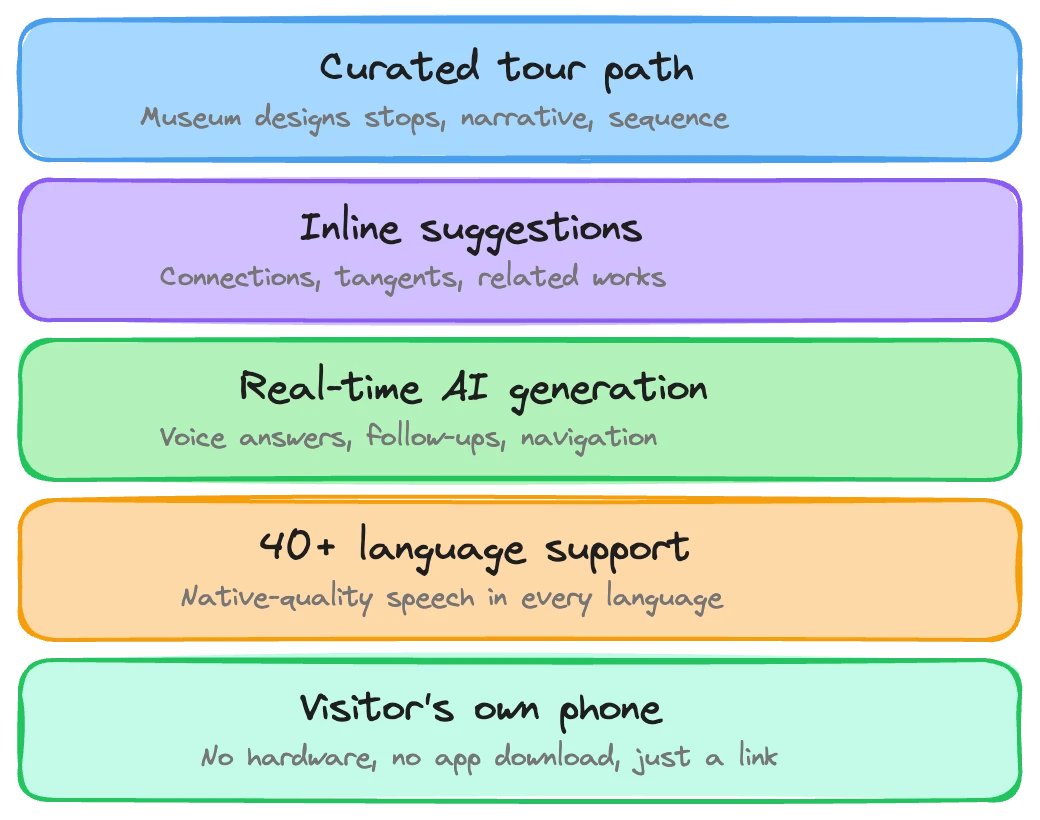
An AI tour guide is closer to an actual person. It speaks in a voice and persona the museum designs. It adapts to questions. It handles 40+ languages natively without separate recordings. It can weave in ambient sound, reference things the visitor has already heard, and adjust depth on the fly.
That's a category shift, not an incremental improvement. And it makes institution-type-specific content strategies less important because the system handles adaptation that previously had to be baked into the script.
The practical workflow changes too. Instead of months of scripting, review, re-scripting, recording, and editing, the process becomes: load your data (catalog entries, curatorial notes, research, whatever you have), design your guide's persona (tone, depth preferences, what to emphasize), set up your tours (which stops, what order, any per-stop instructions), and launch. Adding new content later (a new acquisition, a temporary exhibition, updated research) takes minutes, not months. The guide absorbs it and stays in character.
Planning Around This
If you're developing an audio guide content strategy right now, here's what actually matters:
Your data is your strategy. The richer your source material (curatorial notes, object histories, conservation records, visitor research) the better any AI guide will perform. Spend time on data quality, not on agonizing over whether your institution type requires a "contemplative" or "narrative" approach.
Your persona does the heavy lifting. Instead of writing scripts that encode your institution's voice word by word, you design a character. How formal? How deep by default? What should it emphasize? What should it never say? The persona shapes every interaction without you writing each one.
Don't plan for a single visitor type. The old model forced you to pick your target audience (casual visitor, school group, expert) and write for them. AI guides serve all of them from the same base, adapting on the fly. Plan your data and persona for breadth, not for one slice.
Be honest about fit. If large parts of your visitor experience are hands-on and interactive, an audio guide might not be the right tool for those areas. That's fine. Use it where it works: the permanent collection, the outdoor grounds, the historical context areas. Leave the interactive spaces to do their thing.
Getting Started
The gap between "we should have an audio guide" and "we have one running" has shrunk from months to weeks. A full museum onboarding (data ingestion, tour design, persona creation, testing) can happen in under a week for the core setup, with a pilot running within a month.
If you're evaluating audio guide options and trying to figure out how your institution type affects the decision, the answer is simpler than it used to be. Your content, your voice, your visitors' curiosity. The technology adapts to the rest.