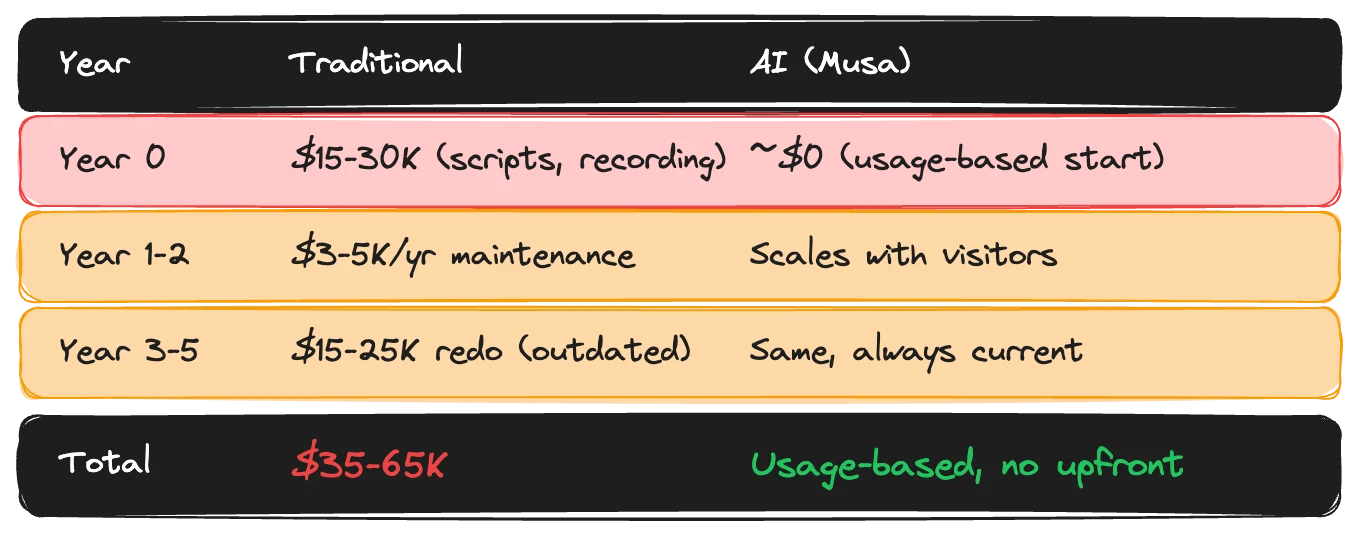
Total Cost of Ownership: Audio Guide Systems Compared
Frequently Asked Questions
What is the total cost of ownership for a museum audio guide?
It depends on the system type. Hardware devices cost heavily upfront (often tens of thousands for scripting, recording, translation, and devices) but have lower per-use costs. BYOD software subscriptions reduce hardware costs but still require content production budgets. AI-powered guides like Musa have near-zero upfront costs, with ongoing costs tied to actual usage.
What hidden costs do museums miss when budgeting for audio guides?
Device theft and breakage, charging infrastructure and maintenance, staff time for device distribution, content staleness from inability to update affordably, and the opportunity cost of being locked into a system that underperforms for years because the upfront investment was too large to walk away from.
How does usage-based pricing work for audio guides?
Instead of paying a large sum upfront, the museum pays based on how many visitors actually use the guide. This can take the form of subscriptions, per-use credits, approximate usage tiers, or revenue share. The provider only earns when the guide is being used, which aligns incentives around making the guide actually work.
Are AI audio guides more expensive than traditional ones over time?
Over a five-year period, AI guides typically sit between hardware devices and basic BYOD solutions in total cost. They're significantly cheaper in year one (no upfront content production or hardware), and the ongoing per-interaction cost is offset by zero maintenance, no device logistics, and the ability to change providers without losing a sunk investment.
Museums pick audio guides based on price. Specifically, based on the number their procurement team sees first. That number is almost always the upfront cost: what it takes to get the system running on day one.
This is a bad way to buy an audio guide.
The upfront cost is often the smallest part of the total spend. What kills budgets is everything after: maintaining hardware, replacing stolen devices, paying for content updates that never happen because the production cycle is too expensive to restart. And worst of all, being locked into a mediocre system for a decade because the initial investment was too large to write off.
We've watched this pattern play out across dozens of museums. The institution that spent the most upfront frequently ends up with the worst outcome, not because they chose a bad product, but because the cost structure removed their ability to adapt.
Here's what the math actually looks like across three models: traditional hardware devices, BYOD software platforms, and AI-powered systems.
Hardware devices: pay everything upfront
The traditional model is familiar. You contract a production company or specialized vendor. They write scripts for each stop, hire voice actors, record in a studio, translate into however many languages you need, and deliver the content on proprietary hardware. Visitors pick up a device at the front desk and return it when they leave.
The upfront bill is substantial. For a mid-sized museum with 40-60 stops and three languages, expect to spend somewhere between 30,000 and 80,000 on initial content production alone. Scripting, recording, editing, and translation for each language adds up fast. The devices themselves run 200-400 each, and you need enough for peak visitor flow plus spares. A fleet of 50-100 devices adds another 10,000-40,000.
That's 40,000-120,000 before a single visitor has pressed play.
Then come the ongoing costs that the proposal doesn't emphasize. Device breakage and theft (plan for 5-15% annual attrition). Charging stations and cables. Storage and cleaning. Staff time to manage the distribution desk. And when those devices reach end of life in four to six years, you replace the entire fleet.
Content updates are where the model really breaks down. Want to add a temporary exhibition? New scripts, new recordings, new translations, essentially a mini production run. A gallery renovation that changes the visitor path? Same process. New research that changes the interpretation of a key work? Same. Many museums simply don't update their guides because the cost of doing so approaches the cost of the original production. The guide becomes a snapshot of the museum as it existed on the day the contract was signed.
This creates a problem that doesn't show up in any budget line: content staleness. Three years in, your guide is describing a gallery layout that no longer exists and missing your best temporary exhibitions. Visitors notice. Adoption drops. The expensive system you bought is now actively working against the visitor experience.
BYOD software: lower hardware cost, same content problem
Bring-your-own-device platforms eliminate the hardware entirely. Visitors use their own phones to access an app or website that delivers the guide. This cuts the device procurement, maintenance, and staffing costs in one move.
Most BYOD providers charge a monthly or annual subscription, typically 300-1,500 per month depending on features and museum size. That number looks attractive compared to the hardware model's upfront investment.
But the content production cost doesn't disappear. It shifts. You still need scripts. You still need recordings or high-quality text. You still need translations. The BYOD platform is a delivery mechanism, not a content creation tool. Some platforms include basic text-to-speech or assist with translations, but the fundamental work of creating stop-by-stop content remains your responsibility and your expense.
So the real cost comparison is: 300-1,500/month in platform fees plus 20,000-60,000 in content production upfront, with the same update costs whenever content needs to change. Over five years, the total spend can approach or match hardware devices. You just spread the payments differently.
The advantage is real but limited. You've eliminated device logistics. You've traded a large capital expenditure for an operational one. But you're still locked into your content the same way. A major content refresh still costs thousands and takes weeks or months of production time.
AI-powered systems: pay for what gets used
This is where the economics shift structurally, not just in amount.
An AI-powered audio guide like Musa doesn't require upfront content production in the traditional sense. There are no scripts to write per stop. No recording sessions. No per-language translation budgets. You load your existing content (catalog entries, wall texts, research materials, existing audio guide transcripts if you have them) and design the tour: the narrative arc, the character voice, the tonal instructions, the per-stop guidance for anything you want to shape specifically.
The production effort is real but fundamentally different. Instead of writing hundreds of individual scripts, you're designing a system. Setting the voice. Defining the rules. Curating the journey. Think days rather than months.
The cost? Near zero upfront. At Musa, we don't charge for onboarding, setup, or content loading. The ongoing cost is tied to actual usage: every time a visitor uses the guide, AI generation runs, and that costs money. That's the main expense line.
Several pricing models exist: subscriptions for museums that want predictable costs, credit-based pricing that tracks exact usage, approximate usage tiers, or revenue share where the museum charges visitors and splits with the provider. The common thread is that nobody pays a large sum before knowing whether the system works for their visitors.
That matters more than the raw price comparison.
The lock-in problem nobody talks about
We've talked to museums that spent 60,000, 80,000, even six figures on an audio guide implementation that they knew was underperforming within six months. The adoption rate was low. The content didn't land. Visitors complained or, worse, just ignored it.
They kept using it anyway. For years.
Not because they loved the product, but because the sunk cost was too high to walk away from. The board had approved a major capital expenditure. The production had taken months. Switching would mean eating the entire investment and starting over. So the mediocre guide stayed, through exhibition changes, gallery renovations, and visitor feedback that consistently flagged it as a weak point.
This is the most expensive cost in the entire audio guide category, and it never appears on any invoice. It's the opportunity cost of being stuck.
Usage-based pricing breaks this cycle. If a museum tries an AI-powered guide and it doesn't work (low adoption, content needs rethinking, poor visitor feedback) they can change course without writing off a massive investment. Switch providers. Redesign the tour. Or stop entirely and reassess. The financial penalty for being wrong is months of usage fees, not years of sunk capital.
We think this is better for the industry. Bad implementations shouldn't persist for a decade because someone signed a contract with a large upfront payment. The faster museums can iterate on what works, the better the overall quality of audio guides becomes.
Five-year cost comparison
Rough numbers for a mid-sized museum (50 stops, three languages, moderate visitor traffic of 100,000-200,000 annual visitors):
Hardware devices
Year 1: 50,000-120,000 (content production + device fleet)
Years 2-5: 5,000-15,000/year (maintenance, replacement, staff time)
Content refresh (if done at all): 15,000-40,000
Five-year total: 85,000-200,000
BYOD software
Year 1: 25,000-65,000 (content production + first year subscription)
Years 2-5: 4,000-18,000/year (subscription + occasional content updates)
Five-year total: 40,000-135,000
AI-powered (usage-based)
Year 1: 2,000-12,000 (usage fees only, no upfront production)
Years 2-5: 3,000-15,000/year (scales with adoption; higher adoption means higher cost but also higher value)
Five-year total: 15,000-75,000
These are ranges, not guarantees. A museum with high visitor volume and high adoption will pay more on a usage model. That's the point: cost scales with the value being delivered. A museum with low adoption pays very little, which means the financial risk of trying is minimal.
Over five years, AI-powered guides sit between hardware and BYOD in cost for most institutions. They're the cheapest option in year one by a wide margin, and they stay competitive long-term, with the added advantage that you can walk away at any time.
Hidden costs people forget to budget
Beyond the headline numbers, several cost categories consistently get missed in audio guide budgets:
Device theft and damage. Hardware guides disappear. Visitors walk out with them, drop them, or spill coffee on them. Budget 5-15% annual replacement. On a fleet worth 20,000, that's 1,000-3,000 per year in devices alone.
Charging infrastructure. Devices need charging stations, cables, organized storage, and someone to manage the nightly routine. The stations themselves cost money. The staff time is the bigger expense: someone has to plug in 50-100 devices every evening and check they're charged every morning.
Staff time for distribution. A hardware guide requires a staffed desk. Someone hands out devices, explains how they work, collects them at the end, checks for damage. This isn't free. Even if it's folded into existing reception duties, it's time that could be spent welcoming visitors, answering questions, or promoting exhibitions.
Content that ages. A guide recorded in 2022 that still references "the painting to your left" when the gallery was rearranged in 2024 doesn't just sound wrong. It actively undermines visitor trust. The cost of not updating is invisible but real: lower adoption, worse reviews, a perception that the museum doesn't care about the visitor experience.
Opportunity cost of doing nothing. Some museums decide the whole thing is too expensive and simply don't offer an audio guide. That's a real cost too. Visitors who would have engaged more deeply, spent more time, had a better experience, told friends about it. Hard to quantify, but institutions that add a quality guide consistently report better visitor satisfaction scores and longer visit durations.
Why we don't charge for features
One note on how we think about pricing at Musa, because it reflects a broader philosophy.
We don't charge for languages. Adding Basque or Japanese or any of the 40+ languages we support costs the museum nothing extra. We don't charge for accessibility features, analytics, or the content management tools. The software is the software. Everyone gets the full product.
The only cost is AI generation per interaction. When a visitor uses the guide, inference runs, and that has a real compute cost. We price to cover that cost with a margin, and that's it.
The reasoning is simple. Restricting access to software features doesn't make the product better for anyone. A museum that can't afford the "premium" language tier just has visitors who don't get a guide in their language. A museum that can't afford analytics doesn't learn what's working. These constraints make audio guides worse, and worse audio guides make the whole category less credible.
The cost structure should reflect the value structure. If a visitor uses the guide and has a good experience, that's worth something. If nobody uses it, the museum shouldn't be paying as though they did.
Making the comparison for your institution
Every museum's numbers will be different. Visitor volume, language requirements, update frequency, existing infrastructure, and staffing costs all change the math. But the framework is consistent: don't compare sticker prices. Compare what you'll actually spend over the useful life of the system, including the costs that don't show up in the proposal.
Ask these questions of any vendor, including us:
What does year one cost, fully loaded? Not just the contract, but everything it takes to get the guide live and in visitors' hands.
What does it cost to add a temporary exhibition? Both in money and in time.
What happens if the guide underperforms? How expensive is it to switch or stop?
Where does staff time go? Distribution, maintenance, troubleshooting, content updates.
What's included and what costs extra? Languages, analytics, updates, support.
The answers will tell you more than any pricing table. A vendor that can't give you a straight five-year cost estimate probably doesn't want you to do the math.
If you want to run the numbers for your specific situation, we can walk through it with you. We'll be honest about where the tradeoffs land, including cases where a different model might fit better.