Audio Guide Pricing Models: Free vs. Paid and Everything Between
Frequently Asked Questions
Should museums offer their audio guide for free or charge visitors?
It depends on your size and goals. Larger, well-known museums can charge separately because visitors expect it and will pay. Smaller museums generally get better outcomes by including the guide free, since it drives higher uptake and a better overall visit. Either way, the choice isn't permanent. You can switch models and test pricing at any time.
What audio guide pricing models are available for museums?
The main models are subscriptions (fixed monthly cost, guide usually offered free to visitors), revenue share (visitors pay through the platform, museum and provider split revenue), and credit-based pricing (pay per interaction, with flexibility to charge visitors or offer it free). Each suits different institutional goals.
Do paid audio guides get less usage than free ones?
Yes, fewer visitors will start a paid guide. But paid users engage more deeply: they listen longer, visit more stops, and are more likely to use the guide through their entire visit. The tradeoff is between reach and per-user commitment.
Can museums A/B test different audio guide prices?
Yes. Platforms like Musa let you change pricing at any time and run pricing experiments to find the point where total revenue is highest, balancing the number of paying users against price per user.
Every museum that adds an audio guide faces the same question early on: do we charge for this, or give it away?
The answer matters more than most people think. Pricing isn't just a revenue decision. It shapes who uses the guide, how long they use it, and whether the guide becomes a core part of the visit or an afterthought that 3% of visitors try. Get it wrong and you either leave money on the table or build something nobody touches.
The good news: unlike most decisions in museum operations, this one is easy to change. But you need to understand the options first.
The three models
Most audio guide pricing falls into one of three structures. Each creates different incentives for the museum and different experiences for the visitor.
Subscription. The museum pays a fixed monthly or annual fee to the guide provider. Because the cost is predictable and already covered, subscription museums almost always offer the guide free to visitors. No price barrier at all. The risk is that the museum pays the same amount whether 50 people use it or 5,000, so the economics only work if you're confident in decent uptake.
Revenue share. Visitors pay to access the guide, typically through the provider's platform, and the museum takes a cut. If nobody uses the guide, nobody pays. If 10,000 visitors use it in a month, both sides earn well. Revenue share aligns incentives: the provider is motivated to help you increase adoption because their income depends on it.
Credit-based. The museum buys credits that are consumed per interaction. This is the most flexible model because the museum decides independently whether visitors pay, how much, or whether access is free. Credits map closely to actual AI generation costs, so you're paying for what gets used. Nothing more.
Each model works. The right one depends on your visitor volume, your goals, and whether you see the guide as a revenue line or a service enhancement.
The case for free
The current trend is clear: most museums we work with are choosing to offer their guide at no cost to visitors. The reasoning is straightforward.
A free guide removes the biggest access barrier. No payment screen. No price comparison in the visitor's head. No "is this worth it?" hesitation at the entrance. Someone scans a QR code and they're listening to the audio guide. Adoption rates go up significantly, and more adoption means more data, more feedback, and a better visitor experience overall.
For small and mid-sized museums especially, free is almost always the right starting point. These institutions are competing for attention against the major names. A visitor at a regional history museum didn't budget for an audio guide the way someone visiting the Louvre might. Charging even a few euros introduces friction that most of those visitors won't push through. They'll just walk the galleries without guidance.
Free also changes staff behavior. When the guide costs money, front desk staff feel awkward pushing it because it sounds like a sales pitch. When it's free, mentioning it is a service. "We have a free audio guide, just scan that QR code." That sentence alone can double your adoption rate.
The math on free works when the guide is funded by a subscription or credit-based model with costs absorbed into the operating budget. Think of it like Wi-Fi. Nobody charges visitors for museum Wi-Fi anymore, even though it costs money to provide. The audio guide can occupy the same category: an amenity that makes the visit better.
The case for charging
Free isn't always better. Sometimes charging is the smarter move.
Large institutions with strong brands (the kind of museum people plan trips around) operate in a different context. Visitors to these sites expect to pay for an audio guide. They've budgeted for it. A well-known national museum charging five euros for a guide won't lose much adoption because the guide is part of the expected visitor spend, like the cafe or the gift shop.
For these museums, giving the guide away means walking past real revenue. If 200,000 visitors a year would pay five euros each and you offer it free, that's a million euros you chose not to collect. That money is staff positions, exhibition budgets, conservation work.
There's also a behavioral argument. Paid users are more committed. We see this consistently: visitors who pay for a guide use it for longer, listen to more stops, and are more likely to complete the tour. Paying creates a psychological stake. "I spent money on this, so I'm going to get my value from it." Free guides don't create that commitment, which is why free access often produces high initial opens but steep early dropoff.
This matters if you care about engagement depth, not just headcount. A museum with 8% adoption where every user completes the tour might get more total listening hours than one with 25% adoption where most people bail after two stops.
Finding the optimum
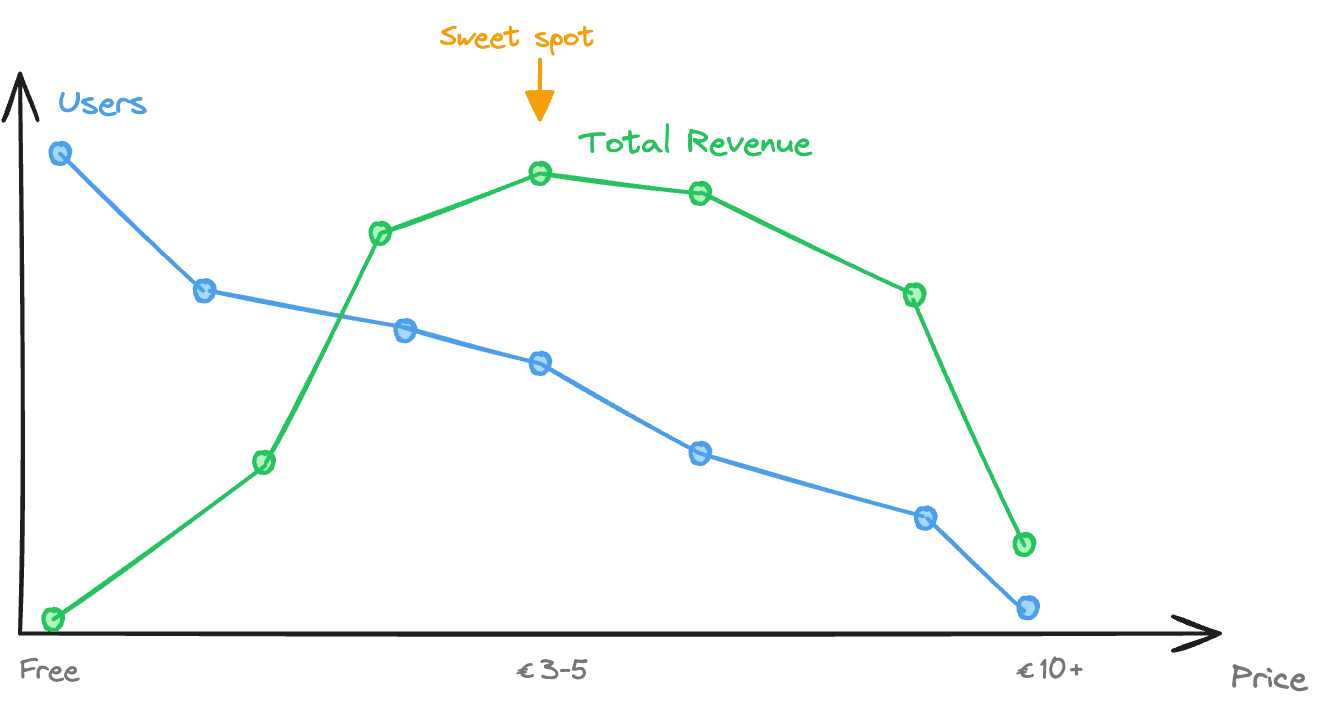
If you do charge, the price point isn't obvious. Too high and you lose users. Too low and you leave revenue on the table. Somewhere in between is a number that maximizes total revenue: users times price per user.
This is a curve, not a line. Dropping your price from six euros to four might increase users by 60% while reducing revenue per user by 33%. Net gain. Dropping from four to two might double users but halve revenue per user. Net zero. Dropping to free maximizes users but eliminates direct revenue entirely.
The only way to find your optimum is to test. Musa lets museums change pricing at any time and run A/B tests, showing different prices to different visitor cohorts and measuring the results. Some institutions have found that three euros produces more total revenue than five, because the additional users more than compensate for the lower price. Others found the opposite. The answer is specific to your institution, your audience, and the perceived value of your guide.
One thing we've learned: the first price point you pick is almost never the right one. Treat it as a starting hypothesis and plan to iterate.
The hybrid approach
Pricing doesn't have to be all-or-nothing. Some museums run hybrid models that capture the benefits of both free and paid.
Free base, paid premium. The standard tour is free. A deeper experience (extended content, specialist narration, behind-the-scenes material) costs a few euros. This gets maximum adoption on the base tier while creating a revenue path from visitors who want more. It works especially well for museums with rich collections that can support multiple tiers of interpretation.
Free for members, paid for general visitors. This turns the audio guide into a membership perk, which can drive membership sign-ups. A family considering a 40-euro annual membership gets more value if it includes free guide access on every visit.
Included with ticket. Some museums fold the guide cost into the admission price. Every visitor "gets" the guide, and the ticket price is set slightly higher to cover it. This works because visitors don't experience a separate purchase decision — the guide is just part of the visit. Adoption rates under this model are typically the highest of any paid approach.
Credit-based pricing supports all of these configurations because the museum controls whether and how to charge visitors separately from how they pay the provider.
What the numbers actually show
Raw adoption rate is a misleading metric on its own. Here's why.
A free guide might get 20% adoption. A paid guide at four euros might get 8%. On the surface, free wins by a wide margin. But dig into the engagement data and the picture shifts.
Those 20% free users include a large number who opened the guide, listened to one stop, and wandered off. The 8% who paid are disproportionately the visitors who use the guide seriously: multiple stops, deeper engagement, questions asked, full tour completion. The revenue from paid users is real. The "engagement" from casual free users is partly phantom.
This doesn't mean free is wrong. It means you need to decide what you're optimizing for. If you want the widest possible reach (more visitors encountering your curatorial interpretation, more languages served, more accessibility), free is the answer. If you want the deepest engagement per user and direct revenue, paid is the answer.
Most museums want some mix of both, which is why testing matters. You won't know your specific tradeoff curve until you measure it.
Size and reputation matter
The guidance we give most often comes down to institutional profile.
Major museums and famous sites. You can charge. Your visitors expect it, and your brand carries the perceived value. Experiment with price points to find the sweet spot, but don't feel pressure to go free. A well-priced paid guide at a well-known institution generates meaningful revenue without killing adoption.
Mid-sized museums with steady traffic. This is the trickiest segment. You could go either way. Start free to build adoption and gather data on how visitors use the guide. Once you understand usage patterns, consider introducing a price and watching what happens to the numbers. If adoption craters, go back to free. If it holds, you've found revenue.
Small museums and emerging sites. Go free. Your goal is getting visitors to experience the guide at all. Charging at this stage creates friction that small museums can't afford. A visitor who skips your three-euro guide and walks through in silence is a missed opportunity to deliver the experience that makes them recommend the museum to others. Build the audience first.
Heritage sites and outdoor attractions. Often the guide is the experience, with no other interpretation available. Charging is easier to justify here because the guide isn't a supplement; it's the product. Visitors understand this intuitively.
Why flexibility matters more than the initial choice
The most important thing about your pricing decision is that it shouldn't be permanent.
Traditional audio guide pricing was locked in at deployment. Hardware rental fees were set. Contracts were signed. Changing the price meant renegotiating vendor agreements and updating physical signage. So museums agonized over the initial decision, often landed somewhere safe, and never revisited it.
With a software-based guide, pricing is a setting you can change on a Tuesday. Musa lets museums adjust their visitor pricing, test different amounts, switch between free and paid, and roll back if something doesn't work. No technical intervention needed. This turns pricing from a strategic gamble into an ongoing experiment.
That changes the decision calculus entirely. You're not choosing a pricing model for the next five years. You're choosing a starting point for next month. If it works, keep it. If it doesn't, adjust.
Making the decision
Start with two questions.
What are you solving for? If the answer is "get more visitors using our interpretation," start free and measure adoption. If the answer is "generate revenue from the guide," start with a modest price and test upward. If the answer is both, start free, build the audience, then introduce pricing once you understand your visitors' engagement patterns.
What does your visitor expect? A tourist at a world-famous museum expects to pay for interpretation. A local visitor at a community museum does not. Match the expectation. Fighting it is possible but expensive: you'll spend effort on marketing and justification that could go toward improving the guide itself.
Then test. Set a price (or set it to free), measure for a month, and look at the data. Not just adoption rate, but completion rates, engagement depth, revenue per visitor, and the feedback visitors leave. The right price for your museum is the one that produces the best version of whatever outcome you're optimizing for.
If you're weighing these tradeoffs for your institution, we can walk through the specifics with you. Every museum's situation is different, and the right model depends on factors that a general article can't cover.