 i
iPantheon
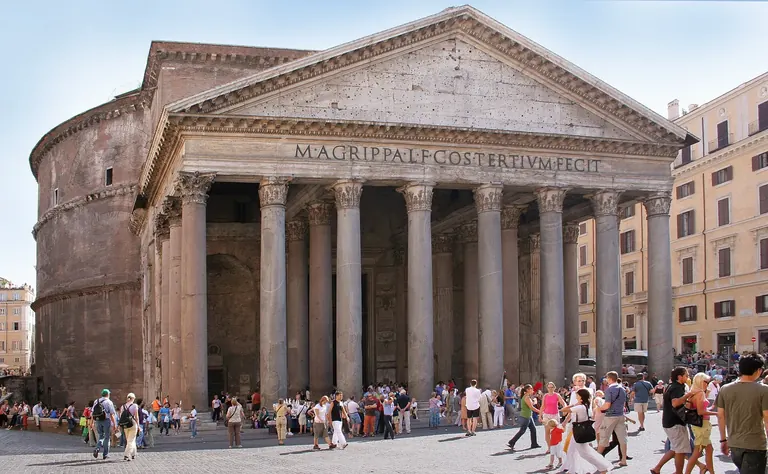
The Pantheon is one of those buildings that genuinely stops you in your tracks. Nearly two thousand years old and still standing with its original dome intact, it is the best-preserved building from ancient Rome and arguably the most influential piece of architecture in Western history. The unreinforced concrete dome remains the largest of its kind ever built, and the oculus at its centre — a nine-metre open hole to the sky — floods the interior with a column of light that slowly rotates through the day. When it rains, the water falls straight through onto the slightly convex marble floor and drains away through almost-invisible holes. Originally completed around 125 AD under Emperor Hadrian, the temple was converted into a Christian church in 609 AD, which is the main reason it survived while the rest of ancient Rome was quarried for building material. It now serves as the Basilica di Santa Maria ad Martyres. Raphael is buried here, along with two Italian kings. The building sits on Piazza della Rotonda, one of the liveliest squares in Rome, and you can walk in off the street — though since 2023 there is a modest entrance fee for tourists. What makes it special is the engineering. Hadrian's architects used progressively lighter concrete as the dome rises, embedding pumice stone near the top, and the coffered ceiling reduces weight while creating a geometric pattern that draws your eye upward to that perfect circle of sky. It is a space that makes every other domed building feel like a response to it — because they are.
More in Rome
Plan Your Visit
Getting there
Hours
| Mon | 09:00–19:00 |
| Tue | 09:00–19:00 |
| Wed | 09:00–19:00 |
| Thu | 09:00–19:00 |
| Fri | 09:00–19:00 |
| SatToday | 09:00–19:00 |
| Sun | 09:00–19:00 |
Admission
From €7
Reduced €2 (EU 18-25). Free under-18s and Rome residents. Free first Sunday of each month. Price increased from €5 to €7 effective July 1, 2026 (per Ministry/Diocese agreement).
Last verified
Nearby
Visitor Information
- How much does Pantheon cost?
- Standard adult admission to Pantheon is €7. Reduced €2 (EU 18-25). Free under-18s and Rome residents. Free first Sunday of each month. Price increased from €5 to €7 effective July 1, 2026 (per Ministry/Diocese agreement).. Prices for special exhibitions and timed-entry slots may differ.
- What are the opening hours of Pantheon?
- Pantheon is open Daily 09:00-19:00. Ticket office until 18:00; last entry 18:30 (groups and schools 18:00). Closed Dec 25 and Jan 1. Hours may change for religious celebrations; ticket sales stop one hour before liturgical services, and entry during Mass (Sat 17:00, Sun 10:30) is for worshippers only. Free first Sunday of each month (no online booking; queue on site).. Holiday hours can vary, so check the museum's website before you go.
- Where is Pantheon?
- Pantheon is located at Piazza della Rotonda, 00186 Roma RM, Italy, in the Pigna / Centro Storico area of Rome. The nearest station is Barberini (Line A).
- What can I see at Pantheon?
- The best-preserved ancient Roman building, with the world's largest unreinforced concrete dome and its iconic open oculus.
- Do I need to book Pantheon in advance?
- Booking ahead is recommended, especially for weekends, school holidays, and special exhibitions. Tickets are normally on the museum's website, and a pre-booked timed slot helps you avoid queues at the entrance.
- When is the best time to visit Pantheon?
- Weekday mornings shortly after opening are typically the quietest, especially mid-week. Late afternoons can also be calmer. Weekends, school holidays, and the lunch rush are the busiest periods.
Image credits
4
- PantheonRoberta Dragan, CC BY-SA 2.5
- Museo di Roma (Palazzo Braschi)Kaga tau / Wikimedia Commons, CC BY-SA 4.0
- Galleria Doria PamphiljKrzysztof Golik, Wikimedia Commons, CC BY-SA 4.0
- Chiostro del BramanteSailko, via Wikimedia Commons, CC BY-SA 3.0