When people hear "AI audio guide," they often imagine a chatbot. Walk up to a painting, ask it questions.
Imagine you're standing in front of a Vermeer. With a pure chatbot, you'd need to:
This gets exhausting fast. After three paintings, most visitors give up or default to "tell me about this." At that point, you've got a voice-activated label reader.
Traditional audio guides already solve the "tell me about this" problem. Dial a number, hear the story. The chatbot added complexity without adding value.
Traditional audio guides got something right: narrative flow.
When you press "next" on a well-designed tour, you're following a story. The guide connects Painting A to Sculpture B because they share a theme, or contrasts Artist X with Artist Y to highlight a movement. Context builds across stops.
Traditional guides have limits though. You can't ask questions. You can't dive deeper when something grabs you. Everyone hears the same script.
Chatbots demand effort—you have to prompt, formulate questions, drive the experience. Traditional guides require nothing but give everyone the same thing. Both fall short.
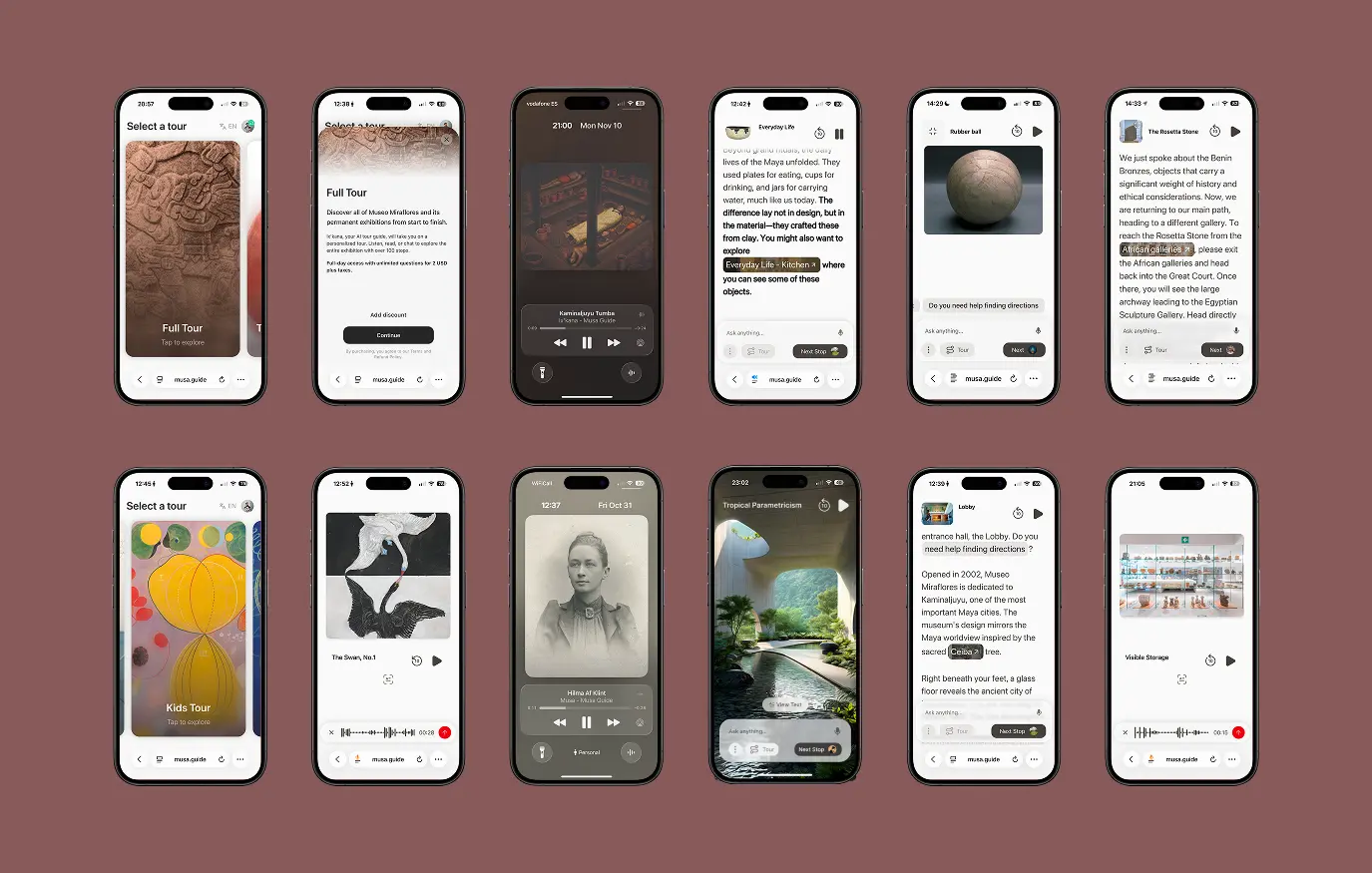
Musa captures the best of both: structure when you want it, depth when you need it. Three levels of engagement, pick whichever suits you:
Zero effort: Press next, get a curated experience tailored to your language, pace, and context. Follow the curator's path. Hear the story as designed.
Low effort: Musa surfaces related content as you explore. "You seemed interested in the symbolism—want to see another work that uses similar imagery?" Tap a suggestion, branch off, come back when ready.
High effort: Ask anything. "Why did the artist use that color?" "Is this related to the piece we saw earlier?" Dive as deep as you want.
The experience adapts to how much you want to engage. And because conversation stays continuous across your entire visit, Musa learns your level as you go. Start passive, end up deep in art history. Or press next the whole way. Both work.
Every visitor creates a unique tour.
Two people start at the same painting. One presses next, next, next—following the curator's path. The other asks about the brush technique, follows a suggestion to a related work in another room, then rejoins the main tour. Both journeys make sense.
This isn't possible with:
A static tour serves one of them. A guided tour with branching serves all. Structure means no one gets lost. Flexibility means no one gets bored.
Our demo lets you walk through a guided tour with live conversation.
Press next a few times. Ask a question. Reference something from earlier.
Want to learn how museums deploy Musa? Read our AI audio guide overview or see the Museo Miraflores case study.